


 91 / 156

Preparedness
Shelters
– The colossal loss of human lives and livestock, which
affected a large part of the rural economy, was caused mainly
due to a lack of strong houses. The brick wall and RCC roof
houses, however imperfectly engineered, were found to have
withstood the forces of cyclonic wind and swirling waters. With
a view to providing safe shelters to vulnerable people, it was
decided to construct multipurpose cyclone shelters (MCS) in
the 10 km belt from the coastline, where the maximum impact
of a cyclone is generally felt. Ninety-five such MCS have been
constructed along the coast with the dual purpose of providing
shelter to the vulnerable populace during disasters and using
the buildings for other community related purposes during
normal times.
The stilted structures provide accommodation facilities on the
first floor, while the ground floor allows storm surge to flow
through. In the absence of such surges, the ground floor can also
provide shelter to domestic animals. These shelters have been
constructed with both technology and usability in mind; there
are separate halls for men and women with the provision of facil-
ities like toilets, water supply, electricity, and ramps for the old
and the disabled.
To create a sense of ownership among the members of the
community, Cyclone Shelter Management and Maintenance
Committees comprising local government officials, public repre-
sentatives and village people have been formed to manage and
maintain the shelters. Besides the 95 buildings constructed by
OSDMA, the Red Cross and several non-governmental organi-
zations (NGOs) have constructed 29 shelters and are presently
constructing a further 30 or so. About 8,000 school buildings
have been constructed, which can also serve as shelters in the
event of a disaster
Communication
– One bitter experience of the super cyclone
was the disruption of all traditional communication links such
as telephone, telegraph, fax and e-mail. Precious response time
was lost due to the collapse of communication networks. To over-
come the problem, a fully dedicated civil VHF wireless network
was established, with 402 base stations covering all district and
block headquarters as well as some key and vulnerable locations.
This provides an alternative communication medium that the
district administration can use in the event of a disaster. In addi-
tion, the telecommunication network has been upgraded and
satellite phones have been provided to district collectors and
other key disaster managers, to enable them to establish contact
in the event of failure of all other means of communication.
Efforts are also underway to promote ham radio among youth
clubs in vulnerable areas.
Search and rescue
– The search and rescue equipment available
in the state and the level of training given to people to handle
emergencies were found to be grossly inadequate to cope with
the situation in the post-super cyclone period. Relief material
could not be transported to the affected areas because the roads
were damaged, blocked and washed away. Help was sought from
the neighboring states at great loss of vital response time. Against
this background, Orissa Disaster Rapid Action Force (ODRAF)
units were created to provide search and rescue assistance to the
administration in the aftermath of a disaster. The units are
manned by Orissa State Armed Police personnel. Modern search
and rescue equipment and high-level skills training have been
provided to these units. Five such units are located at strategic
locations in the state. Besides the ODRAF units, the fire service
wing of the state is being built up as a second line of response
to meet any possible eventuality.
Capacity building
The Disaster Risk Management (DRM) programme is a large-
scale national initiative covering 17 states. Its aim is to create
awareness on disaster preparedness at different levels, beginning
with the community and up to the state level. It is being imple-
mented in 23,263 villages and 3,210 gram panchayats (village
governments) of 155 disaster-prone blocks spread over the 16
districts of Orissa. Under the programme, disaster management
plans are prepared at village, gram panchayat, district and state
level. Disaster management committees and task forces are estab-
lished and trained to discharge different duties in the event of a
disaster.
Urban Earthquake Vulnerability Reduction is a programme
being implemented in three cities of Orissa that come under the
Moderate Damage Risk Zone. City-level and ward-level disaster
management plans are being prepared under the programme.
Awareness generation activities involving community members,
public representatives, engineers, community leaders and
masons are also being devised and implemented.
Two programmes, the National Programme for Capacity
Building of Engineers in Earthquake Risk Management and
National Programme for Capacity Building of Architects in
Earthquake Risk Management, are being implemented to train
engineers and architects in the design and construction of
earthquake-resistant buildings.
As a part of the national initiative, the state is in the process
of formulating a techno-legal regime for the construction of
disaster-resilient buildings. A high-level committee is examining
the recommendations of the National Expert Committee (set up
by the Government of India) on town and country planning regu-
lations, land-use zoning regulations, development control
regulations and building standards regulations for incorporation
in the state.
Capacity building measures were taken up for training of
government officials, people’s representatives, NGO func-
tionaries, professionals like engineers and architects, and
community members. In addition, public awareness campaigns
through electronic and print media, publications, films and
[
] 91
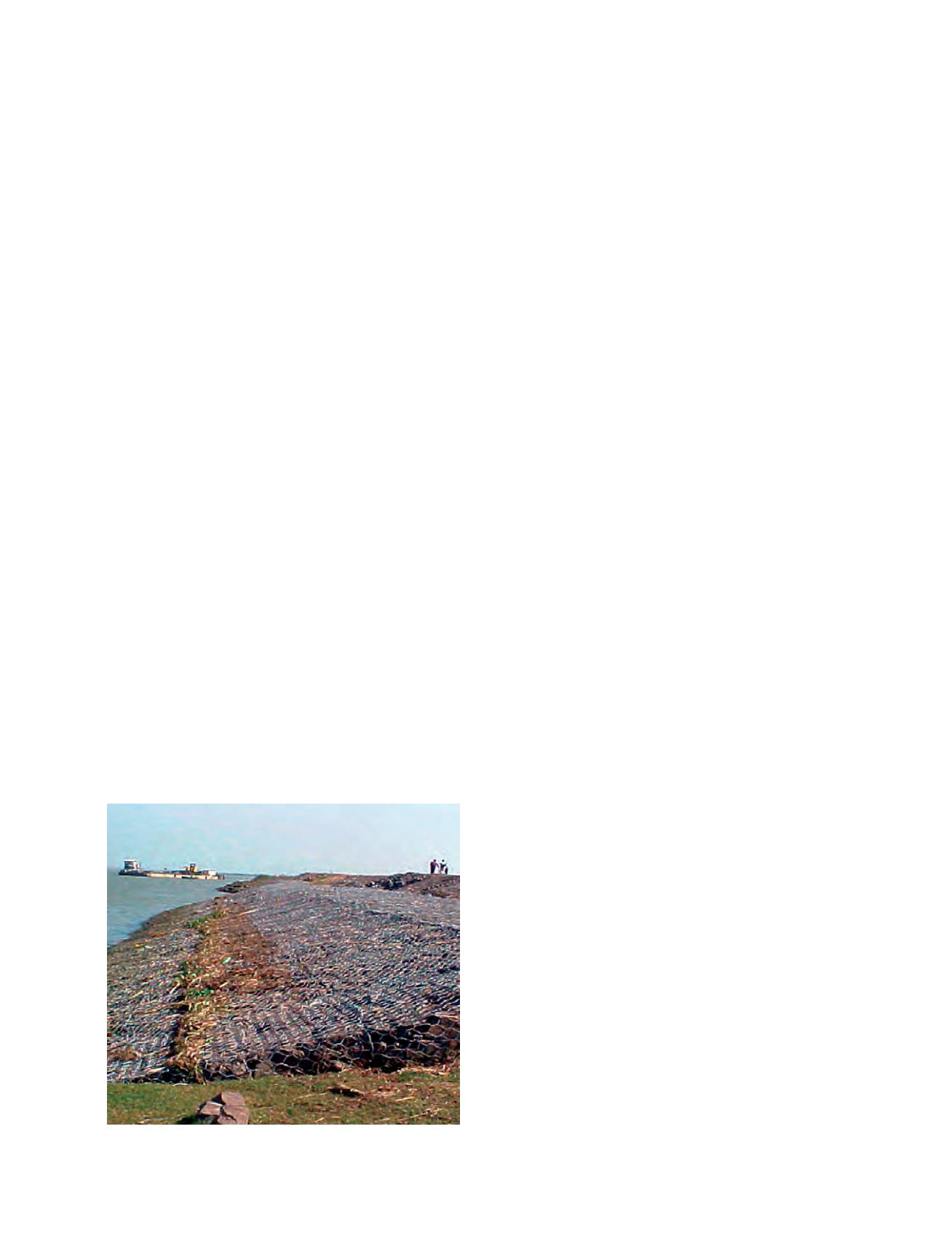
Boulder-crate technology reinforces an embankment
Photo: OSDMA