


 87 / 156

[
] 87
C
ONCERN IS AN
international humanitarian organization
dedicated to the reduction of suffering and working
towards the ultimate elimination of extreme poverty in
the world’s poorest countries. Concern implements both emer-
gency and long-term development interventions with poor
communities in 30 of the world’s least developed countries.
Regular and cyclical natural disasters, coupled with poor gover-
nance, inappropriate policy environment and conflict are
common characteristics of these countries, and frequently inter-
act to create disasters with multiple causes and effects.
Concern sees disaster risk reduction (DRR) measures as a key
requirement to protect the lives and assets of the communities
with whom it works and to underpin the sustainability of its long-
term development programmes. The organizational
Strategic Plan
for 2006-2011
has highlighted the centrality of DRR to Concern’s
mission to contribute to the eradication of poverty. In its country
programmes, Concern has begun to mainstream DRR within
contextual analysis and programming. By June 2006, as part of
an ongoing mainstreaming process, the Concern Emergency Unit
had delivered DRR awareness and planning workshops in 14
country programmes, targeting the staff of both Concern and its
partner organizations.
In 2005, Concern’s Emergency Unit prepared its
Approaches
to DRR
paper where, reflecting the reality of the countries in which
the organization works, a broad view of hazards was taken. The
study explicitly recognizes conflict, poor policies, poor gover-
nance and the impacts of climate change as threats to the
communities with whom Concern works, and therefore as poten-
tial areas of focus for its DRR interventions. Concern’s approach
towards DRR is conceptually grounded in its analysis of liveli-
hoods, and provides a link between its humanitarian and
long-term development work.
The experiences of Concern, its partners and vulnerable
communities in the haor region of Bangladesh have seen the
development of a DRR strategy, built on the lessons learnt from
previous responses to disasters in this area.
The haor area
Concern’s programmes in Bangladesh focus on areas where a
substantial percentage of the population lives in absolute poverty.
One such area is the haor, a low-lying area in the north-east of
the country that floods annually during the monsoon season,
when rainwater originating in the hills of India pours into
Bangladesh, forming huge water bodies. Water depths averaging
over two metres inundate agricultural lands for up to seven
months between April and October. In order to avoid flooding,
villages are located on higher land within the flood plain. Such
land, however, is scarce – villages tend to be densely populated
and widely scattered. The limited road system has high mainte-
nance costs associated with the flooding, and other means of
communication are equally weak. Commonly, the only means of
transport is by boat or, in the dry season, by foot.
During the past few decades, the lives and livelihoods of haor
people have been regularly threatened by rising levels of seasonal
floodwaters and storm-generated waves. This combination of
annual floods and waves is eroding village and homestead lands,
and has occasionally destroyed entire villages.
At the onset of the monsoon season, rural households try to
protect their homestead lands by erecting reed matting (
motha
)
walls tied with bamboo and fortified with
challa
grass
(Hematheria protensa)
. The annual cost of making these defences
is between EUR25 and EUR60, and 16-20 days of labour for
each household.
Concern’s approach to disaster
risk reduction in the haor communities
of north-east Bangladesh
Peter Crichton, Emergency Preparedness Co-ordinator, Concern Worldwide, Dublin
and Pankaj Kumar, Technical Advisor, Concern Worldwide, Bangladesh
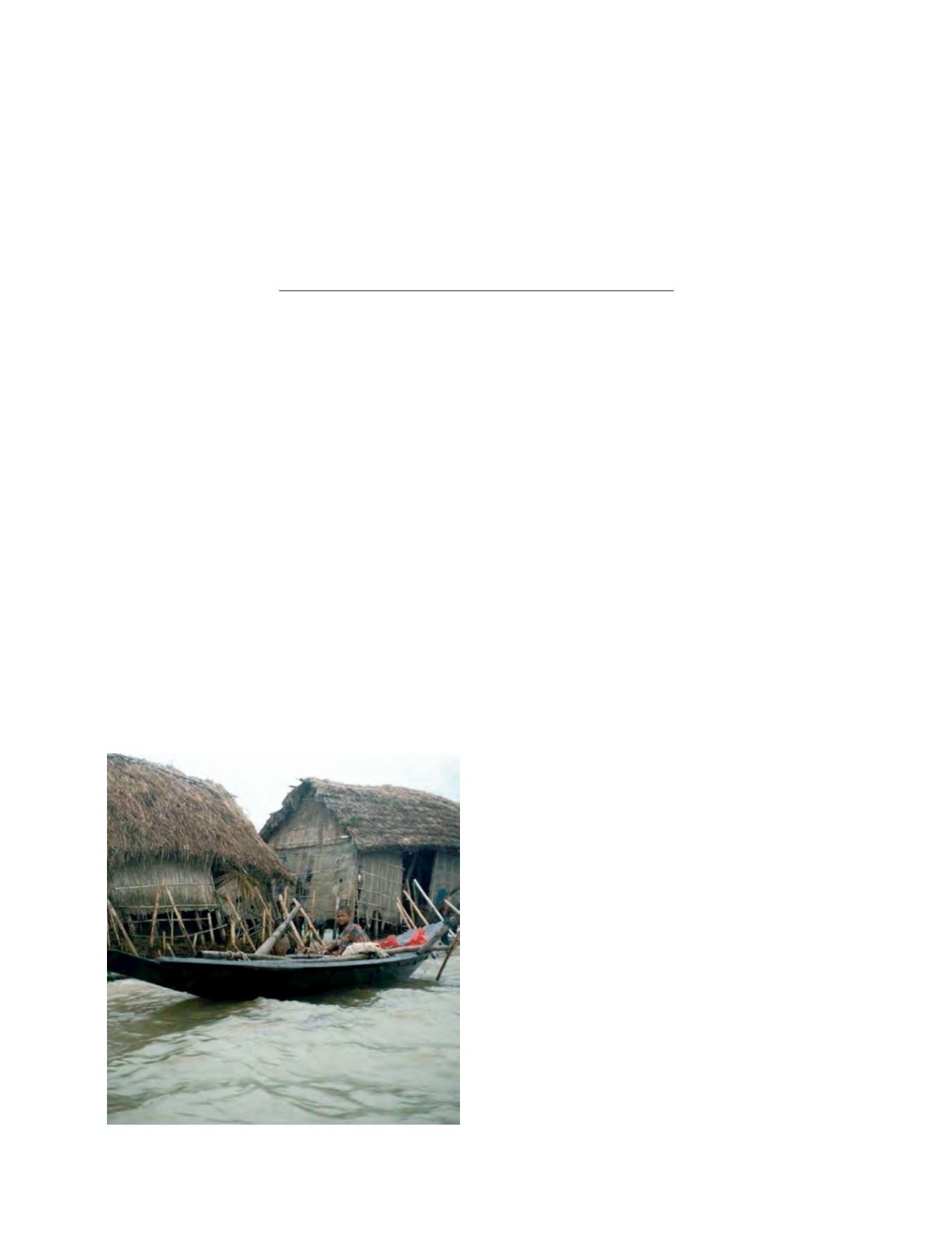
Floods in haor areas regularly impact lives, livelihoods and assets
Photo: Pankaj Kumar