


 83 / 156

Clearly, a disaster is not a single event to be reported on, but
rather an ongoing process that needs to be accompanied by media
coverage well before, during and after the event.
Reporting before, during and after a disaster
Before a disaster happens the role of the media in DRM is mostly
educational. Which prevention measures exist? How can commu-
nities prepare themselves? How does the national early warning
system work? How can official announcements be correctly inter-
preted? These are some of the issues requiring media attention,
the aim always being a high public awareness of possible risks
and mitigation measures.
An ongoing disaster with its human tragedy, grief, despair,
destruction and dramatic rescue operations always makes for a
gripping story. However, journalists should avoid the temptation
to sensationalize their observations. Disaster reporting should
adhere strictly to the facts. Lack of credible information and
rumours can seriously increase people’s insecurity, exacerbate
fear and frustration, and even trigger social, religious and politi-
cal conflict. Access to the field and to officials from relevant
government institutions and relief organizations is therefore of
great importance for journalists. Media workers should plan their
logistics well ahead.
In the aftermath of a disaster, the media can play an impor-
tant role in reuniting families and helping to rebuild
self-confidence among the population. Relevant information and
even entertaining radio programmes can support communities
in their efforts to return to normal life. With hindsight, there
will always be positive and negative lessons to learn from a disas-
ter situation. Both should be thoroughly reported in order to be
better prepared for the next one.
Before, during and after a disaster, mass media also has an
important watchdog role to fulfil. Does the legal and adminis-
trative framework meet the specific needs of DRM? Are
communities well prepared by government? Have lessons from
previous disasters been taken seriously? Is there any evidence of
mismanagement or corruption? Are there examples of ‘good
governance’? All these are typical journalistic questions, and they
also apply when reporting on DRM.
The ‘big’ national media and small regional and local papers
and radio stations are of similar relevance. “They play an impor-
tant role in increasing knowledge and awareness among the
threatened population,” says Torsten Wegner, project coordinator
for InWEnt in Mozambique. “We should therefore strongly
involve local media.”
Since many disasters are spread across national borders, inter-
national media cooperation can also be very helpful. A Journalists
in Africa for Disaster Risk Reduction network was formed by
participants of the Nairobi conference, and is open to all inter-
ested media practitioners from the region. Media from different
countries can exchange reports on best practice examples of DRM
and cooperate in early warning and mobilizing international help.
Media institutions could even become directly involved as project
partners in human resources development.
InWEnt’s efforts to reach out to Mozambiquan journalists and
media have led to a total of five media-related workshops involv-
ing 228 participants. As a result, newspaper coverage of disaster
related issues increased sharply from 20 to 61 articles per year
[
] 83
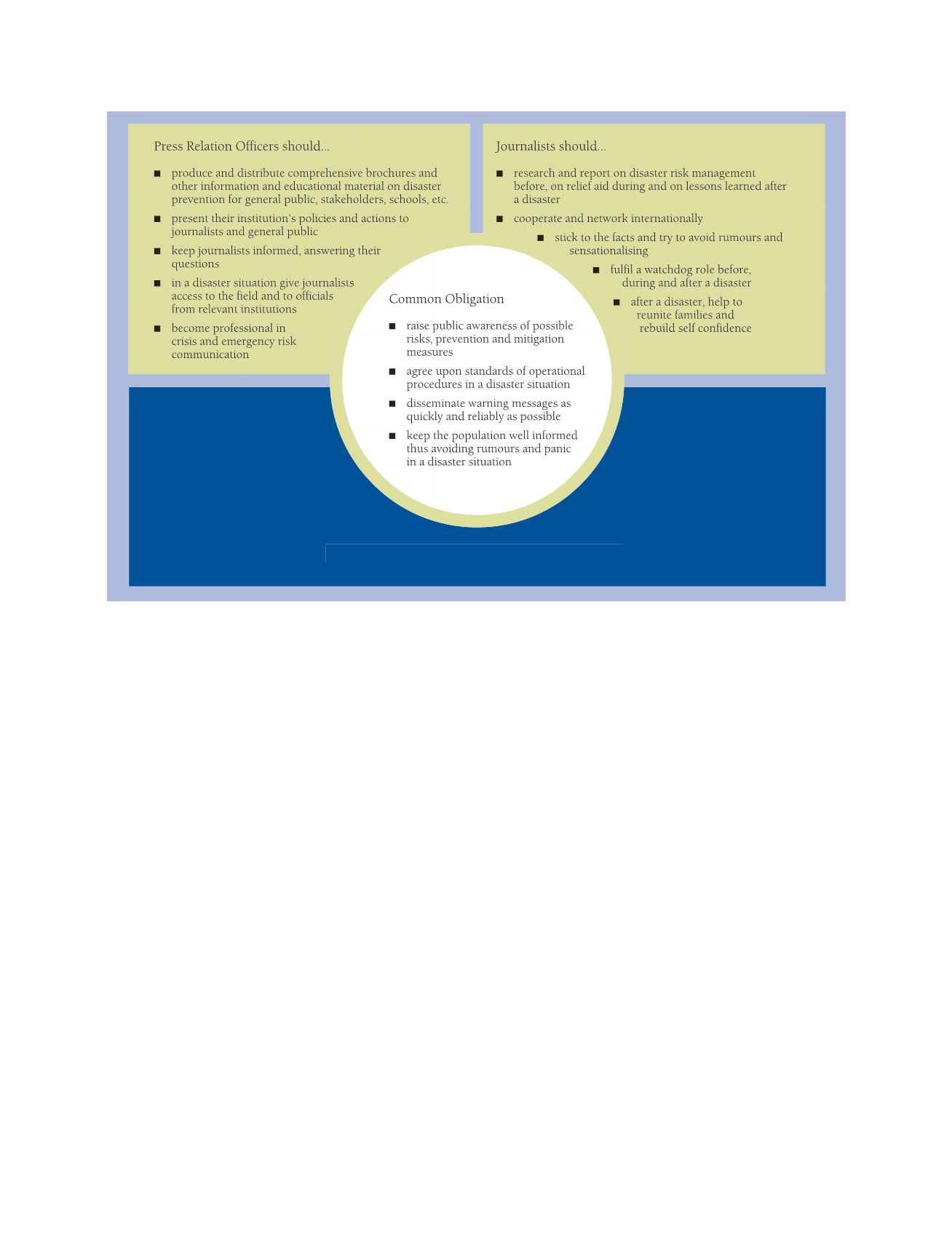
Journalists and press relations officers are important target groups for
InWEnt’s DRM human resources development programmes
Disaster risk management and the media
Source: InWEnt – Capacity Building International, 2006
Disaster risk management and the media