


 82 / 156

[
] 82
T
HERE IS A
65 per cent chance that rainfall will be at lower
levels and later than normal during the next planting
season. For small-scale farmers in the heart of
Mozambique, such information is of high importance. If they
knew what to expect from the weather, they could choose seeds
and fields accordingly. Otherwise, famine is looming – one of
the most common hazards in this disaster-prone Southern
African country.
“Our seasonal weather forecasts have become quite reliable,”
says Moisés Nenessene from the government meteorological
service in Beira, Mozambique’s second largest city. “But most
people misunderstand their meaning because they don’t know
how to correctly interpret a probability.” When they hear a low
rainfall forecast, some farmers take it for granted that the next
rainy season will be short and dry. But, says Moisés Nenessene,
this is not what the weather service wants to say: “A chance of 65
per cent means that a farmer should only plant 65 per cent of
his crops in expectation of a dry season. The remaining 35 per
cent should be chosen for either normal or wet weather.”
With the legacy of a 20-year-long civil war, most Mozambiquan
farmers have little or no school education. In rural areas there are
no newspapers, and very few people have access to TV. The only
way they could be informed about the concept and meaning of
a probability is via the radio. “However,” adds Moisés Nenessene,
“most journalists don’t understand the concept either.”
Mass media has a very important role to play in disaster risk
management (DRM). But in many cases – and not only in
Mozambique – newspapers, TV and radio stations don’t live up
to the challenge. This is why InWEnt – Capacity Building
International
1
has included journalists and press relations offi-
cers as important target groups in its human resources
development programmes for DRM in Southern Africa,
Afghanistan and Indonesia.
Sensitization and networking of journalists in
Southern Africa
At the end of a workshop in Nairobi, initiated by UN/ISDR
together with InWEnt, 18 journalists from eight African coun-
tries unanimously adopted the following statement: “We
recognize the ongoing global efforts made towards disaster risk
reduction. We believe the initiative is crucial for sustainable devel-
opment. We promise to work hand in glove with the UN/ISDR
secretariat and African governments to achieve the ultimate goals.
We call upon all journalists worldwide to join this effort.” The
journalists had spent the past four days exchanging their experi-
ences, identifying knowledge gaps and receiving information from
experts on DRM.
“Disasters are not only events striking at a particular time, but
the result of various processes involving hazards, vulnerability,
governance, etc.,” says international journalist Alain Valency, who
edits the UN/ISDR newsletter,
Disaster reduction in Africa
. During
the workshop, he observed: “Journalists should therefore shift
from an ‘event’ to a ‘process’ approach, from ‘sensationalism’ to
a more responsible ‘contextual’ journalism that allows the ques-
tion of why disasters occur and how their impacts could be
reduced.”
Disaster risk management needs media
support: InWEnt’s commitment to human
resources development for journalists
and press relations officers
Dr Christina Kamlage and Johanna Eisele, Division for the Environment,
Energy and Water, InWEnt – Capacity Building International
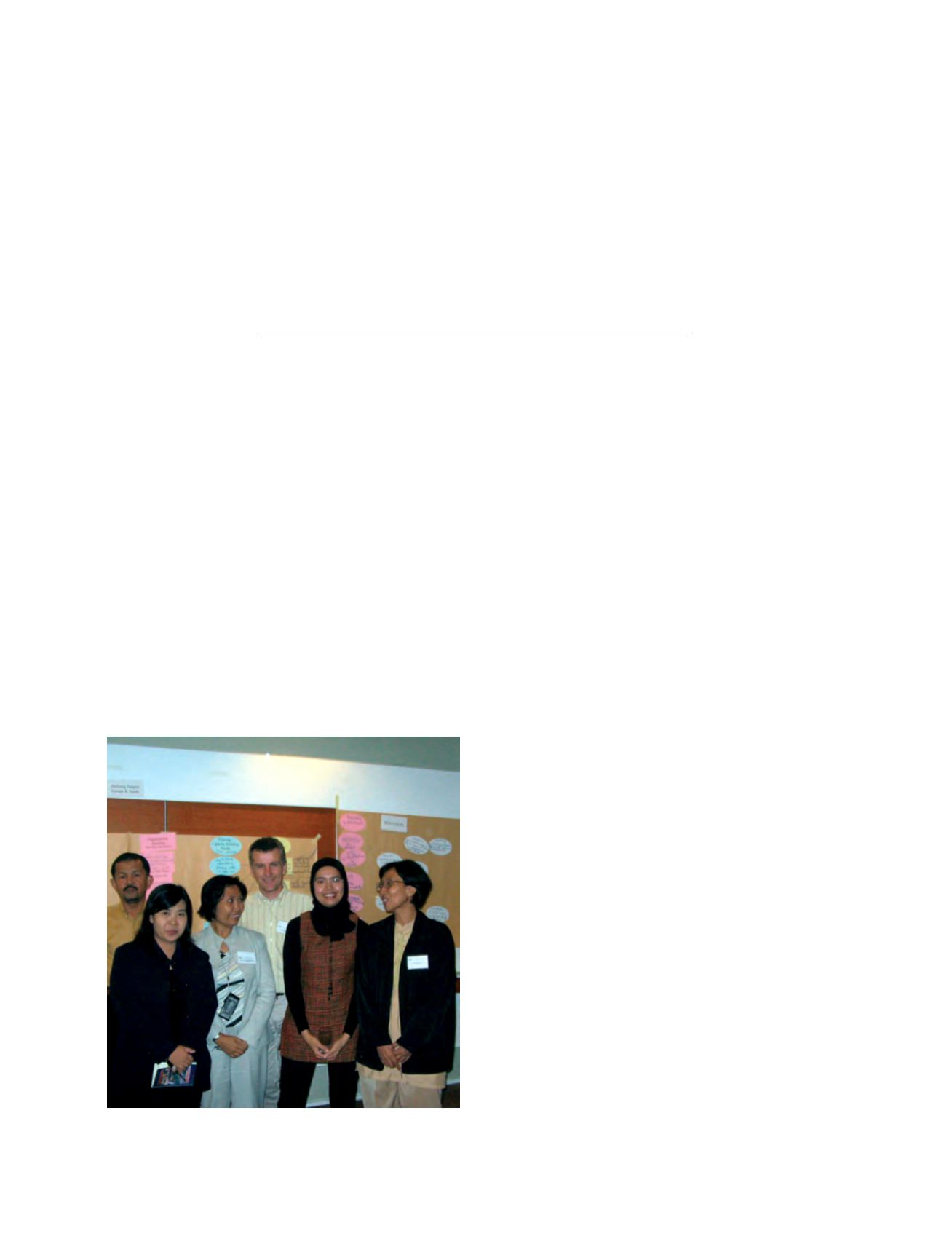
Journalists and press relations officers are important target groups for
InWEnt’s DRM human resources development programmes
Photo: InWEnt - Capacity Building International