


 79 / 156

[
] 79
the UN Disaster Management Training Programme (UNDP),
developed by the UN Disaster Relief Organization (UNDRO),
was introduced to South Africa, leading in 1996 to a partnership
with Technikon SA to offer Certificate Courses in Disaster
Management based on the UNDP modules. The courses were
jointly accredited and certified by Cranfield University in the
UK; the University of Wisconsin in the USA; and the then Civil
Protection Association.
The introduction of additional membership categories linked
to qualifications and experience heralded the start of another
transformation process for DMISA, which is currently gaining
momentum with efforts toward achieving professional status for
the function.
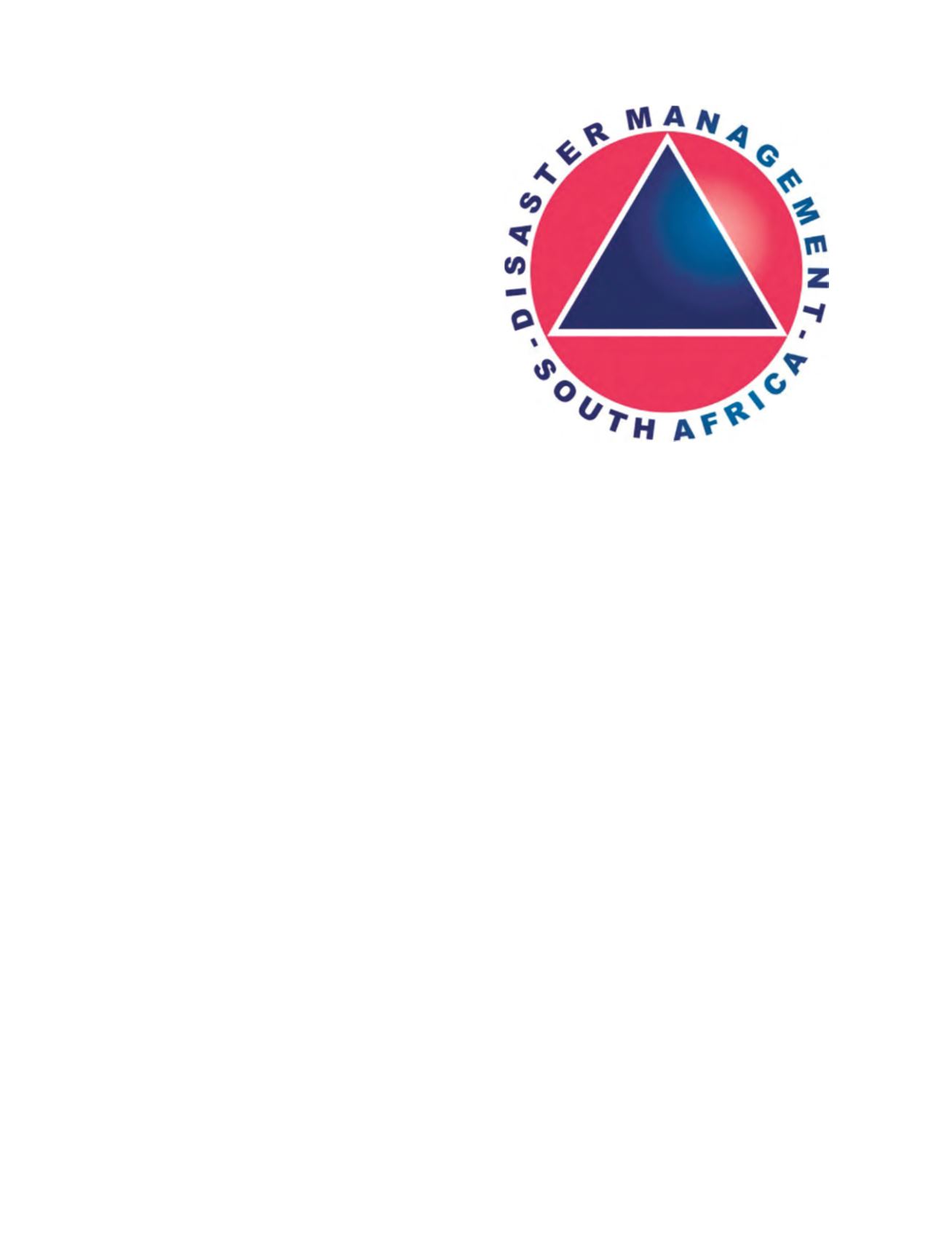
A disaster management emblem for South Africa
An emblem plays an important role in expressing any philoso-
phy, promoting awareness and engendering a sense of belonging
and identification. For this reason, DMISA viewed the need to
develop a disaster management emblem that could be adopted
nationally to replace the defunct civil protection triangle as a
matter of urgency. A democratic process was followed whereby
stakeholders expressed their opinions and voted on a number
of design options. The initiative was embarked on with the
support of the NDMC, and the new emblem was officially
gazetted by the National Department of Heraldry in October
2004. It was officially handed over by the President of DMISA
to the Deputy Minister of Provincial and Local Government at
the DMISA Conference on 20 October 2005.
Although DMISA consulted on an international level, it did
not blindly transplant a symbol from abroad. The emblem’s
colours and shapes follow ancient examples from across Africa,
as well as elsewhere in the world. The emblem is currently in
use in many countries, from the Far East to South America,
including the industrialized north and many developing south-
ern nations. This means that international visitors to South Africa
will recognize the emblem in an emergency situation. Consistent
use of the emblem will ensure the visibility and recognition of
disaster management among South African citizens.
Perhaps the most beneficial effect of the new emblem is the
way in which disaster management officials from the three differ-
ent spheres of government will work under one emblem and one
corporate identity. This will cement relations between spheres of
government, reducing the perceived distance between spheres
and going some distance towards providing a seamless service to
the public.
The deputy minister accepted the logo on behalf of the
Government of South Africa, with a commitment to ensure that
its use is legislated in regulations and encouraged within all
spheres of government. Other countries within the Southern
African Development Community and the African Union were
invited to use it to show where people and governments are
working towards reducing disaster risk.
Innovations in response
The number of natural disasters has increased over recent years,
and with it, losses have increased too, on account of urbaniza-
tion and population growth. As a result, the impact of natural
disasters is now felt to a larger extent. Between 1999 and 2003,
the financial impact of natural disasters was more than ZAR8.7
billion, a dramatic increase due to drought in the country.
Runaway fires destroying hundreds of informal dwellings during
hot, dry and windy summer periods remain a serious concern for
Cape Town Fire and Rescue Services and Disaster Risk
Management. With the successful use of helicopters and fixed-
wing crop sprayers to combat mountain fires during the summer,
there has been a temptation to try and use the aircraft to stop
shack fires as well. While many technical and safety aspects
remained unresolved, it was decided to perform a trial run of
aerial fire fighting for urban informal areas. Possible complica-
tions included injuries to residents due to the weight of 3,500
litres of water coming down on a flimsy wood and corrugated
iron structure, flying hazards in urban areas, response times and
visibility. The test did not raise additional concerns, and indi-
cated negligible risk of injury to residents. During the trial period,
in which the airborne response was complemented by smoke-
detecting cameras installed at strategic high points, helicopters
successfully arrested fire spread and assisted ground crews in
bringing fires under control.
The trial was jointly conducted by the NDMC, the DWAF
Working on Fire project, the City of Cape Town, and the
Provincial Government of the Western Cape.
Rolling out and implementing the Disaster Management
Act and Framework
Two-day workshops were held in every province from 6 June to 8
July 2005 to discuss the National Disaster Management Framework
and implementation strategy. These proved very successful and
provided a great opportunity to clear up any remaining uncertain-
ties regarding respective roles in disaster management.
A national workshop was held on 19 and 20 July 2005, to
which all national government departments and relevant govern-
ment entities were invited. The purpose of this workshop was
once again to ensure that all stakeholders were aware of their
roles and functions in respect of disaster management as provided
for in the Disaster Management Act.
A national DRM system
The Eastern Cape pilot project being rolled out in the Amatole
District Municipality (including Buffalo City) is the result of a
South Africa’s disaster management emblem