


 75 / 156

[
] 75
I
N THE
K
UNDUCHI
area of Dar es Salaam, Tanzania, there are
21 companies undertaking quarrying activities – the crush-
ing machines used in the extraction of rocks produce dust
that spreads all over the area. Dust pollution is widely spread in
the settlement, especially during dry season. Dust comes from
many sources, including the crushing machines.
Dust is also produced by the area’s 1,500 small-scale miners,
who crush gravel and stones by hand. Two different types of small-
scale miners have been observed in the area. The first group
constitutes those who stay in the area and the second group is
those who stay outside the area and they only go in for quarrying
activities. Some of the miners who constitute the first group under-
take their mining activities right from their residential houses.
On average, 200 lorries go in and out of the settlement every
day to load stones, gravel and crush dust for building purposes.
These moving vehicles produce yet more dust, which again spread
all over the settlement.
Dust pollution immediately affects the people who stay in the
area. In a survey of 30 households, 90 per cent indicated that
they live and work within the area and small-scale mining activ-
ities were their main employment opportunity. This means that
this section of the population is affected by dust pollution day
and night, thus putting them at very high risk of acquiring
diseases associated with dust pollution, such as tuberculosis (TB).
Observation in the area has revealed accumulations of dust over
the walls, windows and doors of local houses.
Children are the section of the population that is most vulner-
able to the effects of dust pollution. In every household visited
during fieldwork, the majority of children met were coughing,
and their bodies were covered in dust. A discussion with the
physician who runs a private dispensary nearby revealed that
people who are exposed to dust pollution are likely to acquire
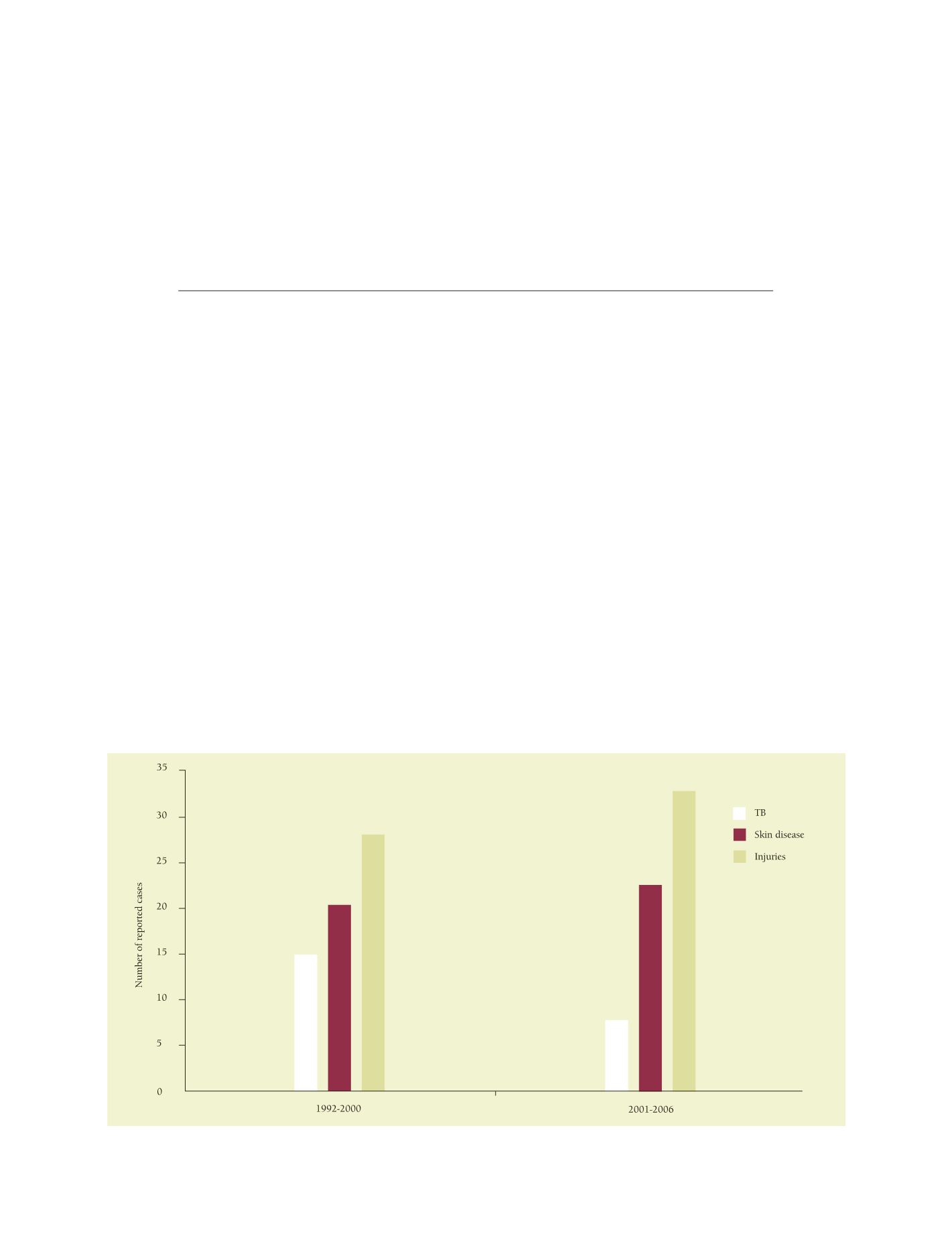
respiratory diseases. Records from a nearby Mecco dispensary
revealed the presence of respiratory diseases.
Disaster risks at the quarry site
and local coping initiatives: the case of
Kunduchi in Dar es Salaam, Tanzania
Benedict Malele, Senior Planning Officer,
University College of Lands and Architectural Studies, Tanzania
Source: Mecco Dispensary Records, Dar es Salaam, March 2006
Reported cases of injuries, respiratory and skin diseases