


 71 / 156

[
] 71
F
LOODING IS A
recurrent phenomenon in Nyando, one of
the 12 districts in Nyanza Province, Western Kenya. The
Sondu Miriu, Nyando, Awach and Ombei rivers drain
from the Nandi Hills where high rainfall is received to Lake
Victoria through the Kano Plains and are a major cause of persis-
tent flooding along their banks as they approach the lake with
devastating effects. As per the assessment made after recent
floods in the Kano plains, the average annual damage is about
USD850,000 with annual relief and rehabilitation measures
costing USD600,000.
1
The area supports a large rural popula-
tion (75 per cent) and the stage of economic growth is
undermined by high absolute poverty levels (69 per cent), dete-
riorating infrastructure and an HIV pandemic (19-29 per cent)
over the past decade.
2
While most studies in the area have concentrated on the physi-
cal aspects of the flood disasters, this study shifted focus and
instead chose to explore constructs of flood risk by investigating
community involvement in flood management.
3
The main objec-
tive of the study was to investigate community flood risk
perceptions and response in relation to flood disaster management.
Methodology
This was a descriptive cross-sectional study. Both quantitative
techniques (questionnaires and structured interviews) and qual-
itative data collection methods (focus group discussions and key
informant interviews) were applied. A list of frequently flooded
areas in the region was drawn and two categories, ‘most-prone’
and ‘medium-prone’ were selected to give a wider coverage to
the sample with a view to accommodating risk level variability.
Based on risk levels, 264 questionnaires were administered in
the most-prone areas termed ‘high risk’, and 264 questionnaires
administered in the medium-prone areas, which were termed
‘low risk’.
Demographic and socio-economic characteristics
Respondents of all ages (18 to over 60) were represented in the
household survey. The survey indicates that the main occupation
of most households (63.3 per cent) is subsistence farming, which
is fairly typical of the general population. The modal gross family
income was below KES2,500 (USD35), which represents 72.8 per
cent of households. Only 6.3 per cent earned above KES10,000
(USD140). These low-income levels among the study population
may be attributed to low levels of education with only a quarter
(24.5 per cent) having gone beyond primary level. This trend could
be associated with slow economic progress and low income per
capita in the area.
Research findings/results
Data from this study reveals only 8.7 per cent of the respondents
first become aware of impeding floods through official means. The
rest rely on informal flood detection techniques. They predicted
floods by observing changes in weather patterns and river levels.
Nearly 96 per cent of respondents reported their most recent
flood experience in years 2002 and 2003 (5.8 per cent), 2004 (28.4
per cent), 2005 (47.2 per cent) and the most recent in 2006 (9.5
per cent). The seven emergency flood risks and their response
measures considered in this study were damage to shelter, loss of
crops, shortage of food, loss of livestock, prevalence of disease,
Community perceptions and response to flood
risks in Nyando district, Western Kenya
Hellen Nyakundi, Dr Isaac Mwanzo, Dr A. Yitambe and Stephen Mogere, Kenyatta University, Kenya
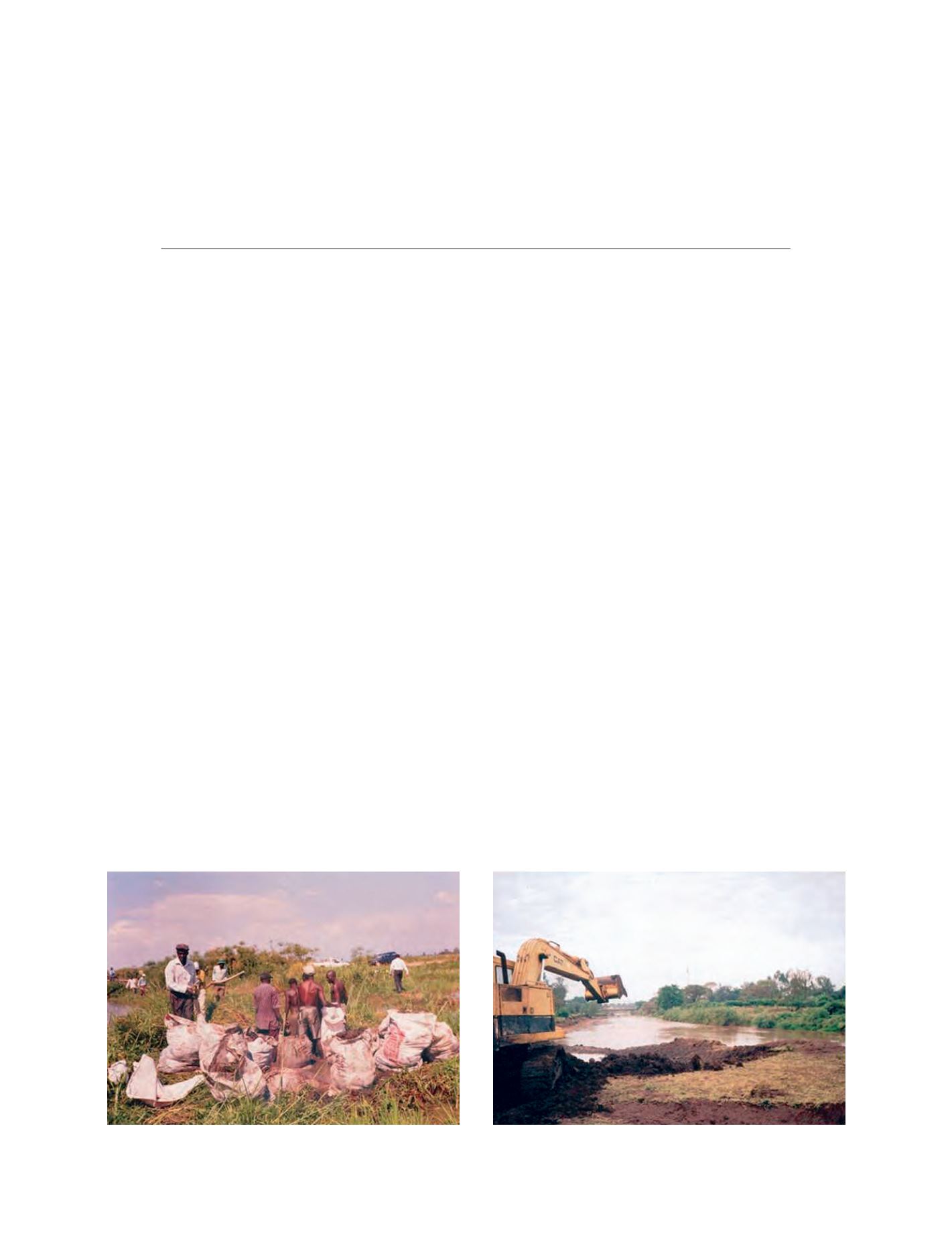
Nyando community using sand bags to block eroded Nyando river bank
Photo: Flood Control Unit,
Ministry of Water and Natural Resources, Kenya
Widening the Nyando river
Photo: Flood Control Unit,
Ministry of Water and Natural Resources, Kenya