


 70 / 156

[
] 70
offer only infrequent image revisits and the delivery of critical
information may take months due to periodic cloud cover and
tasking conflicts.
Recommendations
Given the potential for population expansion in the subdivision,
especially within the city of Limbe, and the eventual need for
more settlement land, the following measures are recommended
to mitigate future landslides and floods in the subdivision:
People should not be moved away or stopped from building
on habitable areas of the ‘hazard’ zone because this might only
be an ineffective and short-term measure. An important propor-
tion of Limbe subdivision is hilly; fortunately most of the hills
at the foot and slopes of which people have dug and put up
houses only rise to a height of around 350m. Landslide miti-
gation measures like excavation
3
and planting of soil-
reinforcement plants can take advantage of the low-altitude hills
and increase well planned development in these hillside areas.
A detailed hydrologic monitoring study of Djenguele River
should be undertaken to ascertain the flow rate and volume of
water discharged both at high (rainy season) and at low (dry
season) peaks. This will provide indispensable data for the canal-
ization of the river from its upper tributaries through its whole
course along the city down to the sea.
A stricter building code should be implemented that, amongst
other things, prohibits people from building at unsafe distances
from the river channel and from disposing of domestic sewage
into the river.
An improved drainage system and monitoring of water level and
quantity/quality of water in hand-dug wells in the city of Limbe will
enhance an appraisal of the volumes and impact of septic waste
and rainfall water contribution to the groundwater budget.
Before the above measures are taken, people living on and at
the foot of steep hills should quit their houses when rainfall is
heavy and continuous (during the rainy season) for two weeks
until the rainfall intensity approaches 1.1 mm/hr.
There should be a development of new building codes, stan-
dards, rehabilitation and reconstruction practices at the national
and local levels as appropriate, with the aim of making them
more applicable in the local context, particularly in formal and
marginal human settlements, and a reinforcement the capacity
to implement, monitor and enforce such codes through a
consensus-based approach, with a view to fostering disaster-
resistant structures.
The issue of informal or non-permanent housing and the loca-
tion of housing in high-risk areas should be addressed as
priorities, including in the framework of urban poverty reduc-
tion and slum upgrading.
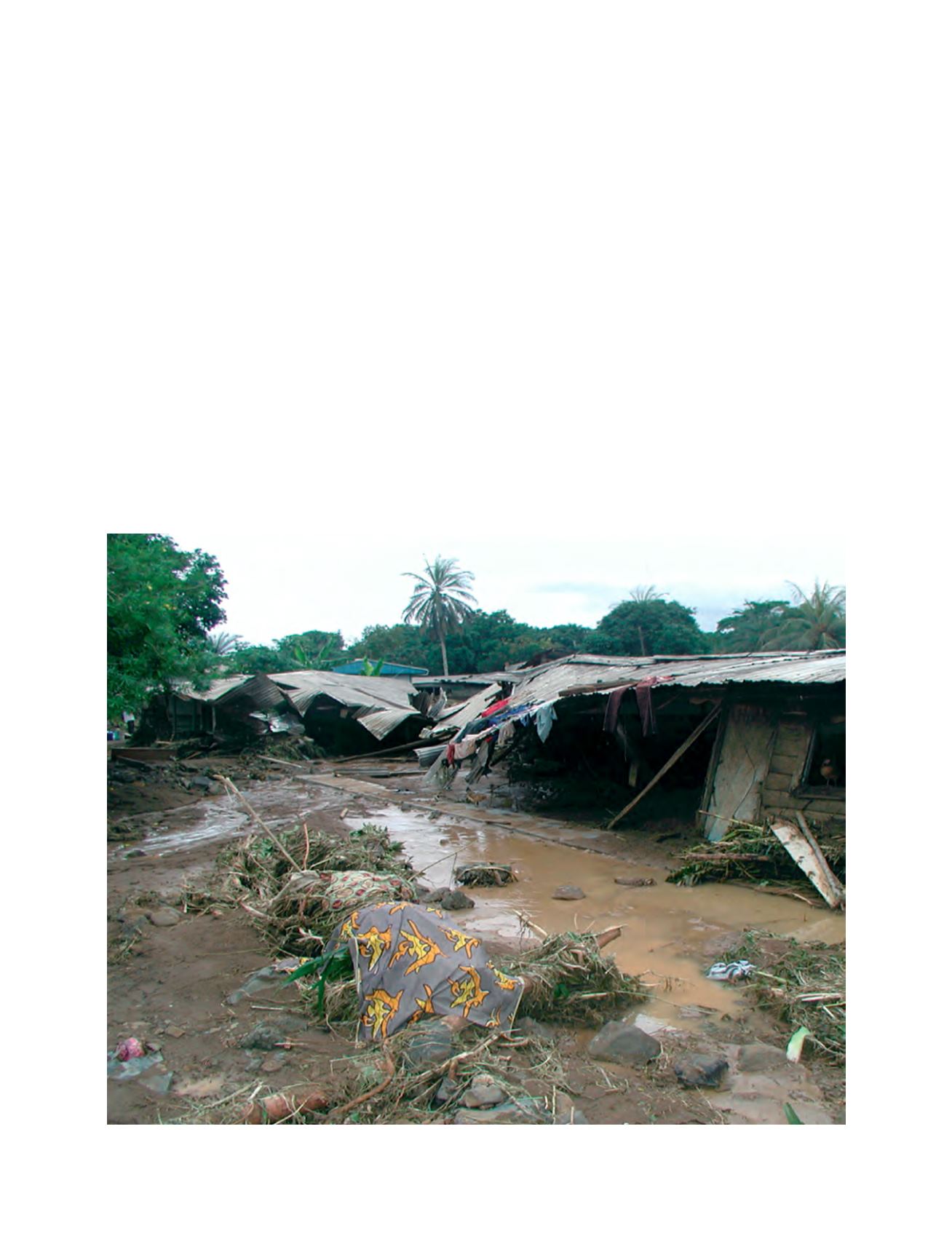
Inundation destroys streams and nearby houses in Cameroon’s Limbe subdivision
Photo: Nsoyunic Lawrence, June 2001