


 88 / 156

The majority of household income is derived from the single
rice crop grown annually. This is commonly produced on a share-
cropping basis, and rent for the land accounts for a substantial
part of this income. Flash floods occur regularly at the end of the
dry season (most recently in 2004) and can lead to losses of the
rice crop and other vital assets including seeds and livestock. There
are few other crops grown in the area and alternate work is limited
to migrational labour and working as day labourers for the large
companies that control the fishing industry in the haor areas.
The paucity of basic services and absence of accountability of
public service providers further compounds the hardship in the
haor area. Government resource allocation for poverty alleviation
does not consider the special needs of this remote and geograph-
ically distinctive area. Despite its uniqueness, there is no specific
government policy to address the problems of the haor. The same
building designs, codes and allocations that apply to mainland
areas apply equally to haor areas.
Concern and the haor area
In recognition of these challenges, Concern has been working with
haor communities since 1988, initially implementing an emergency
response project and then moving in 1992 to the establishment of
long-term development programmes which included a number of
disaster preparedness and mitigation activities.
These activities included providing training to community groups
and local government officials in disaster contingency planning,
the principles of relief distribution and first aid. Other measures
included the construction of raised earth platforms as flood shel-
ters where people could take refuge with their domestic animals,
crops and other assets in the event of flooding. Flood and wave
protection measures such as brick walls and gabion structures were
constructed around village perimeters. Individual homesteads,
plinths, tube wells, sanitation units, and even entire villages were
raised above flooding levels, and saplings were planted along the
slopes of villages to reduce wave-induced soil erosion.
These interventions have helped protect and restore the liveli-
hoods and assets of the haor community and provided them with
an opportunity to engage in alternative income-generating activities
such as poultry rearing and kitchen gardening. Construction of the
physical protection measures provided local employment oppor-
tunities and an added benefit of the flood shelters is that, during
times of normal water levels, they can be used for drying crops and
as a space for social activities. Improved access to better water and
sanitation facilities has reduced the prevalence of water-borne
diseases during the rainy season.
Lessons learned and the way forward
In 2005 Concern, utilizing tools and methodologies developed
in its
Approaches to DRR
, undertook a further comprehensive risk
analysis to identify hazards which are more likely to occur, and
to understand the specific vulnerabilities of individual commu-
nities to their impact. Building on previous actions, specific
mitigation, preparedness and advocacy measures were identified.
Implementation of these through local non-governmental orga-
nizations (NGOs) and disaster management committees will
increase the ability of communities to withstand, respond to, and
recover from the impact of hazards.
Care was taken to ensure that these measures complemented the
recently established national framework on disaster management
and recognized that local government institutions in Bangladesh
have the mandate to coordinate and implement risk reduction
activities. It is clear that Concern has a role in making linkages
between macro-level policy and micro-level activities, particularly
in articulating the vulnerabilities of poor communities.
Mitigation measures
The risk assessment in 2005 revealed that while some of the miti-
gation measures introduced performed well, a number of them
required reassessment in order to better reduce the vulnerability
of communities:
Flood protection measures
– Haor villages have various physi-
cal flood protection measures in place which were constructed
by the communities themselves, Concern, other NGOs, and
government agencies. These include brick protection walls,
concrete blocks, gabion structures and plantations. They have
not all proved to be equally effective or durable, and a cost-to-
[
] 88
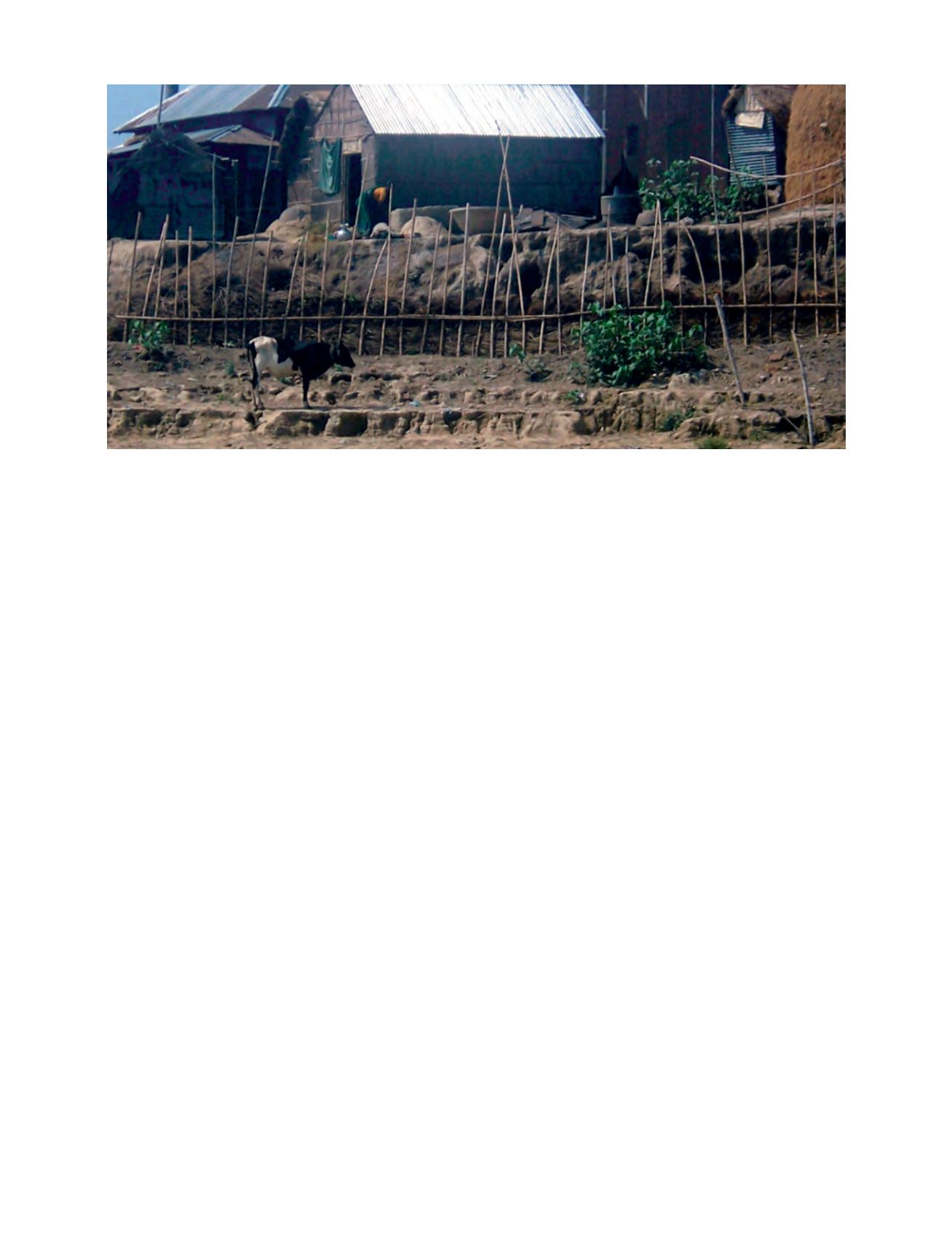
Though often futile, rural households protect their homestead lands by erecting reed sheeting tied with bamboo and fortified with challa grass
Photo: Pankaj Kumar