


 90 / 156

[
] 90
D
ISASTERS HAVE AFFECTED
human populations, causing
considerable damage to their social and economic
support systems from time immemorial. All these years
of suffering seem not to have resulted in an effective mechanism
of disaster mitigation for vast segments of population, particu-
larly for people living in developing countries. Economic
limitations, the socio-political system and administrative/regu-
latory framework prevailing in a geographical entity often
determine the impact of disasters on people.
Economists all over the world agree that democracy is the best
form of hunger prevention mechanism. But experience shows
that no amount of economic stability supported by democratic
set-up alone can protect a population from the vagaries of nature
and their after-effects. We need not go through the horror of the
1999 super cyclone, the killer tsunami of 2004 and the dreaded
Hurricane Katrina of 2005 to understand disasters and their
effects. Rather, one thing that emerges distinctly from all these
tribulations is that perpetual preparedness is the key to limiting
the impact of disasters.
Profile of Orissa
Orissa is a state on the eastern seaboard of India, located between
17˚49’ and 22˚36’ north latitude and between 81˚36’ and
87˚18’ east longitude. It spreads over an area of 155,707 sq km
and is broadly divided into four geographical regions: Northern
Plateau, Central River Basins, Eastern Hills and Coastal Plains.
It has a 480 km long coastline. Its population was 36,706,920
as per the 2001 census. Administratively, the state is divided
into 30 districts, 58 sub-divisions, 314 blocks (administrative
units in descending order of geographical area and population)
and 103 urban local bodies. The average density of population
comes to 236 per sq km with significantly higher density in
coastal areas compared to the interior parts.
Vulnerability
Orissa is vulnerable to multiple disasters. Due to its sub-tropi-
cal littoral location, the state is prone to tropical cyclones, storm
surges and tsunamis. Its densely populated coastal plains are
the alluvial deposits of its river systems. The rivers in these areas
with a heavy load of silt have very little carrying capacity, result-
ing in frequent floods that are only compounded by breached
embankments. Though a large part of the state comes under
Earthquake Risk Zone-II (Low Damage Risk Zone), the Brahmani
Mahanadi graben and their deltaic areas come under Earthquake
Risk Zone-III (Moderate Damage Risk Zone) covering 43 out of
the 103 urban local bodies of the state. Besides these natural
hazards, human-induced disasters such as accidents, stampede
and fire, vector-borne disasters such as epidemics, animal
diseases and pest attacks, and industrial/chemical disasters add
to human suffering.
Orissa State Disaster Mitigation Authority
The 1999 super cyclone affected 14 out of the 30 districts of
Orissa, with the loss of 8,962 precious human lives and about
450 thousand cattle heads. Two million houses and 1.84 million
hectares of crop area were damaged, and transport, telecom and
power systems were paralysed – the entire coastal tract was
devastated. The politico-administrative system and the economy
of the state pointed to a significant gap in the whole process of
handling disasters and their aftermaths. The vulnerability of the
state, its people and their inadequate preparedness level called
for a new approach to disaster management. A consensus
evolved to create a separate organization to meet the challenges
of disaster preparedness and management through integrated
policy enunciation, holistic planning, infrastructure develop-
ment and multi-stakeholder coordination. The Orissa State
Disaster Mitigation Authority (OSDMA) was thus set up in
December 1999. OSDMA has focused its attention on certain
areas of disaster management in a systematic manner based on
past experiences, especially those during and after the super
cyclone. It can legitimately claim that some headway has been
achieved.
Managing disasters: the Orissa experience
N. Sanyal, Managing Director, Orissa State Disaster Mitigation Authority
Rajiv Bhawan, Bhubaneswar, Orissa, India
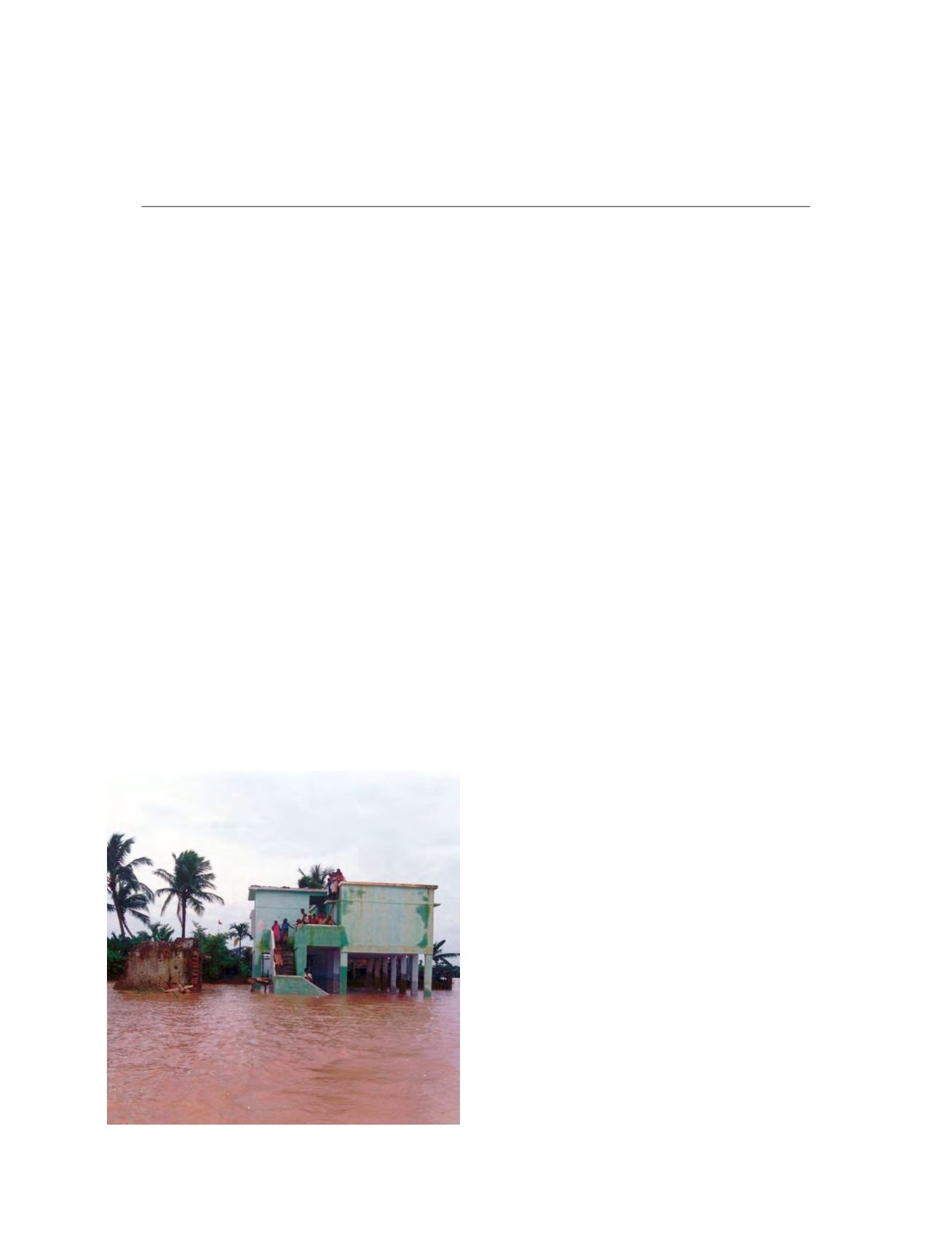
A school-cum-shelter
Photo: OSDMA