



 95 / 156

[
] 95
expanses of land. Tree plantation has been taken up in these
villages to create such natural breakwaters, and about 7,500 horti-
cultural and commercial value trees have been planted. Each
family was given two fruit saplings and made responsible for
nurturing them, so as to own the venture. The commercially valu-
able trees can be sold and income earned, on condition that the
family replaces the cut tree. Further, to prevent floodwater from
logging in the villages, 13 culverts have been constructed to
provide an outlet.
Shelter
– Most people live in mud houses, which become
damaged due to standing floodwater, forcing displacement and
evacuation to safer sites. People are forced to live on embank-
ments and have to keep moving from one higher ground to
another; some are even forced to live in trees for a few days. Lack
of proper living conditions invariably leads to ill health. To enable
communities to live in temporary shelters on dry land, two exist-
ing evacuation centres were repaired and three new ones were
constructed in villages where such shelters did not exist. These
five sites have also been linked with an evacuation route to allow
quicker access to them. In some villages, existing houses were
strengthened with bamboo reinforcement and other houses were
raised above the highest flood level, making them less vulnerable
to inundation. So far, 402 houses have been made safe through
such means.
Preparedness
Early warning systems
– Flooding in these parts usually occurs
when Nepal releases its excess water into India. Before doing so
the Nepal Government warns the Indian Government, and this
warning is immediately passed down to the block level. The Block
Office (BO) then informs the ward members in the village through
the head of the Panchayat (the government body elected at village
level). When the information reaches the state headquarters at
Patna, a radio warning is sounded out through the All India Radio
Station at medium wave frequency 612. This radio warning
system is being strengthened among the communities through
awareness programmes.
Task force group formation and training
– Each village has
formed a task force of about 20-30 youths, depending on the size
of the village. Each task force conducts mock drills with other
members of the community once every three months, to create
village flood preparedness.
Disaster Mitigation Fund
– The structural assets created to
mitigate the impact of floods will, in the course of time, go
through wear and tear. In order to maintain these structures, the
community has created a Disaster Mitigation Fund, which will
also be used for relief operations. Presently, 14 DMCs are collect-
ing INR1-5 per family each month towards the fund. Ten DMCs
have opened bank accounts for the fund. In total, approximately
USD814 (INR35,000) has been deposited over a period of ten
months.
Community participation
Community participation, and not just involvement, is essential
to owning and sustaining a community-based initiative. This
project sought to ensure ownership through participation that is
evident in the various stages of the project cycle.
The community participated in the initial planning through a
PADR process and baseline survey, giving their time and sugges-
tions. The community selected the DMC members, who have
been involved in decision making and monitoring throughout
the project. The DMC takes decisions such as the type and site
of mitigation structures, beneficiaries for the shelter and agri-
culture inputs, and percentage of community contribution.
Community contribution is another aspect of these initiatives
which shows how much the community owns the project. In
Hanuman Nagar village the community constructed the road,
contributing 50 per cent of the labour cost, which was calculated
at the Government-approved minimum wage rate. Gandherian
Museri Tola provides a further example of community initiative.
Here, the community collected INR10 from each worker to
purchase a piece of land within the evacuation site. It is also
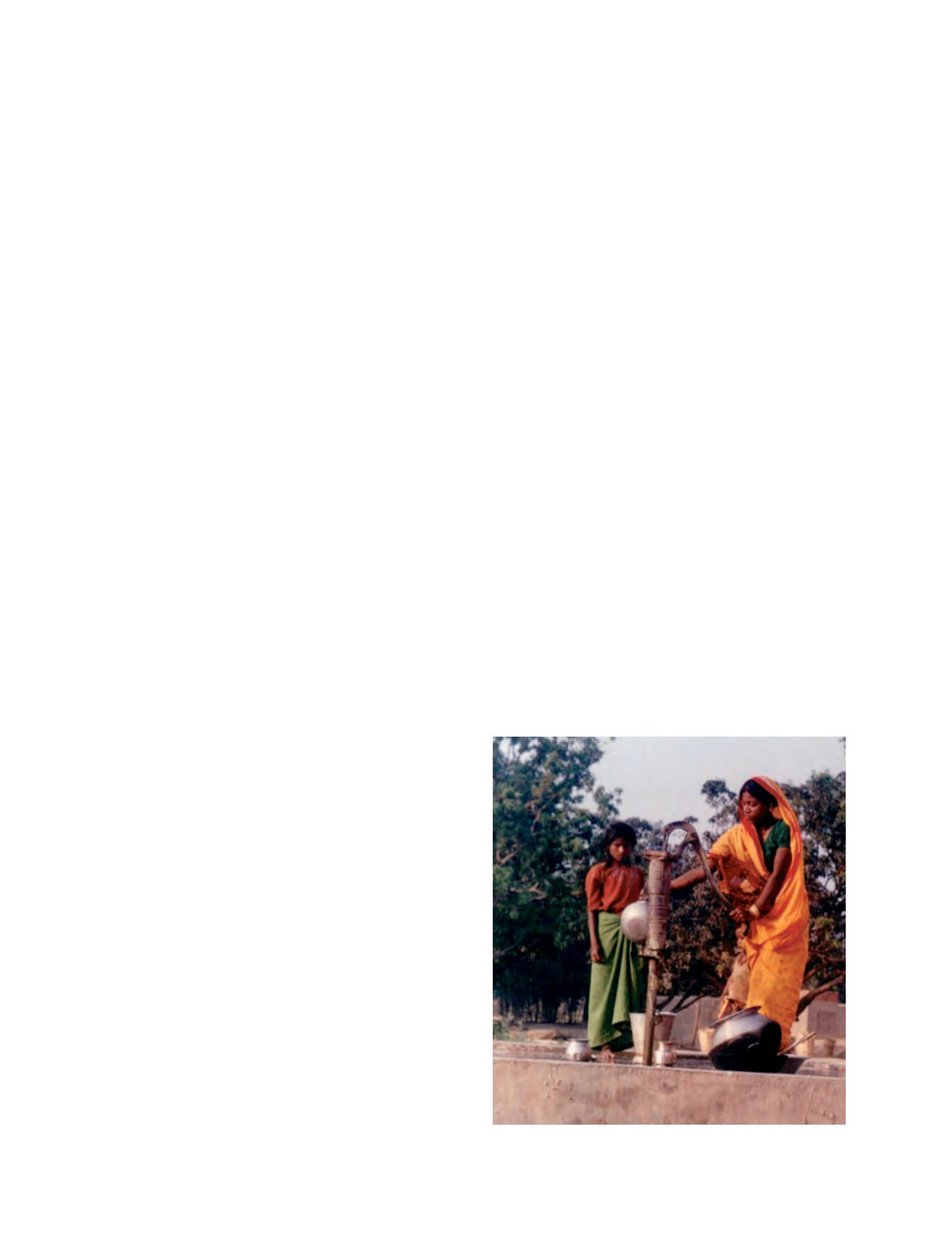
planned with the community to raise some of the existing tube
wells using contributions of INR5-10 from each family.
Linkages
Linking the community with the Government has allowed them
to seek and access various schemes and benefits. The village of
Rakhwari Museritola has been able to gain funds through the
Indira Awas Yogna – the government housing policy; and farmers
are being linked to the Agriculture Technology Management
Association for training in improved agriculture techniques for
sugar cane and wheat cultivation. Ghonghoria and Gandherian
villages were successful in obtaining land from the Panchayat for
use as evacuation sites; the DMC in Hanuman Nagar filed an
application with the Block Development Office (BDO) for provid-
ing a bridge to allow connectivity and easy escape; and some
women’s groups sought finances from the BDO towards agricul-
ture and livestock rearing.
Future plans
The project has now been running for one year. In subsequent
years, the plan is to create seed banks, provide livelihood assis-
tance to landless farmers through the provision of livestock,
encourage insurance of self and livelihood assets through aware-
ness creation and linking with insurance providers, and campaign
with the state government for community-friendly evacuation
sites and raised tube wells.
5
Raised tube wells
Photo: EFICOR