


 101 / 156

[
] 101
T
HE
R
EPUBLIC OF
Tajikistan is the smallest and southern-
most republic of the former Soviet Union. A landlocked
country with a total land area of 143,000 square kilometres,
it shares borders with Uzbekistan to the west and north; the
Kyrgyz Republic to the northeast; China to the east and
Afghanistan to the south. More than 93 per cent of the territory
of Tajikistan is mountainous and only 7 per cent of the land is
arable. Over 72 per cent of the population lives in rural areas.
Tajikistan, one of the countries with the fastest-growing popu-
lation rate in the former Soviet Union, presently has a population
of just over 6 million, with a little more than 10 per cent of the
total population residing in its capital, Dushanbe. The country
gained its independence on 9 September 1991. Since then,
Tajikistan has had to deal with the dual challenges of a collapsed
state-centric political and economic system along with a brutal
civil war which lasted approximately five years. This has been a
challenging period of transition that has included the abrupt
discontinuation of universal social benefits provided by the Soviet
Union, a high level of unemployment with approximately 80 per
cent of the population living below the poverty level, and national
and regional tensions. It is only since the signing of the Peace
Accords in 1997 and with the ensuing relative political, economic,
and social stability that the country has been able to fully concen-
trate on addressing issues regarding its long-term development.
Tajikistan: highly vulnerable to natural hazards
The designation of the International Decade for Natural Disaster
Reduction in 1989 was critical in highlighting the significant
increase in disaster-related loss of life and livelihoods in recent
years. It is estimated that the number of people affected by natural
disasters was three times higher in the 1990s than in the 1970s
and economic losses were five times higher. Moreover, it is
expected that this trend will increase during the 21st century
with issues such as population expansion, displacement, and
environmental degradation all contributing to the increased
vulnerability of populations and infrastructure. Natural disasters
affect all regions and countries, but it is clear that when such
disasters occur in developing or transition countries, they serve
to undo development gains and add further burdens on weak
systems which do not have adequate capacity to respond effec-
tively. The end result is further economic and often social and
political instability.
Due to its geography and climate, Tajikistan is prone to a
number of natural hazards. According to an Asian Disaster
Reduction Centre report, Tajikistan has experienced three of the
ten most severe disasters between 1975 and 2000, according to
the ratio of amount of damage to GDP. In fact, in the span of two
years, 1992-1993, Tajikistan experienced two floods and one land-
slide which together resulted in almost 1,600 deaths and more
than 100,000 people affected.
In addition to these hazards, Tajikistan is located in one of the
most seismically active zones of Central Asia and the world in
general. In the 20th century alone, Tajikistan experienced a
number of major earthquakes which resulted in substantial loss
of life and damage to social and economic infrastructure. The
combined intensity and location of an earthquake in the Western
Pamir mountains in 1911 resulted in a massive landslide cover-
ing the village of Usoi, backing up the Murghab river, creating
Lake Sarez and the world’s highest natural dam. Similarly, the
Khait earthquake in 1949 created a landslide which moved at a
catastrophic speed and buried under it several villages, costing
28,000 lives. Most recently, in 1989 an earthquake 30 km from
Dushanbe, although measuring only 5.3 on the Richter scale,
caused a massive landslide which resulted in 274 deaths and left
more than 30,000 homeless. In addition to these high magni-
tude earthquakes Tajikistan experiences a number of earthquakes
of a lesser magnitude, which may be more isolated in their impact
but still serve to disrupt the lives and livelihoods of thousands.
In recent years, the cultivation of more marginal lands and
increased migration to urban areas, due to the economic pres-
sures in the post-independence era, have created conditions
Disaster risk management in Tajikistan:
a Focus approach
Hadi Husani, Executive Officer, Focus Humanitarian Assistance, USA
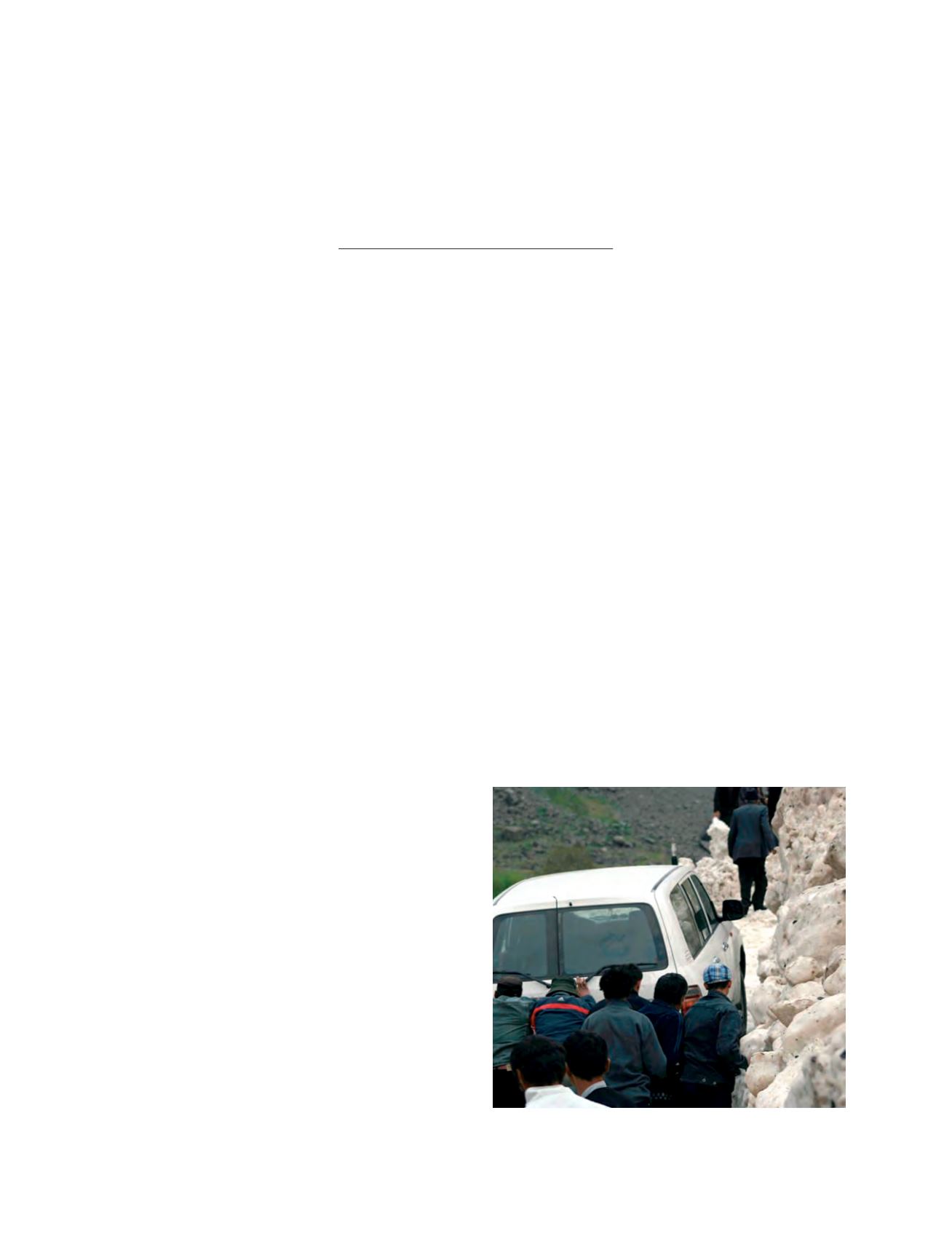
Tajikistan has experienced a number of major earthquakes resulting in
loss of life and damage to infrastructure
Photo: Hadi Husani