


 99 / 156

[
] 99
F
ROM
1995
TO
2004 in Korea, an annual average of 131
people lost their lives, mostly because of floods and land-
slides, to typhoons and torrential rains in the summer.
Various systematic multi-hazard warning systems have been
proposed and established to protect people’s lives and minimize
damage to critical infrastructures in different areas.
From conventional, commercial electronic display boards to
cutting-edge information technologies, six different early warning
systems now operate against natural disasters in Korea: the Cell
Broadcasting Service (CBS) mobile phone message system, auto-
matic verbal notification system, automatic rainfall warning
system, disaster notification board system, TV disaster warning
broadcasting systems, and radio disaster warning broadcasting
system using the radio data system (RDS).
The CBS mobile phone disaster message notification system
broadcasts disaster information to mobile phone users with a
special receivable ID at the base station transceiver subsystem.
Unlike the short message service, which is a point-to-point indi-
vidual transmission, the CBS system can transmit messages
nationwide or to local areas, simultaneously or independently.
Serviceable telecoms companies and targeted areas were selected
in November 2004, after which users’ responses were analysed
and an interactive system was set up in Korea’s National
Emergency Management Agency (NEMA) in 2006. So far, the
system has broadcast 57 warnings to more than 19 million mobile
phone users – that is, 39 for heavy snows and roadblocks, nine
for wildfires, three for tsunamis, three for gusts and heavy rains,
and three for drought and yellow dusts.
This system has several advantages. Information reception is
possible via an equipped CBS module without additional hard-
ware, so nationwide broadcasting is possible. This system is suitable
for real-time warning services because multi-user transmissions are
available simultaneously by broadcasting characteristics. The service
cost is low, independent of the number of users. Users can easily
select, confirm, and delete information.
This system, however, has some weaknesses. For a start, it is
terminal-oriented – without a mobile terminal or CBS module,
information cannot be received. If the terminal is turned off, no
information is available even with a CBS module. The reception
rate is another problem. The disaster information is not available
in radio-dark areas and there is no automatic confirmation method
to check whether or not users have received disaster information.
The second system for early warning is the automatic verbal
notification system. Automatic voice notification equipment
located at the local disaster management headquarters can issue
warnings using fixed or mobile telephones, village broadcast
amplifiers and any available communication tools when inunda-
tion and other disasters are imminent.
When rain precipitation, river level, or any emergency data
in a specific area are analysed, persons to be informed are
chosen and a disaster warning is issued using 32 exclusive emer-
gency communication networks. The system database covers
more than 550,000 people such as emergency managers and
local residents in 234 central and regional districts.
For an effective response, call sequencing has been set up. The
first call goes to the village amplifier in a disaster-prone area, so
that people in the vicinity can obtain general information about
the imminent disaster situation. A second call goes to the village
chief, who can personally deliver the information and encourage
people to evacuate to a safe place. The final call goes to the related
public organizations and officers in the targeted area.
The third system is for localized rainfall warning. After a one-
night flash flood killed 95 campers and hikers in the Jiri National
Park in 1998, the local observatory system needed to be expanded
to monitor local torrential rains which cannot be easily observed
Early warning systems for
natural disasters in Korea
Dugkeun Park, PhD, Senior Analyst
The National Emergency Management Agency, Seoul, Korea
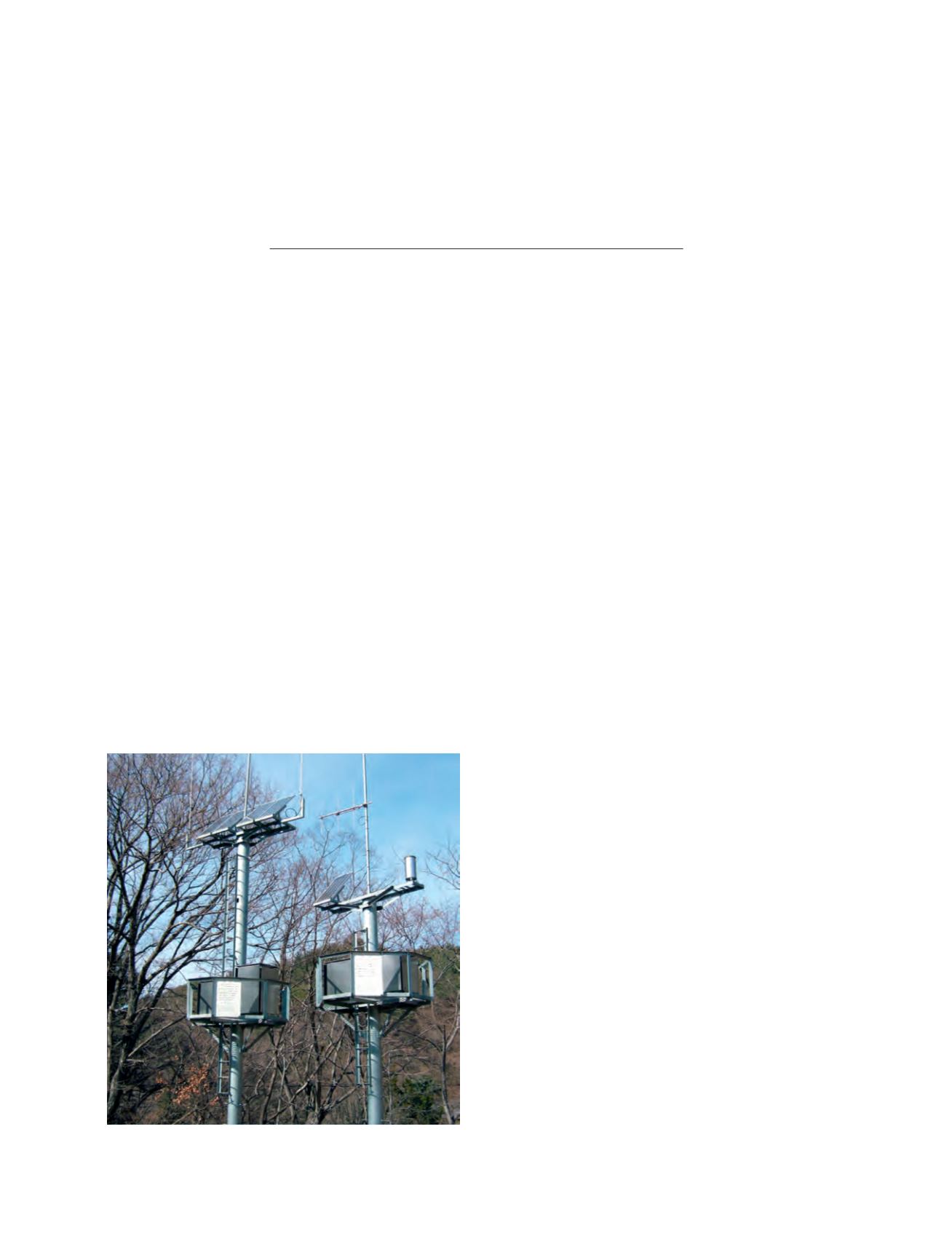
Observation tower
Photo: NEMA