


 103 / 156

[
] 103
O
N THE MORNING
of 26 December 2004, a large earthquake
occurred under the sea northwest of the island of Sumatra.
It caused an enormous rift 1.2 kilometres long in the earth’s
crust and a tsunami of massive proportions. The tsunami was devas-
tating, especially on the coasts of Sumatra, Thailand, Sri Lanka and
India: about 300,000 people were killed or went missing. Other
people were injured and entire communities were destroyed.
Community-based interventions
For those who survived, the consequences of the disaster were
severe. Many of them lost relatives, friends or acquaintances and
most experienced the local events as very shocking, often with far-
reaching psychological consequences.
Many victims continue to complain about ongoing (or even
worsening) psychological and physical problems long after a disas-
ter. This can partly be explained as the normal course of personal
problems related to disasters in general: after the initial and imme-
diate stage of a disaster, a second stage called the ‘honeymoon’
stage will follow, usually creating a strong bond between victims
and non-victims – existing hierarchical structures make way for a
sense of being among fellow sufferers, and for massive aid. As a
result, victims feel unconditionally supported by the community –
a feeling fuelled by the media and the authorities, who in most
cases promise to take all necessary measures.
But after a few weeks, a third stage of the disaster will inevitably
follow, the ‘disillusionment’ stage: as people return to ‘business as
usual,’ those victims who still appeal for help or understanding run
the risk of being considered complainers by the people around them,
as if they were out to profit from the situation instead of repairing
the damage and coping with events emotionally. Proper care must
be focused especially on minimizing negative effects on the victims’
ability to recover. Psychosocial aid focused on strengthening the
supporting communal bonds can play an essential role here.
People affected by major disasters typically suffer a whole range
of losses, while at the same time natural social networks and other
support mechanisms are wiped out. As existential needs are met
by the provision of food, water and shelter, and as safety is ensured,
psychological defences may drop, and awe of the reality may be
so overwhelming that individuals become numb and feel power-
less. At this point, leadership in providing social care is essential.
The key objective is the re-establishment of meaningful patterns
of interaction in the community which, after massive trauma, is the
vehicle for reconstructing a sense of life purpose. The extent to
which people get support from others (family, neighbours, author-
ities, aid organizations) is crucial for their empowerment,
mastering the hardship and overcoming post-traumatic symptoms.
This is because one of the main healing functions of a commu-
nity is to contain and support both family systems and individual
members.
1
Psychosocial aftercare in the Netherlands
The consequences for Dutch survivors of the tsunami disaster were
also severe. Psychological consequences for the survivors came to
light very soon after the disaster. Victims became tense, jumpy and
easily irritated. They suffered from insomnia or nightmares or felt
intensely sad. They had trouble shaking themselves free from
memories of the tsunami and were not able to take up their daily
responsibilities. There was therefore a requirement for help in the
Netherlands too.
The objective of Impact, the Dutch Knowledge and Advice Centre
for post-disaster psychosocial care, is the advancement of high
The healing community: the importance of
community-based interventions
Magda Rooze, Ariëlle de Ruyter, Dean Ajdukovic, Nienke Fundter and Jorn Hövels,
Stichting Impact, Dutch Knowledge and Advice Centre for post-disaster psychosocial care
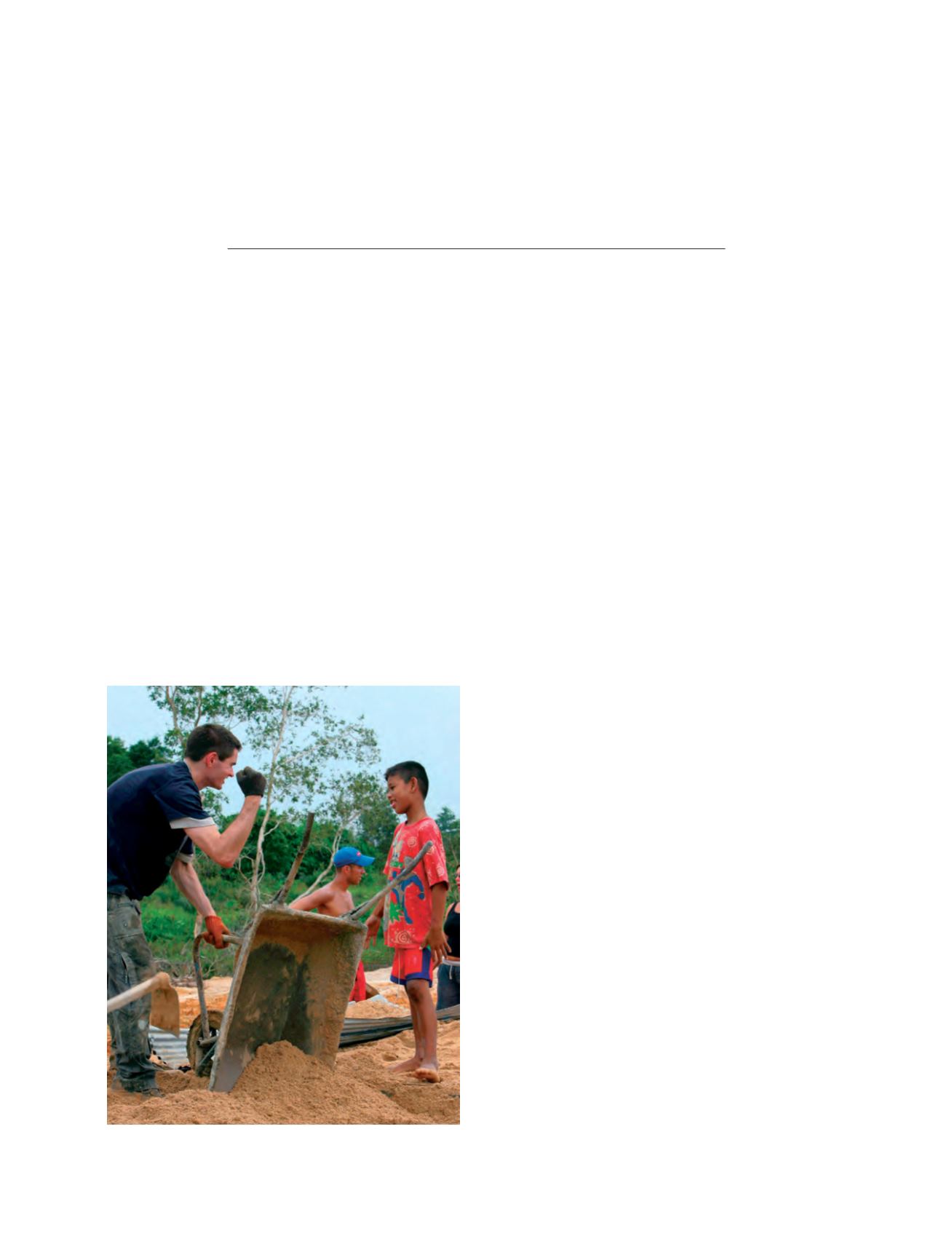
Community-based interventions can involve every level of the community
Photo: www.anp-photo.nl / Barbara Walton