



 108 / 156

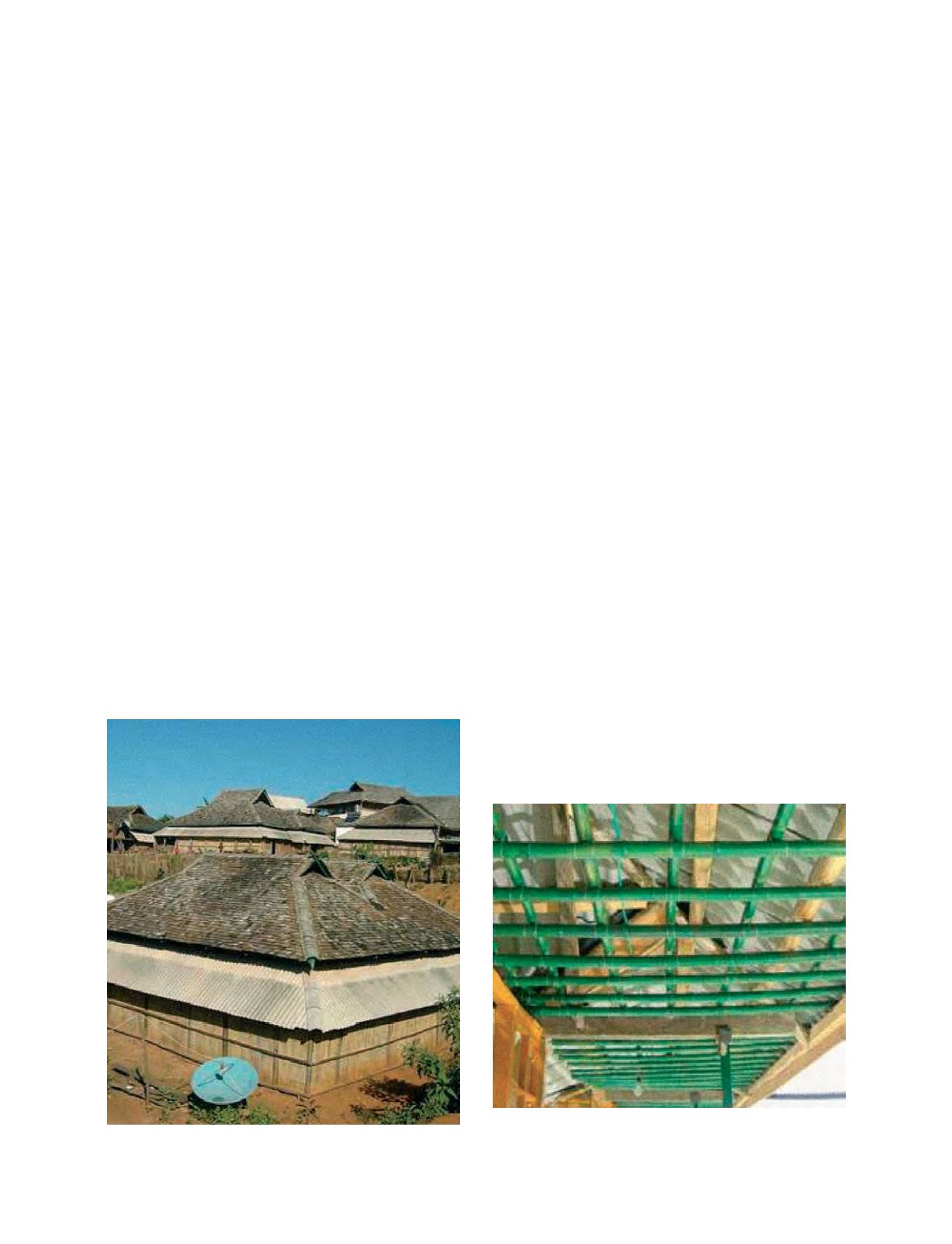
as a traditional architecture has many undeniable merits and the
advantages are quite remarkable.
With the protection of the seismic-resistant bamboo houses, more
people will survive in the event of an earthquake. Local governments
should build more bamboo public shelters in Xishuangbanna. In
peaceful times, these can be rented to tourists and travellers so that
they can experience the area’s traditional ethnic cultures. Once an
earthquake occurs, these shelters will be used only to displace and
resettle the victims. In term of the official data, there are a total of
104 renowned scenic spots in Xishuangbanna, 83 of which are
located in the villages of ethnic minorities. The construction of
bamboo houses would help to create better landscapes, enhance the
service condition of tourism and attract more tourists, so as to benefit
the village’s economy and the villagers’ incomes. Therefore, bamboo
houses can not only facilitate the development of tourism and increase
the financial income of local governments, but can also provide local
government with an effective and available emergency resource for
resettling victims affected by earthquakes. Local government
economic and social development plans should prioritise projects
for the construction of bamboo shelters in the interests of disaster
preparedness and community-based disaster risk reduction efforts.
Local governments also have the responsibility to encourage and
guide local residents to build more bamboo dwelling houses in the
post-disaster reconstruction period. On one hand this will help to
protect the residents themselves from earthquakes; on the other it
will retain the area’s traditional landscapes and the culture of
bamboo houses. Combining government efforts with residents’
participation will accelerate the achievement of the goal of commu-
nity-based disaster risk reduction. However, in order to improve the
reliability of bamboo houses, some effort should be directed toward
the key fields of preservation, jointing, structural design and codi-
fication. So, in the process of implementation of the project, local
governments should provide scientific architectural designs and
technical guidance to local residents, and establish a project manage-
ment system to facilitate the building at the community level.
Bamboo houses help protect ecological resources
Bamboo is widely recognized as one of the most important non-
timber forest resources. The forest area on the Earth has gradually
decreased in recent decades, particularly in the tropics. This has
focused world attention on the need to identify a substitute mate-
rial, which should be renewable, environmentally friendly and widely
available. Globally, the area of tropical forest has decreased 2.4x10
7
hectares per year since 1988, while the bamboo forest area has
expanded and reached 2.2x10
7
hectares. In view of its rapid growth,
a ready adaptability to most climatic and edaphic conditions and
properties superior to most juvenile fast-growing wood, bamboo
emerges as a very suitable alternative.
This is particularly the case in the geographic environment and
climate conditions of Yunnan Province, which produce many and
varied bamboo resources for wide distribution. There are 230 species
in 28 genera of bamboo in Yunnan. The number of genera is 40 per
cent of the world’s total, 70 per cent of the total genera in China.
The number of species represents 20 per cent of the world’s bamboo
species and 50 per cent of those in China. Yunnan was named as
the ‘Bamboo Kingdom’ for its rich variety and source of bamboo.
Therefore, there are enough accessible bamboo resources available
to build bamboo dwelling houses and bamboo shelters in Yunnan.
The outline of the 11th Five Year Plan constituted by the Chinese
Government takes the forest covering percentage as a key index of
economic and social development, and points out that this percent-
age will increase from 18.2 per cent in 2005 to 20 per cent in 2010.
During the 11th Five Years, China will further enlarge the strength
of forest planting, returning land for farming to forestry and strictly
restraining deforestation to ensure the realization of this goal. As a
better resource, bamboo materials have the beneficial characteris-
tics of cheap prices and short growth periods. So, it is key to
promoting the regional economic and social development of poor
areas in Southwest China, by intensifying technical innovation and
scientific research in the application field of bamboo materials, and
creating potential economic, social and ecological benefits.
Therefore, the development and construction of bamboo houses in
Yunnan not only protects the local residents from earthquake disas-
ters, but also promotes economic development in bamboo areas
where people are living on low incomes, and saves forest resources
to protect the ecological environment as a wood substitute.
1
[
] 108
The new-built bamboo dwelling houses in Dai People’s village, Yunnan
Photo: Dr Hongzhou Lai
The seismic-resistant structure in the bamboo dwelling houses of Dai
People, Yunnan
Photo: Dr Hongzhou Lai