


 110 / 156

ities in the area), paralysing the entire healthcare delivery system
and increasing the difficulty of relief and rescue efforts.
Education and health are cornerstones of AKDN’s socio-economic
development efforts. AKDN recognized, early on, the importance
of constructing health and education infrastructure facilities to
appropriate seismic resistant standards, and was constructing hospi-
tals, health, and education facilities to such standards as early as
1983.
The region’s education has traditionally been provided primarily
by the Government using a system of free primary, middle and,
more recently, high schools. However, in the 1950s, there were not
enough government schools, especially for girls, in the region. In
the early 1950s, His Highness Sir Sultan Mahomed Shah Aga Khan
III, then Imam of the region’s Ismaili Muslims, began constructing
additional ‘Diamond Jubilee’ girls’ schools. With stone walls and
corrugated iron roofing on timber trusses, these schools were often
built by the communities themselves on community-donated land,
with some financial support from the Imam.
In 1984, it was realized that these school buildings were not
strong enough to resist earthquakes. Thus started the Self-Help
School Construction Programme (SHSCP), initially supported by
the Aga Khan Foundation, Pakistan, (AKFP) and later funded by
other international donor agencies. The primary objective for the
SHSCP was to develop a system that could improve the educational
environment for girls in NA/C, particularly within the 100 or so Aga
Khan Education Service, Pakistan (AKESP) schools that were then
housed in temporary accommodation. In the event of an earth-
quake, the earthquake-resistant schools were to provide temporary
shelter to those whose houses were destroyed.
The school design had to respond to the hilly and narrow terrain
with the limitation that many sites were inaccessible by modern
transport, and to cope with long cold winters as well as heat and
solar radiation during the summer. Local skills were used maximally
to reduce costs and to enhance ownership by the community, which
was to maintain the building as its asset once the construction was
over. Therefore, the buildings also had to be low maintenance so as
not to overtax the community’s resources.
The prototype design consisted of 13 rooms, built in four phases
to provide three, six, ten and then thirteen rooms as the school grew
through primary, middle, secondary and then high school levels.
Village communities contributed free unskilled labour, sand, aggre-
gate and gravel, while the SHSCP paid for the skilled labour and all
non-indigenous materials.
Responsive design solution
The result was a single-storey building with concrete, hollow-block,
un-plastered walls made onsite using locally available sand and
gravel. The building was shaped like an eight-cornered star: a core,
comprising five classrooms and an administrative office was built
first, with ‘corner’ rooms added incrementally as the need arose.
The design avoided the need for shuttering in vertical elements, and
reinforcement was embedded in the hollow blocks, making the
school easy to build by semi-trained craftsmen. The roof was also
of pre-cast concrete, though it did require some cast-in-situ concrete
work with shuttering. The buildings were designed to withstand
seismic loads according to the then existing US building classifica-
tion codes.
In 1990, it became clear that the school design used too much
flat land, and that the cast-in-situ concrete elements required
complex skills. A research and development exercise tested several
alternatives and a revised design – maintaining its concrete, hollow-
block walls – added the option of a soil-stabilized block wall. The
roof was fully pre-cast, requiring no cast-in-situ concrete work. The
footprint of each four-classroom block was considerably smaller and
each block could be built on a different slope. The seismic require-
ments were upgraded to the revised and updated US building
classification codes.
Further design development exercises in 1996 and 2003 resulted
in revisions including a double-storey option to further reduce the
footprint, and random rubble stone walls with metal roofs to cater
for varying constraints in different villages. Seismic resistance,
however, remains a key design parameter. To date, over 800 class-
rooms have been built in over 250 villages providing safe schools to
over 25,000 students in the NA/C region. The ongoing programme
has been recognized by UN-HABITAT as good practice in human
settlements.
Similar to the SHSCP, the Aga Khan Health Service, Pakistan
(AKHSP) and AKPBSP in 1993 initiated a Health Centre
Construction Programme (HCCP) on self-help construction
concepts. The health facilities’ buildings consisted of a consultant
room, a procedure room, a ward, and nurses’ accommodation.
Successive improvements have increased the design’s cost-
[
] 110
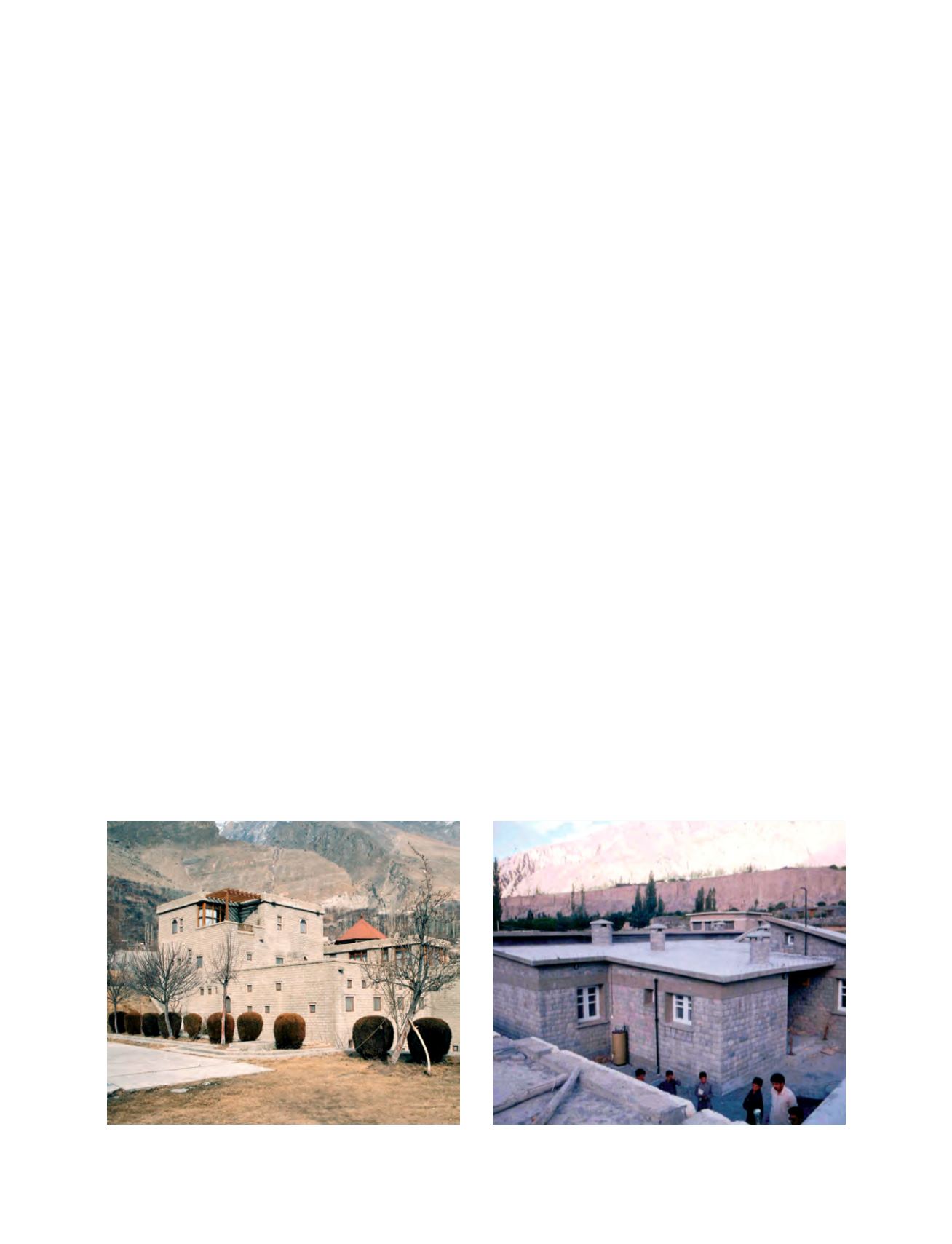
Seismic resisitant Aga Khan Girls Academy, Hunza, Northern Areas
Photo: AKPBSP
A typical seismic-resistant rural health centre
Photo: AKPBSP