


 112 / 156

disasters and, most importantly, to impart skills and knowledge
required to enable sustainable responses to disaster by local commu-
nities. Whether a disaster is major or minor, it is these people who
suffer most. Coping and survival strategies enable them to respond
to the situation long before outside help arrives from the govern-
ment or non-governmental organizations (NGOs). Communities
wish to protect themselves through community-based disaster
preparedness and mitigation.
The following is a list of key elements of CBDRM, derived from
FOCUS’ experience in the NA/C:
•
Community participation
– Community members are the main
actors and propellers; while sustaining the CBDRM process,
they directly share the benefits of disaster preparedness, miti-
gation and development.
•
Priority for vulnerable groups
– Subsistence farmers, children,
women, elderly and indigenous people are the most vulnerable
in rural areas.
•
Hazard vulnerability capacity risk assessment
– Risk reduction
measures are community-specific and are identified after an
analysis of the community’s disaster risk.
•
Recognition of existing coping mechanisms and capacities
–
CBDRM builds upon and strengthens existing coping strate-
gies and capacities, such as cooperation, community/people’s
organizations, volunteerism and local knowledge and resources.
•
Capacity building
– FOCUS has trained over 25,000 commu-
nity volunteers to use local resources to respond to and manage
different types of disaster.
•
Provision of stockpiles
– FOCUS has also provided stockpiles
at community and regional levels to support community
response efforts.
•
Acceptance and recognition
– The ownership of the CBDRM
remains with the community and is therefore easily accepted
and recognized within it.
AKDN-AJK earthquake response
The Kashmir earthquake in 2005 was the worst to have affected
South Asia over the past 100 years. With a magnitude of 7.6 on the
Richter scale, its epicentre was about 95 km northwest of Islamabad
in Pakistan-administered Azad Jammu and Kashmir (AJK). This
major quake was followed by many aftershocks of severe intensity
for many days.
The earthquake covered approximately 30,000 square kilome-
tres, causing massive destruction in nine districts of Pakistan, in the
Northwest Frontier Province (NWFP) and AJK. Apart from the dead,
severely disabled or injured, the earthquake left over 2.8 million
people without shelter, assets and livelihood.
Immediately after the earthquake, AKDN was able to mobilize its
resources, initially for relief, and then for the reconstruction phase.
FOCUS’ experience with search and rescue and its relationship with
RAPID-UK was used to mobilize the first international search and
rescue effort. Its trained team and logistical support were extensively
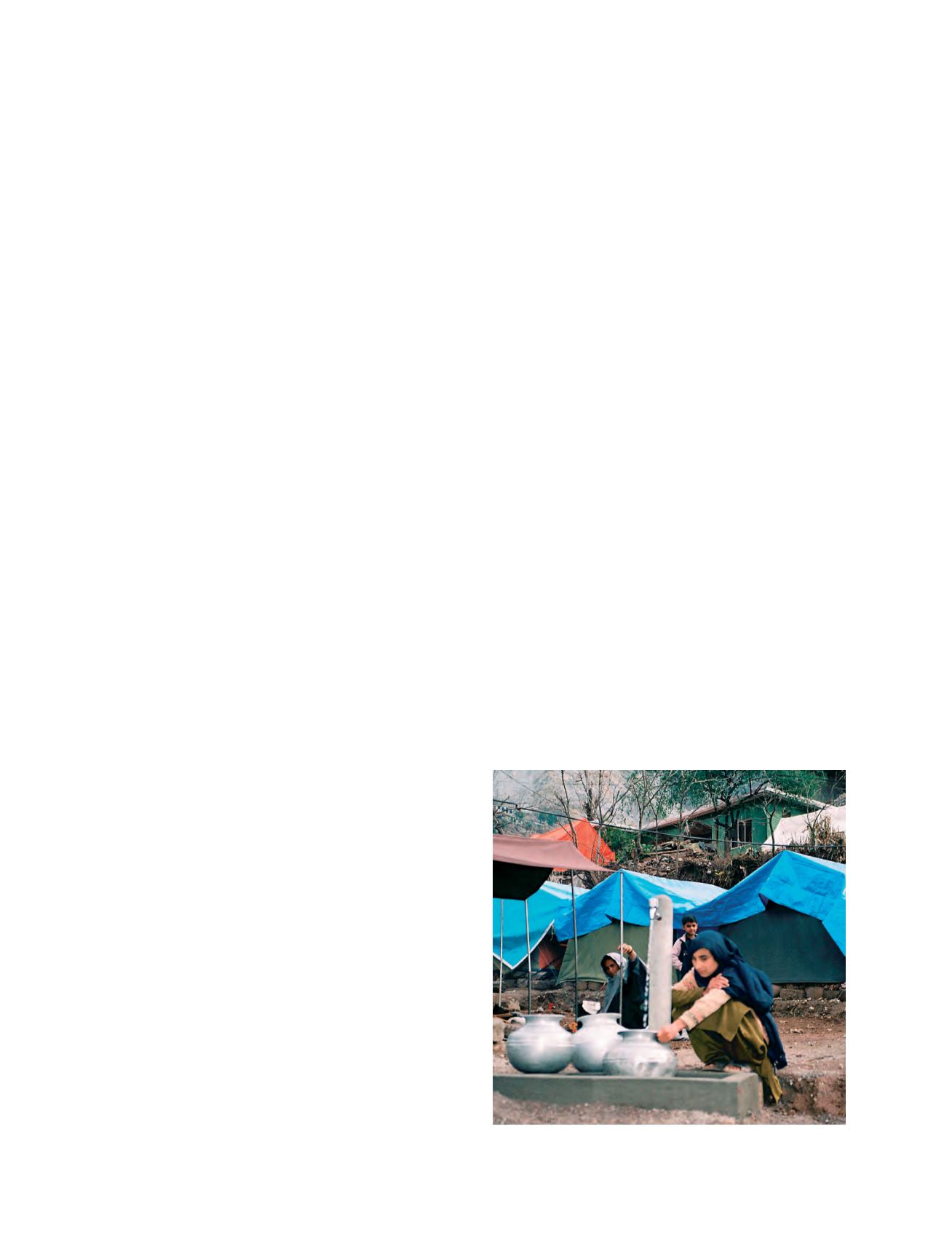
used for distributing relief goods and tents. AKPBSP installed water
supply and sanitation facilities in camps and villages and constructed
temporary shelters before the winter onslaught. Other agencies,
such as AKHSP, AKFP, and the Aga Khan University Hospital
(AKUH) also provided extensive services. The AKPBSP and FOCUS
relief-phase experiences were shared with the local communities,
NGOs and the Government, where AKPBSP house construction
techniques have been incorporated in official infrastructure recon-
struction guidelines.
AKDN is now undertaking a multi-input programme in an entire
valley of the Kashmir, covering over 25,000 people. Inputs include
water and sanitation, housing, education, health, livelihood, other
critical infrastructure and disaster preparedness, to be supplemented
by the construction of two schools in NWFP.
The AKDN organizations’ experiences reveal several key lessons:
• Disaster preparedness is a long process, as infrastructure and
facilities are built over a long period, and needs to be part of the
development attitude incorporated in all approaches and
programmes
• While constructing safer public buildings is important, most
damage is done by houses falling down and this sector cannot
be ignored
• Underdeveloped and poor communities require programmes
and technologies specifically developed for their circumstances
and with their continuous input, in order to make them sustain-
able, affordable and socially acceptable
• Technological solutions need to be supplemented by prepared-
ness activities such as training for relief work
• AKDN experiences in Pakistan affirm the effectiveness of involv-
ing communities in disaster preparedness and mitigation. While
communities have built on local coping strategies and capaci-
ties to reduce some vulnerability, many necessary structural
mitigation measures involve large capital outlay
• Vulnerability is a complex web of conditions, factors and
processes, which can only be reduced through complementary
and concerted action among multiple stakeholders from various
disciplines.
AKDN has been working on various aspects of disaster risk reduc-
tion in northern Pakistan for decades with a multi-faceted
approach that is unique in Pakistan and has been of considerable
assistance to the Government and other agencies, especially in
responding to the Kashmir earthquake. AKDN has promoted its
experiences and techniques at various forums in Pakistan and
has campaigned extensively for a national earthquake prepared-
ness programme. However, much still needs to be done, especially
in the housing sector. This clearly underlines the huge task
involved in making communities resilient to earthquake risks,
and the urgency of starting such work wherever there is risk.
[
] 112
Water supply installed by AKPBSP in Kashmir
Photo: AKPBSP