


 111 / 156

[
] 111
effectiveness, durability, and responsiveness to local needs. Almost
40 such facilities have been built to date, with German and British
support.
Training to build seismically safe buildings
Wood has traditionally been used for building reinforcement in
northern Pakistan. This has lessened over recent decades as forests
have diminished and more cement, steel and bricks are being used
for local construction. This has made the local houses unsafe and
non-durable, as craftsmen lack the skills to properly use modern
materials and the resulting elaborate, high-maintenance structures
are vulnerable to earthquake risks. To address these issues, AKPBSP
initiated two programmes in 1988:
• The Mobile Training Course (MTC) for semi-skilled adults
• The Basic Engineering Course (BEC) for schoolchildren.
The 5-6 week long MTC takes place in villages, with hands-on train-
ing in the form of constructing an actual building. At the end of
each MTC, a toolkit and a manual are given to the village organiza-
tion to be loaned free of charge. Enhancing the community
participatory approach, the course deals with topics including site
selection and planning for construction, house orientation, and
building materials.
The BEC aims at creating awareness among schoolchildren about
improving and maintaining the quality of the environment. Manuals
are carefully conceptualized to be accessible to children of various
age groups, and are continually upgraded, while an inbuilt moni-
toring system charts the success of the course.
The popularity of the MTC/BEC is clear from its social accept-
ability and increasing enrolments. Its value is also evident in the
improved shelter construction in NA/C. Through community
effort, trained people also help unskilled neighbours, and there is
a marked improvement in living standards. Over 3,000 craftsmen
and children have benefited form MTC and BEC courses. A recent
internal evaluation found that over 70 per cent of MTC partici-
pants have been able to significantly improve their earnings
because of the course.
Housing and construction improvement
Private dwellings in northern Pakistan are often found in clusters,
combined to form communities or villages. There are three distinct
types of house: Bipush or Kho houses, plain area houses, and
terraced area houses. The houses are mostly made of timber
columns and beams with non-load-bearing infill walls of stone, and
mud-reinforced walls with horizontally placed timber logs. Most
houses are highly vulnerable to the impacts of natural disasters,
such as high-intensity earthquakes. The problem has been exacer-
bated by the extensive use of wood for traditional house
construction, heating and cooking, which has caused excessive
degradation to vegetative cover. In addition, most community build-
ings, schools and other public buildings in the valleys are
non-engineered structures.
AKPBSP develops, manufactures and delivers affordable, region-
ally appropriate home improvement products which provide
practical solutions to issues including seismic resistant, energy effi-
cient house construction and insulation. These products and
techniques include lighter bow-string and composite beams for
reducing timber use in roof construction, HDGI wire wall rein-
forcement (earthquake resistant) to replace timber wall
reinforcement and reinforced concrete columns, and proper foun-
dation techniques to improve load bearing capacity. These
techniques, on average, cost only 5-10 per cent more then tradi-
tional construction, but are more seismically resistant, less damag-
ing to the environment, and easy to build as they optimize traditional
skills.
Non-masoned houses depend on good stone construction with
adequate tie-stones, roof diaphragms, minimum openings, low wall
constructions and short wall lengths for earthquake resistance.
Nevertheless, even the best-constructed non-masoned houses will
fail in a major earthquake. HDGI wire is provided in the shape of a
long, ladder-like mesh that can be produced locally. It is applied
horizontally between courses of stone or mud block, binding the
two faces of the wall and providing longitudinal reinforcement. The
technique is equally applicable to dry-stone masonry using stabilized
mortar only; mud walls and adobe construction; and in masoned
construction with either stone or cement blocks.
Through in-house research, AKPBSP has developed, tested and
applied over 60 different interventions to improve living condi-
tions in NA/C, from portable shelving and food storage containers
to energy-efficient and thermal-efficient house construction tech-
niques, solar products, double-glazed and roof hatch windows,
and water heating facilities. Over 12,500 products have been
installed in 5,000 households, benefiting over 43,000 people
across 100 villages and reducing annual household biomass
consumption by up to 60 per cent in the region. The ongoing
programme has been recognized by UN-HABITAT as good prac-
tice, and by the UNDP Small Grants Programme as best practice
in human and environment development.
Community preparedness
FOCUS’ Community Based Disaster Risk Management (CBDRM)
project aims to build the knowledge and skills that will enable
communities to survive and recover from natural and man-made
disasters. Community involvement and social cohesiveness are key
to the success of the project at the local level.
CBDRM has been designed for both urban and rural communi-
ties to enhance local awareness and understanding of hazards and
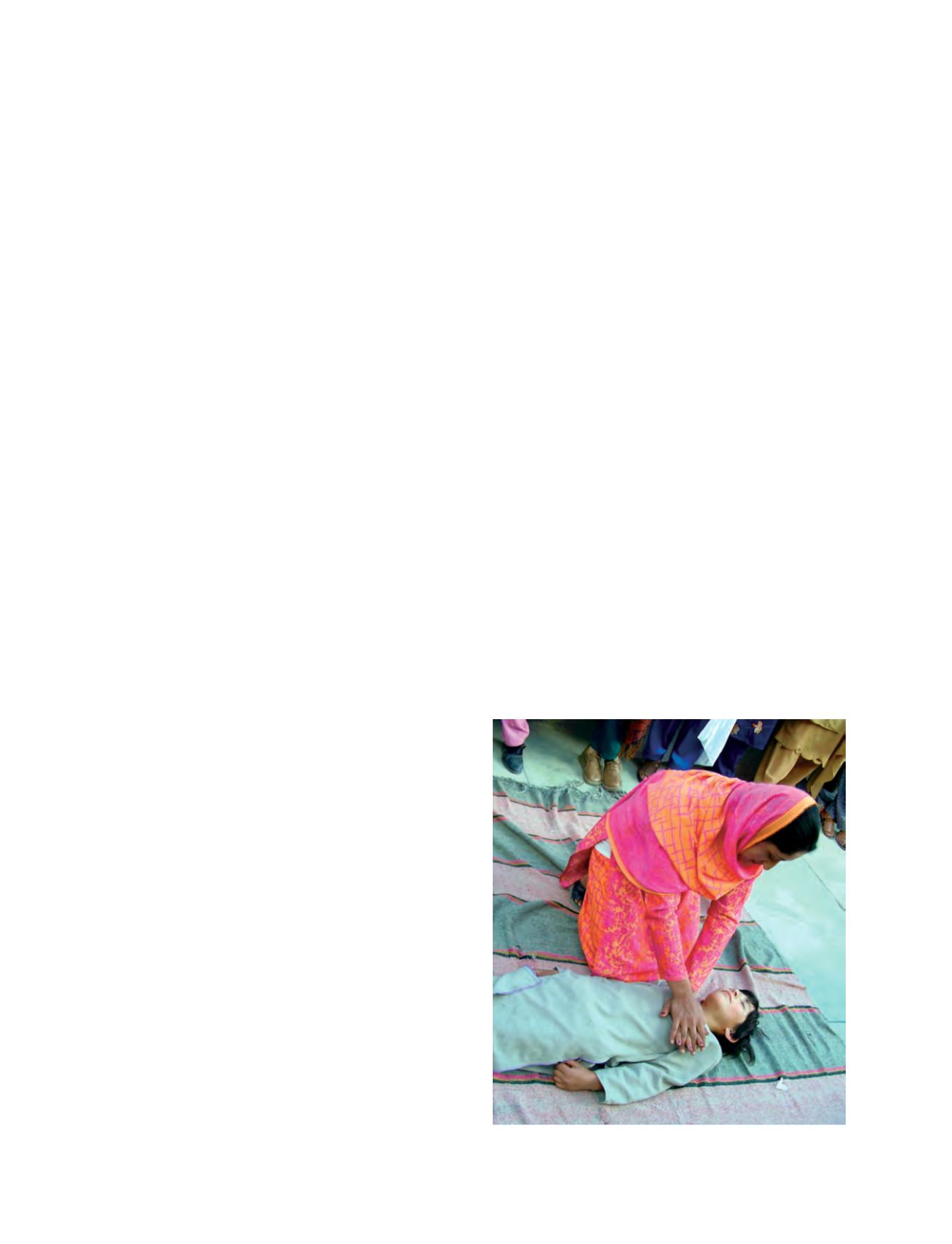
Training volunteers for post-disaster rescue work
Photo: FOCUS