


 115 / 156

[
] 115
D
EVELOPING COUNTRIES SUCH
as Turkey face a variety of
natural risks, leading to disasters which cause immense
loss of life and property. The Marmara earthquake of 1999
exemplifies the immense scale of many such disasters, empha-
sizing the critical importance of effective planning and
programming for post-disaster reconstruction, including not only
the provision of shelter for victims, but also the rehabilitation of
physiological, social and economic infrastructures.
One crucial challenge in post-disaster reconstruction is ensur-
ing the sustainability of interventions – in many cases,
reconstruction has compounded the vulnerability of settlements.
Following the Marmara earthquake, steel-stake construction for
apartments and reliance on modern technology for the construc-
tion of urban housing has failed to reduce vulnerability to future
earthquakes, and may have increased the physical, social and
economic vulnerability of local communities.
1
Reducing vulnerability from a physical and psychological
perspective
The principal causes of increasing pre- and post-disaster vulner-
ability are related to existing psychological, social, economic and
political conditions as well as post-disaster reconstruction poli-
cies. Often, existing development processes for rural and urban
settlements contribute to social and economic poverty, a market
economy and an undeveloped education system. Rural and urban
areas of Turkey and other developing countries present major
challenges in seeking to reduce vulnerability through develop-
ment of local knowledge and capacity. These include:
• Loss of material and land resources (from rural communities)
• Loss of traditional skills
• An acquired culture of external interventions
• Increasing social and economic poverty and inequity
• Weakening municipalities and city administrations.
2
Vulnerability is a set of negative conditions within a community,
which may be caused by inherent weaknesses or external threats.
Knowledge and capacity result from positive conditions, repre-
senting the internal strengths and external opportunities of a
community. However, vulnerability to disasters is both the cause
and effect of decreasing knowledge and capacity in local admin-
istrations, and of conditions of poverty.
3
Disaster-related damage is a complex phenomenon that might
relate to one or multiple risks, affecting the whole society or
sections within it. A significant aspect of the interlinkage between
the vulnerability and capacities of afflicted societies is in the
dynamic nature of the relationship. The negative effects of a disas-
ter do not remain the same over time, especially after a natural risk
such as an earthquake or hurricane.
On one hand, vulnerabilities can form the context for a disas-
ter; on the other, reactions such as relief and rehabilitation
processes may help to eradicate or reduce certain kinds of risk
while compounding others. Certain aspects of vulnerability
precede a disaster, creating a setting for it and contributing to its
nature and severity. These can be reinforced and changed by post-
disaster response decisions and by the overall social, economic,
political and institutional context. Vulnerability to natural disas-
ters can therefore be understood in terms of ‘products’ and
‘processes,’ existing before as well as after a disaster, with certain
aspects carried forward because the underlying causes remain.
Because societies are always in transition, local knowledge and
capacity are accumulative, and develop continuously in response
to various situations. Internal perceptions dictate the learning
processes and communication mechanisms which develop over
Rethinking post-disaster reconstruction:
rural and urban areas of Turkey
Muzaffer Baca, Vice President, International Blue Crescent Humanitarian Relief Organization
Ömer Faruk Görçün, Instructor, Anadolu Bil Professional School of Higher Education
International Blue Crescent
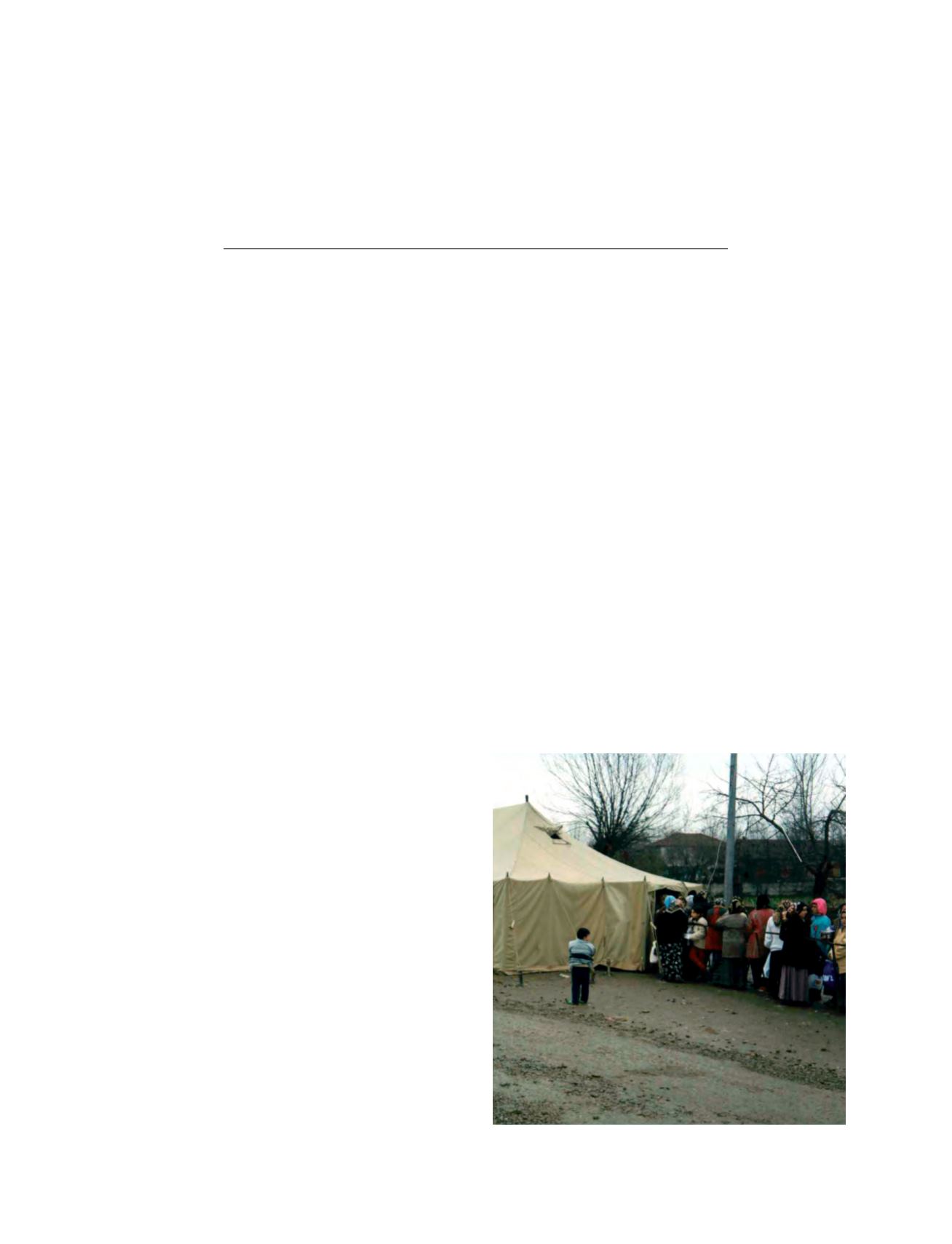
Vulnerability is a product of immediate and long-term disaster responses
Photo: Muzaffer Baca, International Blue Crescent