



 114 / 156

for repair and retrofitting of overall building stock is possible. If this
assessment follows an initial round of rapid assessment, it can also
provide a more conclusive evaluation of structural safety. Unlike the
rapid assessment, the procedure for detailed assessment varies for
different kinds of construction and building types.
Engineering evaluation of buildings is required to determine the
structural adequacy and integrity or distress of a structure or selected
elements prior to undertaking retrofitting, strengthening or repair.
The decision to conduct an engineering evaluation is mostly the
responsibility of the building owner, due to the cost and time
involved in the process.
Structural elements to be considered for building damage
assessment
It must be recognized that different natural hazards have a differ-
ential impact on structures. Cyclones, with their high-speed winds,
impact lighter elements of a structure such as the roof (especially if
pitched), wall cladding and openings, while the heavy rains and
floods that often accompany cyclones affect the foundation.
Cyclones also often render the surrounding area unsafe by uproot-
ing power supply lines and trees.
In floods the level of physical vulnerability of a structure depends
on its capacity to withstand the prolonged inundation, and pressure
from water in case of flash flooding. Building damage assessments
following floods must integrate an assessment of components such
as the building’s foundation (or in case of some flood-prone areas the
stilts that prop the structure) and walls. Floods are also accompa-
nied by secondary hazards such as ground settlement.
In the event of earthquakes, every structural and non-structural
element needs to be examined carefully for damage. Damage to
vertical load-carrying elements such as columns and walls due to the
ground shaking is often the most dangerous, since this may cause
building collapse. Hence, particularly in the case of earthquakes,
columns need to be critically examined for vertical, diagonal and
cross cracks (wide or hairline width). In some cases, there may be
uneven settling of ground due to liquefaction, which can severely
impact the structure.
Policy and institutional considerations in damage assessment
While building damage assessment is undertaken after most major
disasters, not many countries have taken the necessary measures
for institutionalizing a scientific and consistent approach toward
building damage assessment in Asia. Gujarat state in India is one of
the few pioneers in having initiated the process of developing and
institutionalizing a methodology for damage and loss assessment.
Having the necessary human and material resources pre-
identified, trained and ready for deployment at any time is essen-
tial for an effective and efficient damage assessment system. Since
building damage assessment requires expertise in structural and
civil engineering, it is often useful to establish and maintain
contact with local engineering chapters or associations, which
can provide volunteers for undertaking such an exercise when
required.
As stated, one of the key functions of building damage assess-
ment is to point towards appropriate future policy with a view to risk
reduction. In many Asian countries, building codes are available,
but are either not mandatory or not complied with. Assessment
including engineering evaluation can ascertain the exact elements
of the construction that did not comply with building codes, conse-
quently causing structural failure and damage to the building. For
example, corner reinforcement of buildings in an earthquake-prone
region may be specified in the code, but might be frequently ignored,
resulting in cracking or collapse at the corners of buildings in an
earthquake.
Building codes tend to be exhaustive; therefore, such assessment
based on identification of typical failures would indicate precisely
which aspects of the code should be emphasized in future construc-
tion policy to avoid repetition of similar failures. Justification for the
enforcement of such policy could draw upon the findings of the
damage assessment. It could also form the basis for public aware-
ness, skills development and capacity building of professionals and
construction workers, and spontaneous compliance with codes,
leading to the mainstreaming of hitherto neglected aspects of the
building codes.
A similar scenario applies in the case of building regulations. Even
though, unlike building codes, these are mandatory, the vast major-
ity of owner-built constructions pay little heed to such regulations.
Enforcement is often lax and subverted by corrupt dealings between
building owners and authorities. A clear, scientifically-driven damage
assessment can be a powerful tool toward reversing this process by
demonstrating the adverse consequences of overlooking or avoiding
building regulations. Additionally, where adequate building regula-
tions have not been in place, the assessment would provide
directions for formulating relevant regulations based on the nature
of damages, and where applicable, be a basis for revising existing
regulations.
Similarly, existing land use plans are often not followed properly
– for example, an area demarcated for agricultural use might be
used for housing by building unauthorized settlements. When a
flood occurs in such an area, the property damage and economic
loss might be significant compared to what it would have been if this
was an agricultural area – benefits might even have been gained in
terms of crop irrigation. In such cases, damage assessment may
allow revision and reorganization, or the formulation of new land use
plans based on its findings and future risk reduction considerations.
At a more refined level, it may demonstrate the risk and possible
futility of settlement in areas earmarked hazardous through hazard-
zoning. Such hazard-zoning, not only on the macro-national level,
but also micro-zoning within cities, exists in some Asian countries.
However, people are often unaware of the risk of living in areas zoned
as hazardous until a disaster does strike. An opportune moment
then arises to build awareness for more selective settlement patterns
and policies, facilitated by and demonstrated through the findings
of a damage assessment.
[
] 114
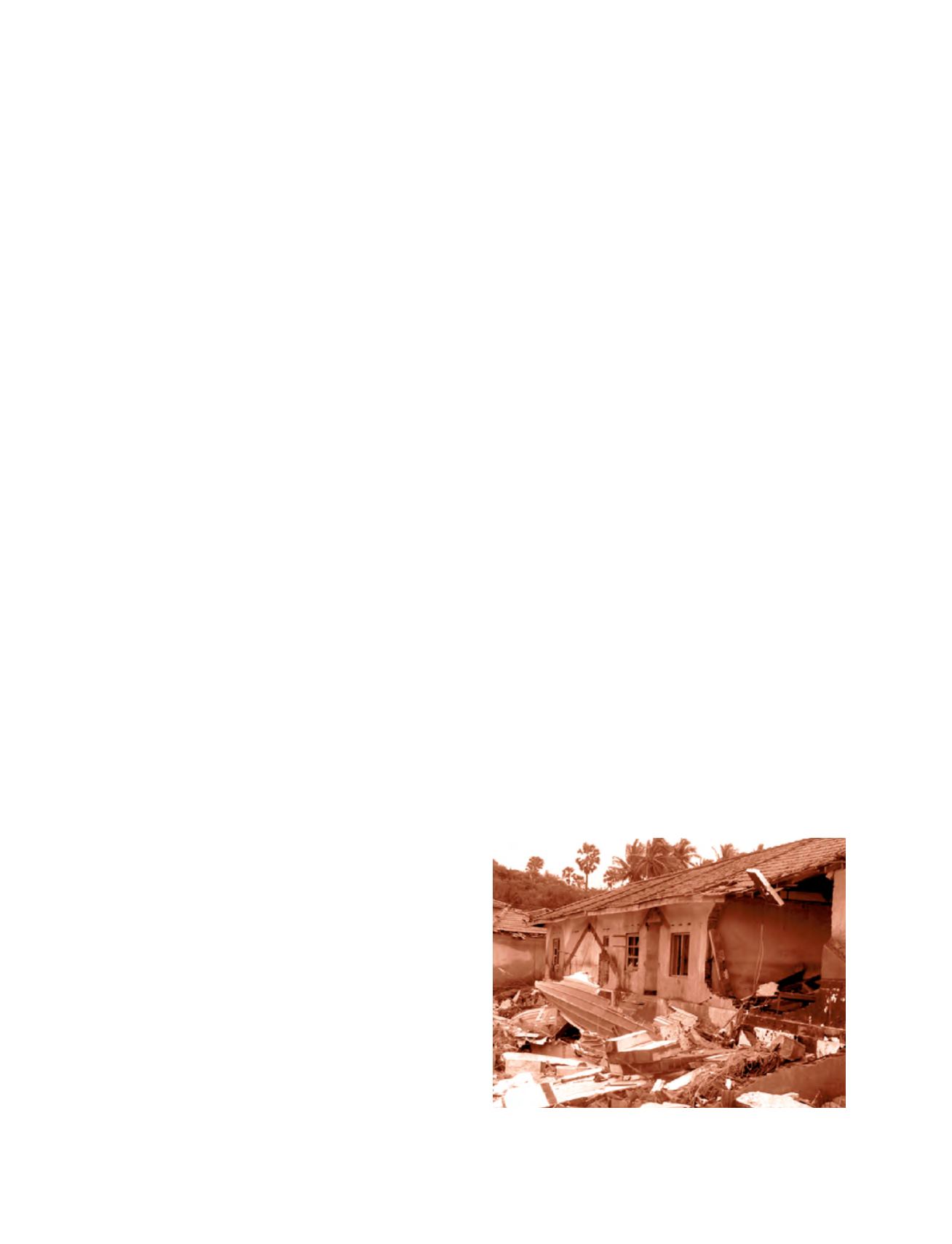
Building damage assessment may be used to identify immediate damage
and measures to prevent this in the future
Photo: Mr. N.M.S.I Arambepola