


 118 / 156

ciation help avert disaster? Under what conditions should vulner-
able historic buildings be demolished? Linking post-disaster
elements with the development of neighbourhood plans presents
an opportunity to nail down details of post-disaster reconstruc-
tion and mitigation that might otherwise escape notice.
7
While damage assessment is usually done by sector specialists,
it is essential that disaster-affected families participate in surveys
involving their housing units. A needs assessment determines the
level and types of assistance required by the affected population,
their priorities, and their preferred strategies to meet these.
Common needs include housing, livelihood, personal (injury,
handicap, bereavement, trauma), and services (water supply and
sanitation, electricity, schools, health centres). The information
helps to identify and prioritize needs, leading to appropriate assis-
tance and inputs for reconstruction in the medium and long term.
Clearly, reconstruction needs to be holistically planned – it is
not merely a question of replacing damaged building stock and
infrastructure, but also of reconstructing communities, ensuring
equity, access to resources and equality of opportunity for the
most disadvantaged members of those communities, and reduc-
ing community vulnerability to hazards.
8
Disaster assessment methodology
Technical evaluation of structural damage
– This is usually
conducted through a street-by-street, house-by-house survey to
determine the precise nature and extent of damage to all build-
ings. Damage is classified according to pre-defined categories, via
direct onsite visual evaluation of building exteriors.
It is essential that the surveyor consult with each affected family
to develop a reasonable consensus on the method and basis for
classifying the dwelling under a given damage category.
9
It is also
important to evaluate every structure within the area, even those
that are not affected. This ensures that isolated, undamaged homes
are identified and recorded, and helps pinpoint the specific cause
of damage to those that are affected. This assessment provides the
basis for the level of housing assistance allocated to affected fami-
lies, who should be informed of the results as soon as possible.
Inventory of affected assets
– This detailed survey of all losses
(assets and income) caused by the disaster is the basis for special
financial provisions given to the affected people. Categories
include shops, workshops, stalls, tools and equipment, and live-
stock. The owners or heads of households may need to
countersign the inventory to minimize the possibility of subse-
quent claims or disputed claims.
10
These detailed surveys rely on interviews with a sample of the
affected population and the collection of statistical information.
Generally, sample surveys are used for needs assessment. There
are several different sampling methods:
• Simple random sampling: Every member of the target popu-
lation is equally likely to be selected, and the selection of a
particular member has no effect on other selections
• Systematic random sampling: Every fifth or tenth member
on a numbered list is chosen
• Stratified random sampling: The population is categorized
and members from each category are selected by simple or
systematic random sampling before being combined to give
an overall sample
• Cluster sampling: Restricted to a limited number of geograph-
ical areas (‘clusters’), from which samples are selected by
simple or random sampling. Sub samples are then combined
to give an overall sample.
Rethinking post-disaster reconstruction implies establishing or
strengthening the management systems of tangible and intangi-
ble, ‘historical’ and ‘living’ dimensions of cultural sites and
establishing systems that address risks to sites and property in
an integrated manner through preparedness before, during and
after disaster situations. After all, integrated risk management for
a living culture is about addressing the knowledge and skills accu-
mulated in the past, surviving in some form in the present, and
with a potential for reducing disaster vulnerability and increasing
capacity for the future.
It is about linking past, present and future by managing change
with a proactive approach that addresses the underlying causes
of a disaster in both pre- and post-disaster situations. An inte-
grated framework for risk management addresses the larger forces
that put cultural heritage at risk. Risk preparedness initiatives can
be strengthened by integrating the needs of living heritage with
existing disaster management systems at national and state levels.
This requires re-addressing existing development policies and
their impact on risks to cultural heritage.
Risks are a shared reality facing individuals, villages, districts,
even regions. Responses must be multi-pronged – no single initia-
tive can address risks to cultural heritage. Rather, there must be
multiple initiatives at various administrative levels through the
involvement of multiple public and private stakeholders.
Dialogue, collaboration and coordination are essential to this
vision.
[
] 118
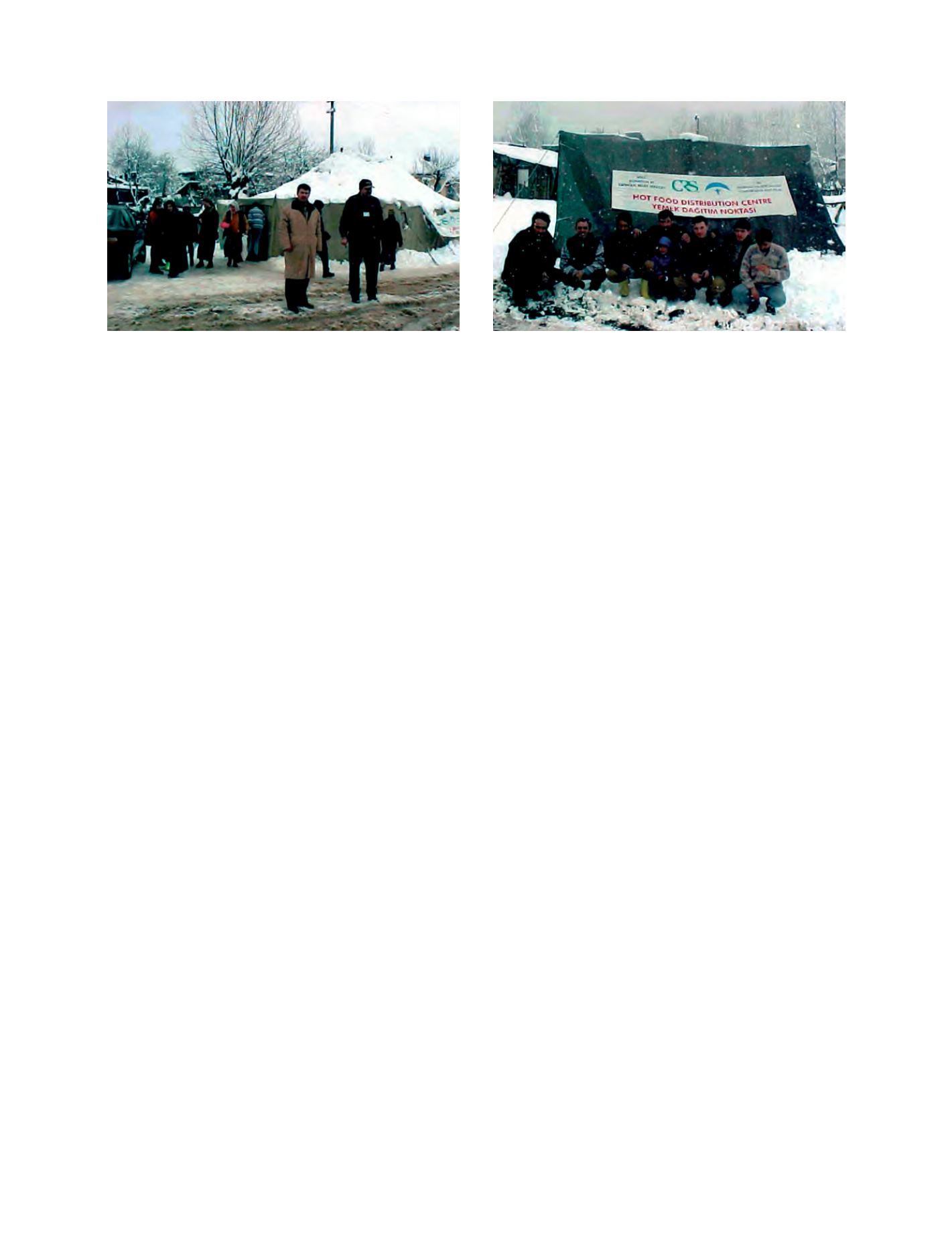
Participating in neighbourhood development can help raise
awareness of the need for preparedness and mitigation
Community ownership of preparedness measures
helps to reduce vulnerability
Photo: Muzaffer Baca, International Blue Crescent
Photo: Muzaffer Baca, International Blue Crescent