


 124 / 156

damage caused by floods and storms to housing and public infra-
structure is usually unnecessarily high. It can be avoided at a far
lower economic and social cost than that of post-disaster recon-
struction. Reconstruction of a typical central Vietnam 40m
2
house
costs USD950. But spending just 15-30 per cent of this sum spent
on preventive strengthening would make the same house resistant
to the effects of most floods and storms. The same applies to
small communal facilities.
DW
6
has worked with poor and vulnerable communities along
the storm-exposed coast of central Vietnam, encouraging fami-
lies to strengthen their homes, training builders and community
leaders in safe construction techniques, developing management
capacity at commune leadership level, and involving children in
safety and disaster prevention issues.
On a technical level, families are encouraged to apply the ‘ten
key points’ of flood and storm resistant construction, which apply
to almost any house or small public building, and to all but the
frailest of homes. Each point addresses a specific risk and indi-
cates the action required: separate the veranda roof from the main
roof; use doors and shutters to seal the building; fix together all
parts of the structure; firmly secure the roof covering; etc. Builders
and community leaders are trained to apply the safety points to
different situations as demonstrated on existing houses and small
public buildings.
Participating in preventive strengthening
If individual families are to strengthen their homes, technical
solutions have to be compatible with local house styles, in order
to develop acceptance. Each house is surveyed, followed by a
discussion of its weaknesses, a suggested work programme and
costs. A contract is then drawn up with the family and the
Commune Damage Prevention Committee (CDPC), detailing the
work and defining the contribution of each with DW support.
No two buildings have the same strengthening needs. The project
typically contributes about USD150 per family. The family covers
the remaining costs, sometimes by borrowing, and if necessary
using hired skilled labour. The CDPC can help families with diffi-
culties, for example those headed by widows. All but the very
poorest families contribute both in kind and financially to the
cost of strengthening, and many go on to make additional
improvements since they now have confidence in their home.
Early in the programme, beneficiary enthusiasm was such that
families resorted to borrowing from usurious moneylenders in
the absence of a credit system specifically addressing house
strengthening. This caused hardship, and DW concluded that
the project needed to demonstrate that credit for house strength-
ening can work. Credit programmes relate more commonly to
income generation activities, but in DW’s experience, strength-
ening the house is considered just as important an investment.
Families have been ready to borrow sums of USD100-150 and to
make regular repayments (over 18 months). Terms are tailored
to means: 0.3 per cent monthly interest with flexible payment
conditions, depending on the rhythm of family income. The credit
system has been managed by the CDPC in collaboration with the
Women’s or Farmers’ Union, and repayment rates are consis-
tently good. DW wants other organizations, including banks, to
note that poor people do repay loans for house strengthening,
thus propagating similar credit opportunities.
Financial commitment by families is important to the success
of DW’s strategy: it shows the degree of their belief in the value
of strengthening their homes. Women head 40 per cent of the
beneficiary families. Women often make the decision on whether
to borrow, and are also key actors in changing the attitude of fami-
lies to make prevention a priority in housing improvement and
construction.
Families also need professional skills to help in preventive
strengthening. DW runs concise two-day training sessions for all
construction workers in a commune. Community representatives
also attend so they can explain and discuss strengthening houses
and public facilities. For many, these workshops are the first time
[
] 124
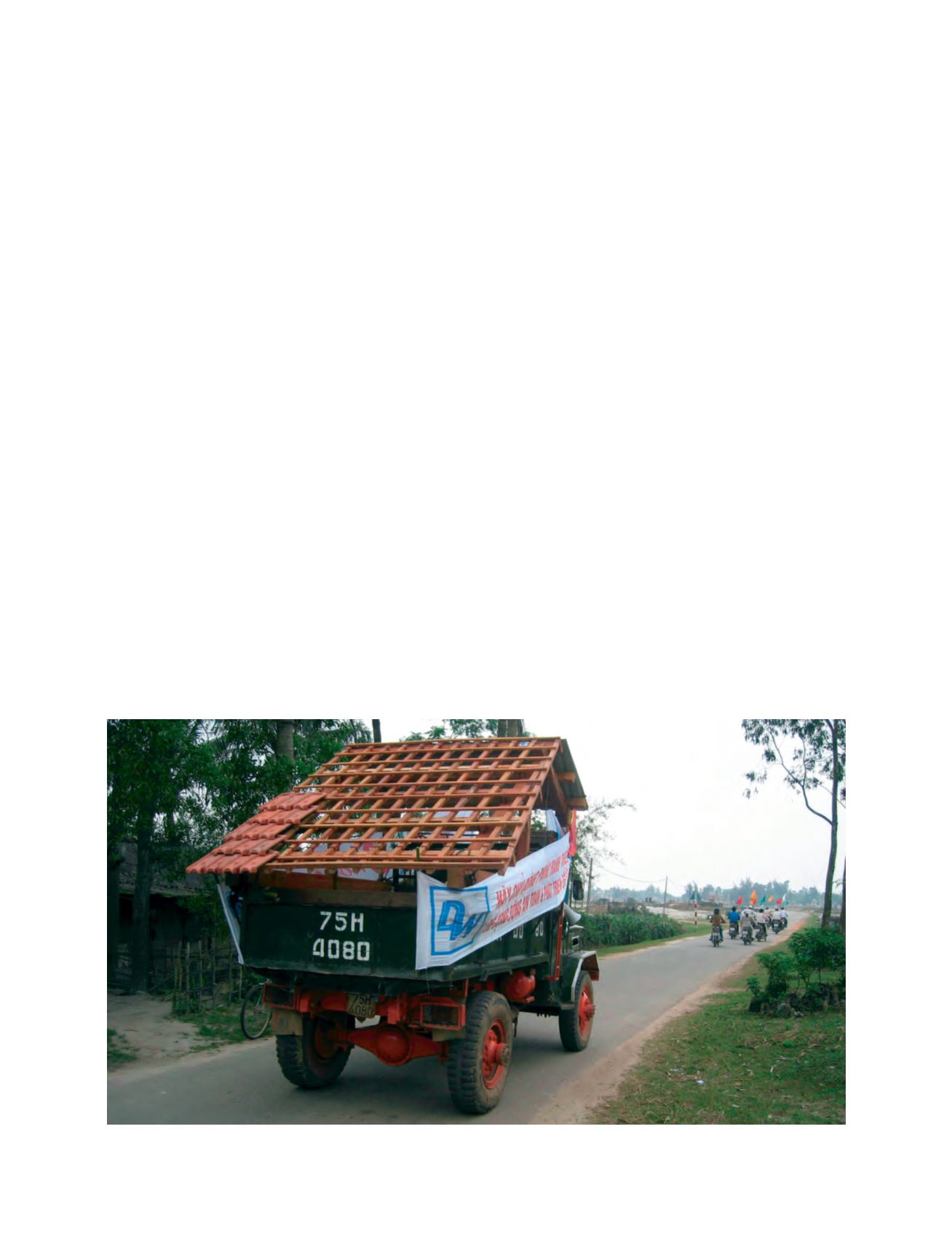
A model house travels the communes
Photo: Development Workshop