


 129 / 156

Strength assessments and computer analyses of this class of
building have indicated an increased seismic risk for buildings of
two or more storeys, which lack both strength and ductility. This
vulnerability is partly due to irregularities in planning and eleva-
tion, non-uniform distribution of load-bearing elements,
disproportionate door and window openings and, above all, poor
construction practice and lack of attention to reinforcement
details. Vulnerability can be significantly reduced via the seismic
strengthening of these buildings.
Assessment and retrofit techniques for reinforced concrete
buildings have been extensively studied and implemented in
developed countries, with a clear focus on engineered construc-
tions. Conventional techniques use braces, jacketing or infills,
and more recent approaches include base-isolation and supple-
mental damping devices. These techniques, prevalent in
developed countries, have rarely been implemented in develop-
ing countries like Nepal. Rather, the construction of the ‘frame’
type of buildings, as discussed above, is rapidly growing in an
unplanned manner. Instead of reducing vulnerability, these struc-
tures are creating more and more risk every day. The National
Building Code was recently made mandatory in three munici-
palities of Nepal, but is yet to be enforced practically.
New, non-engineered constructions can be made safer by cost-
effective methods that can be adopted even in developing
countries. Seismic vulnerability reduction requires a differential
approach between residential buildings in which the safety of
lives is of primary concern, and buildings that house critical or
community facilities, such as hospitals and schools. These rules
obviously do not aim to prevent all damage from moderate or
large earthquakes, but they do help to prevent life-threatening
collapses and aim to limit damage to reparable proportions. We
need to be concerned about the lack of awareness regarding the
availability of simple solutions and their effectiveness in achiev-
ing seismic safety as a preventive measure at minimum cost for
all communities.
Improving the seismic performance of existing buildings is a
more complex task. There has been very little study concerning
vulnerability evaluation and practical methods for reducing vulner-
ability in existing non-engineered buildings. Suitable retrofitting
techniques must be developed, and alternative intervention
methods found. A simple, easy-to-use, efficient retrofitting scheme
can be developed that can readily be adopted by local people in
order to develop and enhance the safety of communities.
This requires a thorough understanding of the potential ‘weak
links’ in the structure, based on which the designer can devise
repair and strengthening measures for improving the building’s
response during future earthquakes. It is advisable to adopt wall
jacketing for buildings of two to four storeys as a strengthening
measure to improve their response in large earthquakes.
Similarly, for buildings of four or more storeys, wall jacketing
may not suffice and alternative measures such as the addition
of reinforced concrete structural walls at appropriate locations
should be adopted. These methods can significantly increase
the resistance of a structure to lateral forces, although estab-
lishing a sound bond between the old and new concrete is of
great importance. This can be achieved by chipping away the
concrete cover of the original member and roughening its
surface, by preparing the surfaces with glues (for instance, with
epoxy prior to concreting), by additional welding of bend-rein-
forcement bars, or by reinforced concrete or steel dowels. The
approximate cost of such interventions is estimated at between
NP1,500 and NP4,000 (USD20 to USD60) per square metre,
against NP11,000 (USD160) per square metre for new construc-
tions. However, the actual cost for retrofitting methods depends
on the number of storeys the building has, and the method of
strengthening adopted, which is determined through detailed
analysis and design.
Out of the various available methods, these are considered to
be the most practically feasible and economically viable, and are
the most widely used methods worldwide, although more expen-
sive alternatives are also available. These options address the
needs of a vast majority of Nepalese people. These simple and
economic techniques can be applied on a wide scale in Nepal
and other regions. What is most urgently required in the present
context is to educate the general public about earthquake risk
and advocate safer building practices.
[
] 129
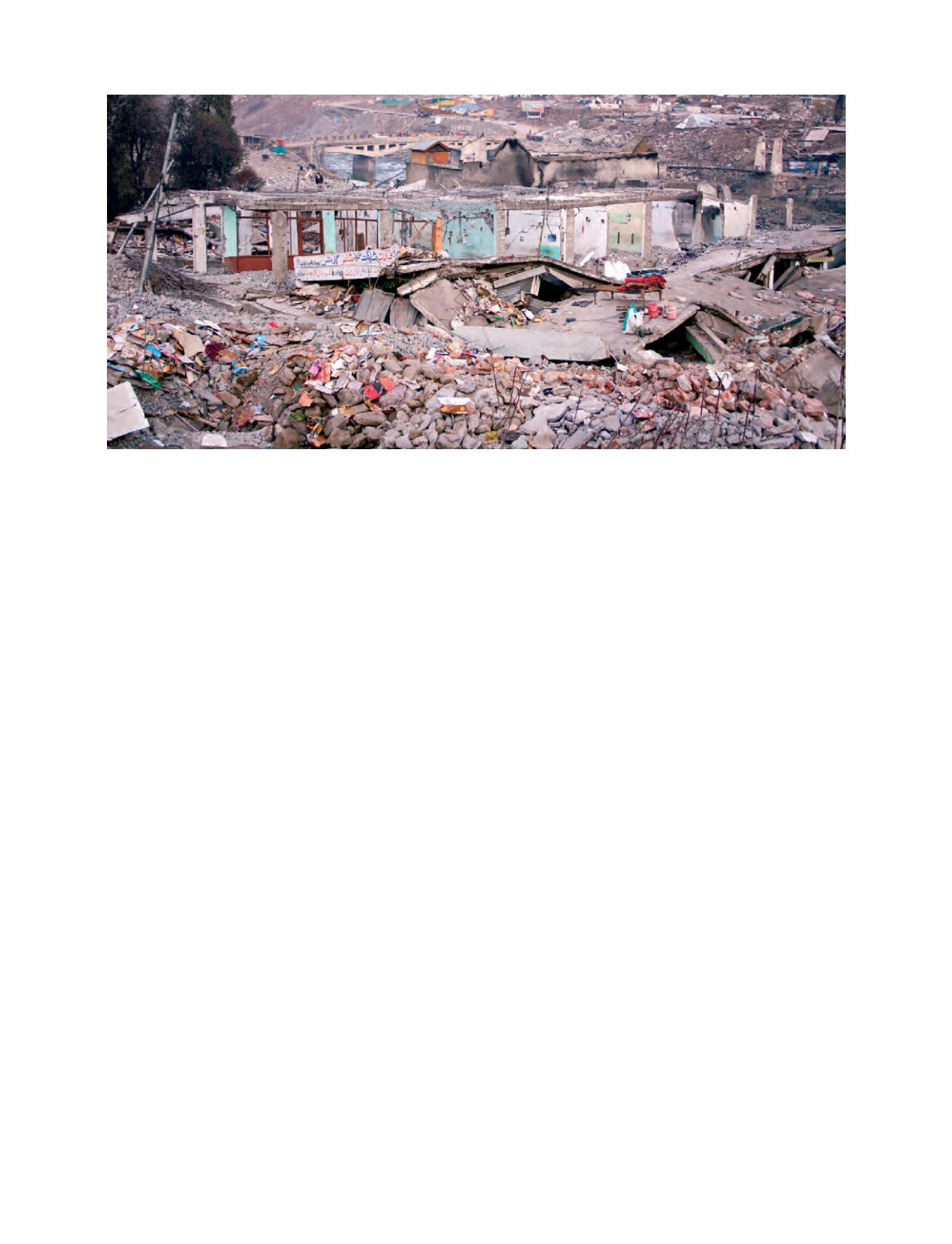
Retrofitting requires a thorough understanding of a structure’s potential weaknesses