


 128 / 156

[
] 128
M
OST OF THE
lives lost in past earthquakes have been
due to the collapse of buildings. In developing coun-
tries, these are generally non-engineered buildings
constructed informally in the traditional manner with little or
no intervention by engineers. Across the world, in zones of
moderate to severe seismic risk, more than 90 per cent of the
population still lives and works in such buildings.
1
In view of
this, the safety of such structures from the fury of earthquakes
is a subject of the highest priority.
In developing countries, the risk to lives is further increasing
also due to rising populations, poverty, lack of awareness and a
lack of the necessary skills and technology for safe construction.
The scenario is the same for buildings in all parts of Nepal.
Nepal lies in a ‘high’ seismic zone along which the Indian plate
is subducting under the Eurasian plate. Many large earthquakes have
occurred consistently in the past, with Kathmandu having suffered
devastation due to large earthquakes several times since 1833.
Due to the concentration of economic, political, administra-
tive and cultural activities in Kathmandu Valley, the demand for
buildings has increased tremendously, leading to unplanned
development which has in turn resulted in an ever-increasing
vulnerability to earthquakes. According to a study by the
National Society for Earthquake Technology in Nepal under the
Kathmandu Valley Earthquake Risk Management Project
(KVERMP) in 1998, an earthquake measuring 9 on the
Medvedev-Sponheuer-Karnik (MSK) seismic intensity scale in
Kathmandu Valley today would cause over 40,000 deaths, over
95,000 injuries, leave more than 700,000 homeless, damaging
60 per cent of the existing building stock beyond repair. The
main risk factors are low awareness, lack of proper knowledge
and technology dissemination mechanisms, and a high popu-
lation density accumulated in haphazardly constructed
buildings without any consideration of earthquake risk. Despite
the knowledge of historical seismicity, and continued geologi-
cal researches in the Nepal Himalayas, implementation of
earthquake risk management efforts is poor.
As a result of rapid urbanization and continuously rising land
prices, building height has increased tremendously in recent
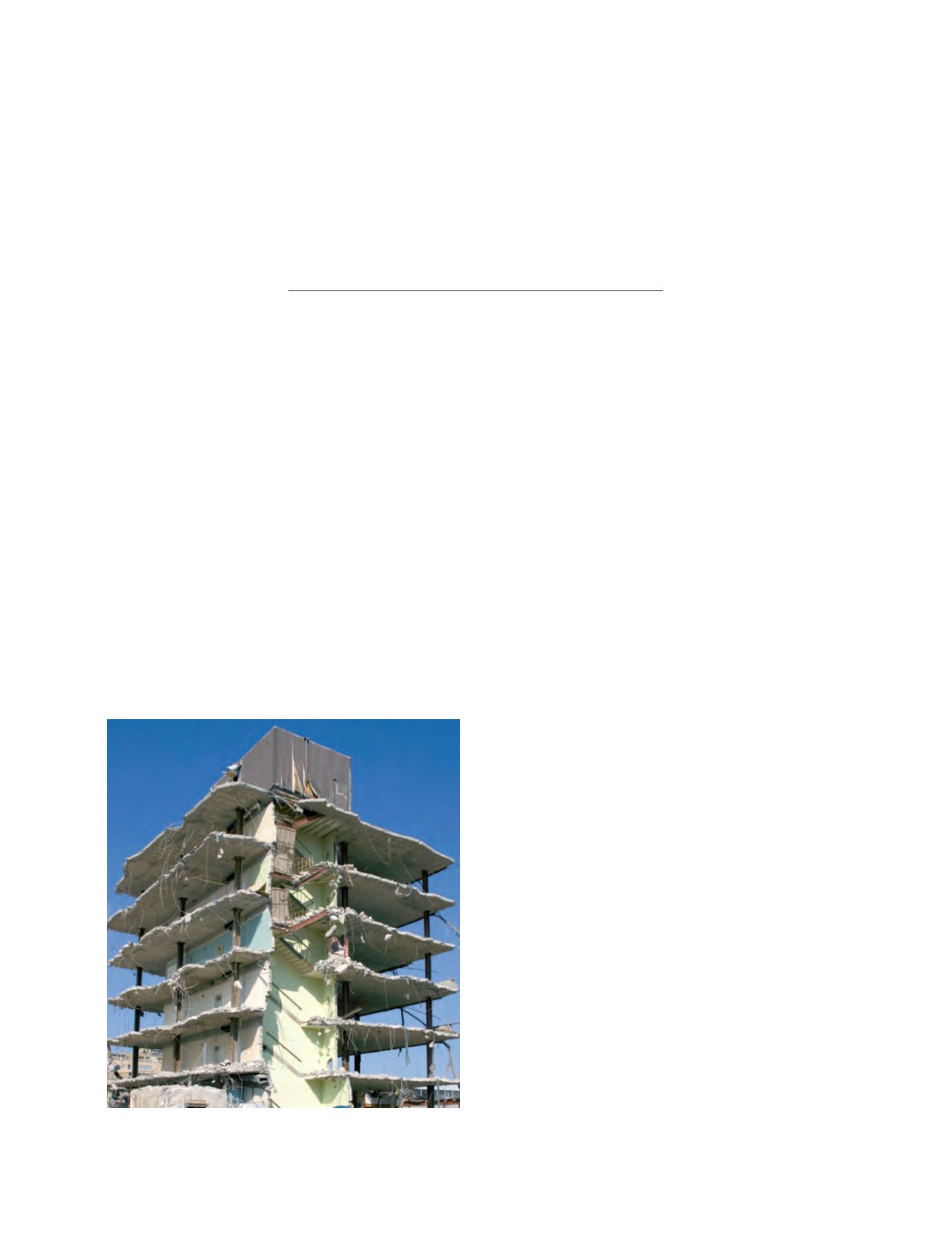
times. Reinforced concrete framed building with masonry infill
has become the most the common construction system, account-
ing for about 25 per cent of the buildings in urban areas of
Nepal.
2
However, most of these buildings are not designed and
constructed to meet the seismic requirements specified by the
National Building Code. Many of them do not even meet the
requirements for vertical load design. Disproportionate height
and large occupancy means that most of these buildings pose
significant risk in urban areas. The situation is worse in inner city
areas, which have narrow streets with tall buildings on both sides.
Rescue and relief operations may encounter problems during
large earthquakes. The tendency to neglect seismic design recom-
mendations in building reconstruction, repair and refurbishment
has dramatically increased the percentage of highly vulnerable
structures within the existing stock. The National Building Code
addresses the earthquake resistance of new constructions only –
it does not advise on the seismic strengthening of existing build-
ings. The most recent earthquake events (Bhuj, 2001; Turkey,
1999; Iran, 2003 and Pakistan, 2005) showed that this class of
building suffered catastrophic damage, causing larger-scale losses
of life and property. Therefore, the seismic retrofit of these build-
ings is a pressing need, especially given the fact that a large
earthquake is considered overdue in Nepal.
Vulnerability and risk reduction:
existing non-engineered buildings
in urban areas of Nepal
Hima Shrestha, Structural Engineer, National Society for Earthquake Technology, Nepal
Rapid urbanization has increased the height of buildings,
but not their safety