


 132 / 156

[
] 132
Tropical cyclones (the generic term for hurricanes and
typhoons) and, to a lesser extent, weaker storm systems like
Katrina, are difficult to measure. To relate the radar energy return
to actual wind speed, scientists compare measurements taken
from buoys and other ground stations with data acquired by the
satellite at the same time and place. Because the high wind speeds
generated by cyclones are rare, scientists do not have the corre-
sponding ground information to know how to translate satellite
data for wind speeds above 50 knots (about 93 km/h or 58 mph).
Also, the unusually heavy rain found in a cyclone distorts the
microwave pulses in a number of ways, making a conversion to
accurate wind speed difficult. Instead, the scatterometer provides
a nice picture of the relative wind speeds within the storm and
shows wind direction.
Although Katrina was a catastrophic event that we won’t want
to see any time soon, the forecast provided by NOAA was timely
and accurate. That is why it is important to consider the social
aspects of weather forecasting where a good forecast may not
necessarily be enough to prevent catastrophe. It will be just as
important to consider how people respond to events as well as
how people prepare for events.
The future holds much for science and technology and their
application to social needs. NASA’s Applied Sciences programmes
in Earth science are central to three important presidential initia-
tives, the Climate Change Science Programme (CCSP), Global
Earth Observation (GEO), and the Oceans Action Plan.
In the next ten years, NASA will deploy the next generation of
advanced observation and research capabilities:
• The National Polar Orbiting Operational Observing
Environmental Satellite System Preparatory Project (NPP)
will extend the data record of essential measurements begun
by EOS and demonstrate new instruments
• The Cloudsat and CALIPSO missions will use advanced radar
and laser technologies to observe three-dimensional struc-
tures of clouds and aerosols
• The Glory mission will help researchers characterize aerosol
properties
• The Global Precipitation Measurement mission will extend
global and more frequent coverage demonstrated by TRMM
• The Ocean Surface Topography Mission (OSTM), a joint
project with France, will take the next step towards opera-
tional ocean altimetry
• The Orbiting Carbon Observatory will take the first measure-
ments of the global distribution of carbon dioxide, a key factor
linking global ocean circulation and climate change.
NASA’s partnerships in global modelling and data assimilation over
the next decade will shorten the distance between observations and
answers regarding important questions, and continue the efforts in
benchmarking the assimilation of NASA research results into policy
and management decision support tools for environment, economy,
safety, security, preparation and response for the next big event.
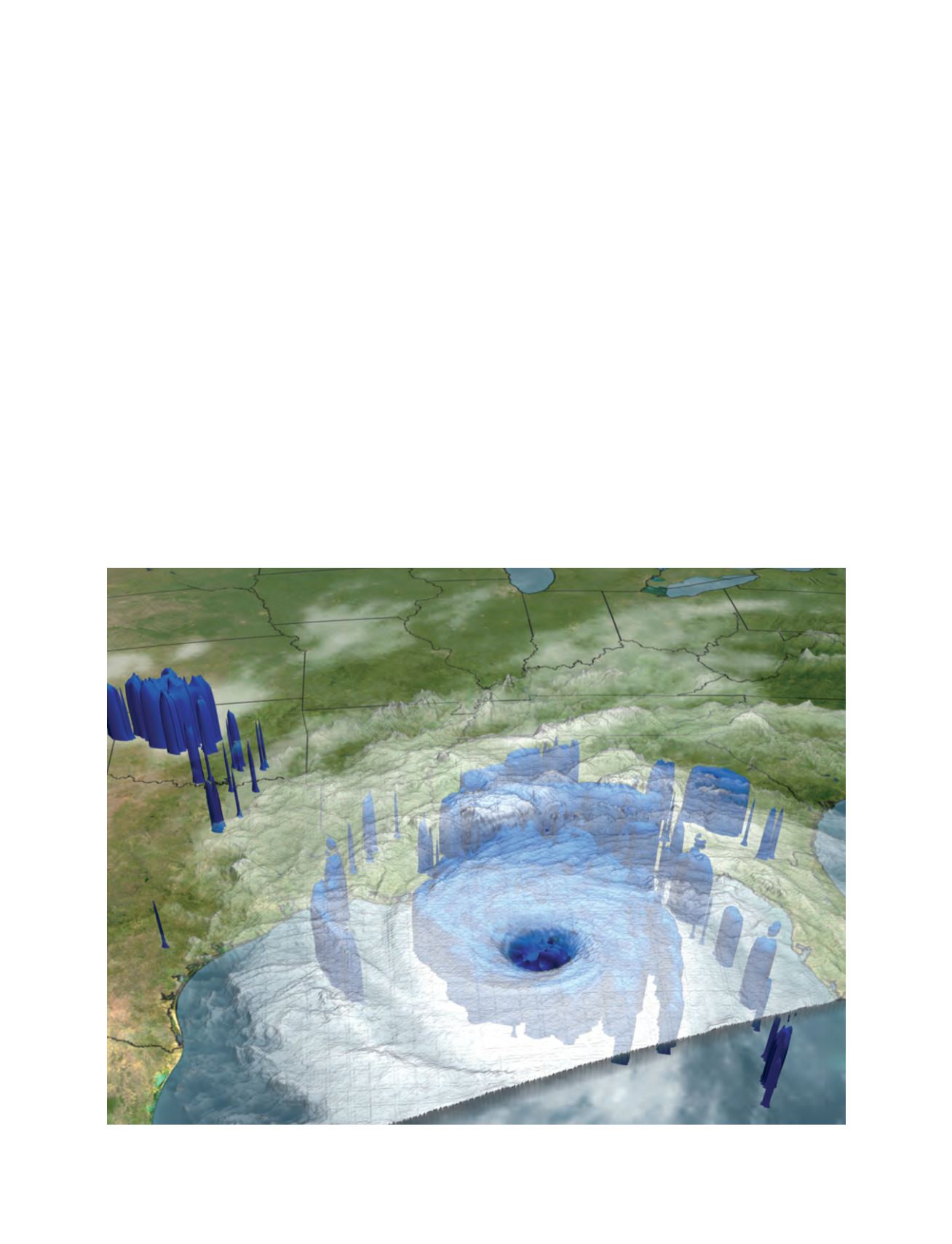
TRMM image of Hurricane Katrina, 29 August 2005
Image: NASA