


 138 / 156

[
] 138
W
HEN THE
U
NITED
Nations General Assembly held the
World Summit on Sustainable Development (WSSD)
in Johannesberg, South Africa in September 2002, it
was clear that progress in implementing sustainable develop-
ment was lacking. Sustainable development, as described at the
WSSD, indicated the need to implement rather than debate
solutions. Instead of a political debate, the 2002 meeting turned
out to be a summit of actions and results, where it was under-
stood that there is no ‘magic bullet’ to solve the problems of
developing countries, particularly Africa, and that practical and
sustained steps are needed to address many of the world’s most
pressing problems for sustainability and societal benefit.
The WSSD should be used as a benchmark for governments to
establish key performance indicators in committing themselves to
implementing safe minimum living standards, which are neces-
sary to ensure quality of life and environment, especially for the
poor. The summit was described as a “successful effort” by United
States Secretary of State Colin Powell, who said: “I think it shows
that we have a shared vision of how to move forward. I think it
shows that the world is committed to sustainable development.”
He added, however, that the real challenge lay “in the actions that
need to take place in the months and years ahead”.
NASA is responding to this call for action by initiating a
community-wide inventory of NASA research and applications that
can be used by African countries and organizations to address their
societal problems. There may be many such investments involving
the continent of Africa, whether through validation of NASA science
products or through their application in solving real-life societal
problems. These are NASA investments and may be made either
through the Research and Analysis (R&A) or Applied Sciences
programmes as competed or earmarked grants, or independently
funded from a NASA centre to a university partner.
This inventory will be used to gather information useful to
the development of a comprehensive NASA programme for
sustainable development where NASA investments are made
efficiently for global benefit.
Background to NASA’s involvement
The WSSD brought together tens of thousands of participants,
including heads of state and government, national delegates
NASA’s plan for sustainable development in
response to WSSD goals and objectives
Shahid Habib, NASA Goddard Space Flight Center, Greenbelt, Maryland
Stephen Ambrose, NASA Headquarters, Washington, DC
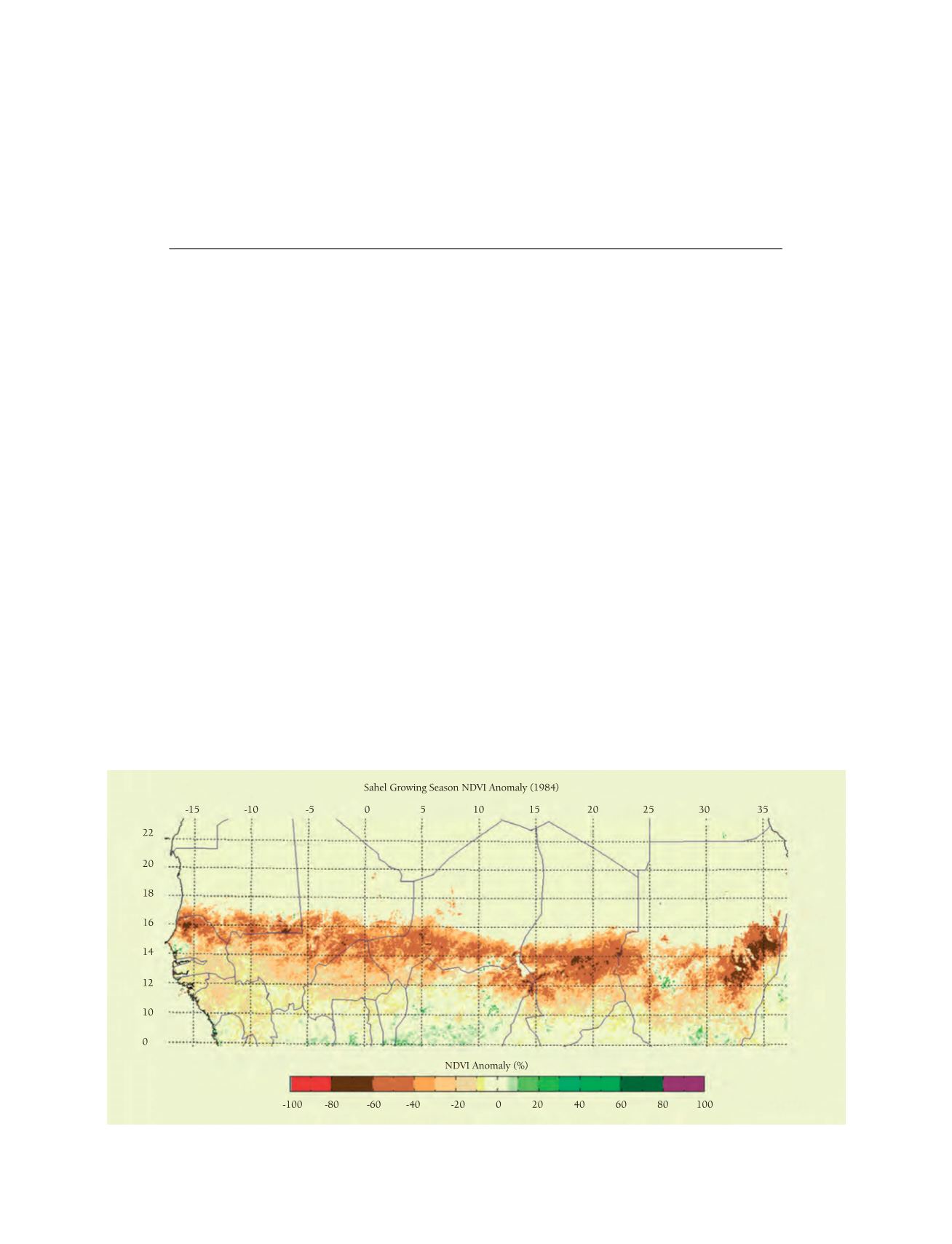
Source: Anyamba and Tucker, 2005
Growing season (July-October) normalized difference vegetation index (NDVI) anomaly for 1984 showing large-scale drought
across the Sahel zone of Africa. Most of the region experienced persistent drought conditions throughout the 1980s