


 144 / 156

[
] 144
Macroeconomic and financial modules were developed to
assess the impact on various sectors of the state economy; the
fiscal implications for the state budget; and for making sugges-
tions on cost-effective risk financing and risk transfer
arrangements.
The probabilistic drought risk assessment model ensured
accurate and extensive drought risk assessment with statistical
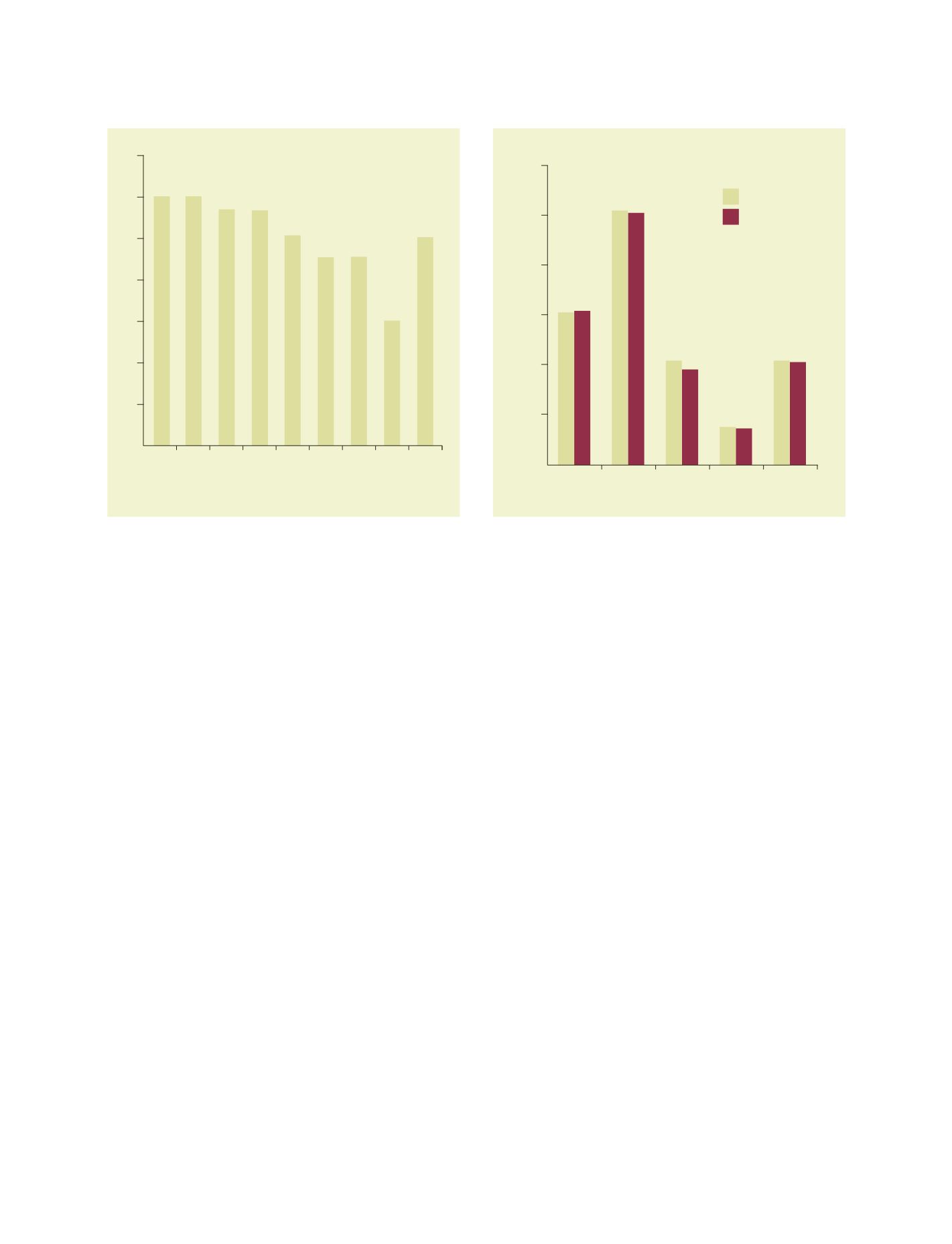
outputs, such as average annual loss (AAL), and loss exceedance
curve (LEC) calculations. It further formed a powerful tool to
investigate the impact of risk coping strategies and climate
scenarios on crop yield and production in each block of the
drought-prone districts selected for the study.
The model was calibrated using local experience in manage-
ment practices and crop phenology in the selected districts. Its
validation proved extremely successful for the five major crops
grown in these districts, i.e. paddy, maize, jowar (sorghum),
sunflower and groundnut.
Droughts generate significant indirect losses, as compared to
direct losses in crop production. These indirect losses were
estimated through a macroeconometric and an input-output
analysis. A critical task was to link drought risk analysis at the
block level for the selected districts to the statewide macroeco-
nomic analysis. A prototype macroeconometric model was
developed to explain how the variability of the value of crop
production in selected districts impacts the variability of the
state gross value added (GVA) in the main economic sectors of
Andhra Pradesh. The input-output model, the first ever devel-
oped for Andhra Pradesh, was used to provide details of the
linkages between the different sectors and sub-sectors of the
economy, the flow of goods and services, and employment.
Contrary to rapid onset disasters, droughts normally lack
highly visible impacts. Instead, their impacts are generally
nonstructural and spread over long periods and large areas.
Therefore, though our approach broadly followed the general
catastrophe risk-modelling framework used for assessing the
impacts of rapid onset disasters (such as cyclones, floods and
earthquakes), it was customized to be applicable for slow onset
events.
Case study 3: Addressing vulnerability to climate vari-
ability and climate change – an integrated modelling
system development
Nearly two-thirds of India’s population lives in rural areas and
is greatly dependent on climate-sensitive sectors such as rain-
fed agriculture, forestry and fisheries, which are highly
vulnerable to current climatic variability, particularly floods and
droughts. Moreover, agriculture represents a core part of the
Indian economy and provides food and livelihood activities to
a major portion of the Indian population.
While the magnitude of the impact of climate change varies
by region, it generally has an impact on agricultural productiv-
ity and shifting crop patterns.
The overall objective of this study was to assess the impact of
climate change, which in turn would help determine how the
climate is expected to change at the regional level; what will be
the projected impact of increased climate variability and climate
change on water and agriculture resources; which regions are
vulnerable to climate-induced changes in water resources, and
the impact of these on agricultural crops.
The study was carried out for three regions of India: Pennar
basin in Andhra Pradesh, Lower Mahanadi basin in Orissa, and
the Godavari basin in Maharashgra.
An integrated modelling system (IMS) was developed to estab-
lish functional links between water and agriculture resources.
Under this study, water and main cereal crop productivity was
assessed with an emphasis on water management to clarify its
vulnerability to climate change. The assessment included:
• Baseline climatology and meteorology
Anantapur
1%
0
2%
3%
4%
5%
6%
7%
Mahabubnagar
Cuddapah
Kurnool
Rangareddy
Chittor
Nalgonda
Prakasam
8 districts
AAL of production value as a percentage of normal year for each of the
selected eight districts and also the consolidated AAL for all districts
Source: RMSI
0.5
0
1
1.5
2
2.5
3
Yield (t/ha)
Jowar
Rice
Maize
Groundnut Sunflower
Simulated Kharif
Reported Kharif
Crop yield validation for select crops in
the Ananthpur district of Andhra Pradesh
Source: RMSI