


 147 / 156


partners from the space sector, but above all thanks to the
commitment of the local community and the mayor himself to
developing technical capacity locally to respond to local needs.
This policy mirrored precisely the mission of UNOSAT and led
rapidly to the setting up of a local technical centre, the Centro
de Información Geográfica de Matagalpa (CIGMAT). This
happened on the heels of the catastrophic impact of Hurricane
Mitch in 1998, and signified a new approach to using geographic
information gathered during the emergency phase in order to
benefit local populations after relief operations have ended. In a
certain way, it was a forerunner of today’s concept of early recov-
ery in the specific area of information management.
The establishment of CIGMAT was not an end in itself. It
rapidly became clear that what had caused most damage in the
area when Mitch struck was the lack of appropriate urban plan-
ning supported by geographic information. As Alain Retiere of
UNOSAT put it: “No territorial planning means no one knows
how to manage the city growth, where to build and where not
to; how to design roads and bridges; where to locate safe sites
for public services and main infrastructures.”
It was therefore necessary to create this capacity to visualize the
town and the vulnerability of the community living in it. An inter-
national project was designed together with the mayor’s office,
which requested it, and two main objectives were identified:
• Strengthen the municipal office for territorial planning
• Establish CIGMAT as a technical support centre that would
in future acquire and process the data necessary for the
municipal offices to work efficiently.
The Canton of Geneva, Switzerland, funded the project for the most
part, and some other institutions also supported the activities.
CIGMAT has been operational since June 2003. Currently it
has a staff of seven people who received training by UNOSAT.
Today Matagalpa is still regarded as a trend-setting example and
one that should be replicated as widely as possible for at least two
reasons: firstly, it is locally centred, expandable, and based on
local needs, skills and techniques; and secondly it is relatively
inexpensive.
Perhaps the most important benefit of using GIS for land plan-
ning, as in the case of Matagalpa, is the increased awareness that
local administrators gain of the need to address development in a
more holistic framework, including prevention and vulnerability
reduction. In this context GIS has a role that goes beyond the mere
technical aspect to become an objective and verifiable basis for
sensible decision-making at the local level.
In the example of Matagalpa, CIGMAT has significantly
contributed to a better understanding of the various aspects of
urban planning and how this is inextricably linked to disaster
prevention in communities exposed to endemic risk from natural
hazards. According to the then mayor of Matagalpa, CIGMAT GIS
services brought about the opportunity of an effective territorial
management plan for the city. That is a major step forward for a
region with strong demographic growth. Furthermore, the success
of a community-based GIS service goes well beyond servicing the
local decision makers. CIGMAT is often contracted to render
services to other projects as an autonomous technical support
capacity integrated in the community. As a result, CIGMAT is able
to finance part of its own work, which is an impressive fact in itself.
Locally funded services have included a Matagalpa city map and
regional tourist map as well as land use analyses for neighbouring
municipalities. This proves that GIS applications can also be cost-
effective in disadvantaged communities.
CIGMAT is now discussing with local and national authorities
and UNOSAT how to implement a regional watershed plan. This
is an ambitious task that will also involve national institutes located
on the west and east coasts of Nicaragua. By taking advantage of
the motivation and professionalism that a community-based GIS
service such as CIGMAT brings, the regional upscaling of a local
programme may soon be another success story from Nicaragua.
Based on this concluding experience, UNOSAT has built other
similar projects in African countries, always with the active partic-
ipation of local authorities and other UN agencies. As a result, a
more ambitious plan, the ‘1,000 Twinning Campaign,’ is now
taking shape. The campaign will be officially announced in
September 2006 and rests on the straightforward fact that satel-
lite-based GIS is still unaffordable in those places where it could be
useful the most for people and society.
Thus, the idea of mobilizing local authorities and donors world-
wide to take part in a global long-term initiative of cooperation
among cities to bring satellite technology down to earth. Based
upon the well-tested model of decentralized cooperation, the 1,000
Twinning Campaign will focus on communities in those geographic
hotspots known for being at high risk from natural hazards. A large
amount of data and maps has been generated so far by accumu-
lating material created during emergency response operations.
While the key is to become able to transfer coherent informa-
tion from the crisis to the reconstruction phases, it is accepted that
additional dedicated funds and capacities are necessary to cater
for GIS for disaster reduction. This is why in 2004, UNOSAT estab-
lished the Global Mapping Grant Facility, a trust fund aimed at
providing developing countries with satellite-derived products,
services and training for capacity building, to be able to integrate
GIS and satellite technology into land use management and devel-
opment planning. This trust will be used to receive funds to power
the 1,000 Twinning Campaign and ensure the overall coherence
and transparency of the programme.
It is hoped that this initiative will stimulate the driver for trans-
lating technology into useful (and usable) applications. This is not
being attempted for the first time, of course. But it is the first time
concrete applications for identifiable beneficiaries at the local level
are being pursued. The partnership proposed by UNOSAT gathers
important actors like ILO, UNDP and ISDR, as well as local author-
ities and their associations. These large players, together, could
make the difference.
[
] 147
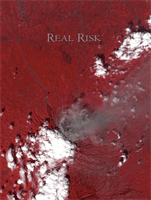
Example of urban development as seen by satellite. Note the densely
developed housing infrastructure in the centre of the image
Image: Space Imaging, distributed by INTA Space