



 125 / 156

[
] 125
that they can discuss local building issues with professionals.
Evaluations have shown that trained builders are confident about
applying the safety techniques, and ready to promote the princi-
ples of storm prevention in housing construction inside or outside
the target communes.
Getting the message across
Raising awareness among diverse groups of beneficiaries is funda-
mental to the DW approach. The basic message – prevent storm
damage – is communicated in numerous ways to different target
groups (children, families, builders, village leaders, local organi-
zations etc.). The project hammers home that prevention is
important, easy and affordable; that it is cheaper than rebuilding
after a disaster; and that anyone can get help and advice from the
CDPC. The ideas and media used are varied and draw on cultur-
ally familiar events for adults and children, such as competitive
boat races, banners and public address systems.
Much of this activity is designed to be memorable months or
years later. Concerts with local musicians, singers and poets, many
of whom perform their own material written for the project,
convey the prevention message. A series of ‘home story’ sketches
about a family has used different scenarios to encourage people
to strengthen their homes before the storm season. Performed by
commune actors and actresses, the sketches usually have a ribald
subtext, as laughter helps to make the message memorable.
DW has made a particular effort to work with primary and
secondary schools and kindergartens, discussing children’s
concerns about disasters and exploring with them what can be
done. Competitions for drawings, stories and poetry are popular
among children.
Developing a framework for prevention
Aside from this focus on family involvement, the social and insti-
tutional environment that supports preventive strengthening
cannot be ignored. Partnerships between family groups and
CDPCs have been established with DW support in each partner
commune. Activities cannot be sustained without the engage-
ment of both families and commune representatives.
Family groups are the smallest ‘unit’ in the programme and are
central to the implementation of a family-based vulnerability
reduction process. DW works at hamlet level where there is
enough social and geographical proximity to allow meetings to
take place easily. Families participate in making beneficiary selec-
tion a democratic process with an open vote for the family they
each think is most in need. Groups of families then become a
focal point for sharing information and experience.
The CDPC, set up by DW with the People’s Committee in each
commune, manages the project activities with support and guid-
ance from DW. It operates the annual budget that has been agreed
on by the commune and DW to cover the costs of activities
retained for action, including building safe public buildings such
as schools and markets, and to which the commune also
contributes financially. The CDPC is also helped to organize suit-
able activities in the commune.
Developing family-level damage prevention action planning was
a priority in 2005: the CDPC has worked alongside families and
village leaders to identify risk issues ranging from typhoons to
drought and disease. It assesses these against different forms of
human and material vulnerability and identifies what action can
be taken, with or without DW support. Each commune and
hamlet has its own concerns and priorities, and the planning
process has contributed to widening the expression of these.
Ensuring that damage prevention committees become part of
the province disaster preparedness structures is key to longer
term sustainability, and to achieve this the informal network of
partner communes is being fused into a commune prevention
network that will have stronger links with the districts and
provinces in managing prevention activities.
DW’s team has developed a programme that is changing the
attitudes and practices of different stakeholders in the community,
making damage prevention in housing a higher priority.
The diversity of activities has encouraged active involvement
from local authorities and the population; beneficiary families
are reassured by their strengthened homes; community leaders
fully understand the project’s aims and are engaged in the
process, and they recognize that by motivating people and mobil-
ising relatively small sums of money a great deal can be achieved
to reduce vulnerability. They recognize too that with a safer home,
families can turn their attention to meeting other needs with
greater assurance – they have less to lose.
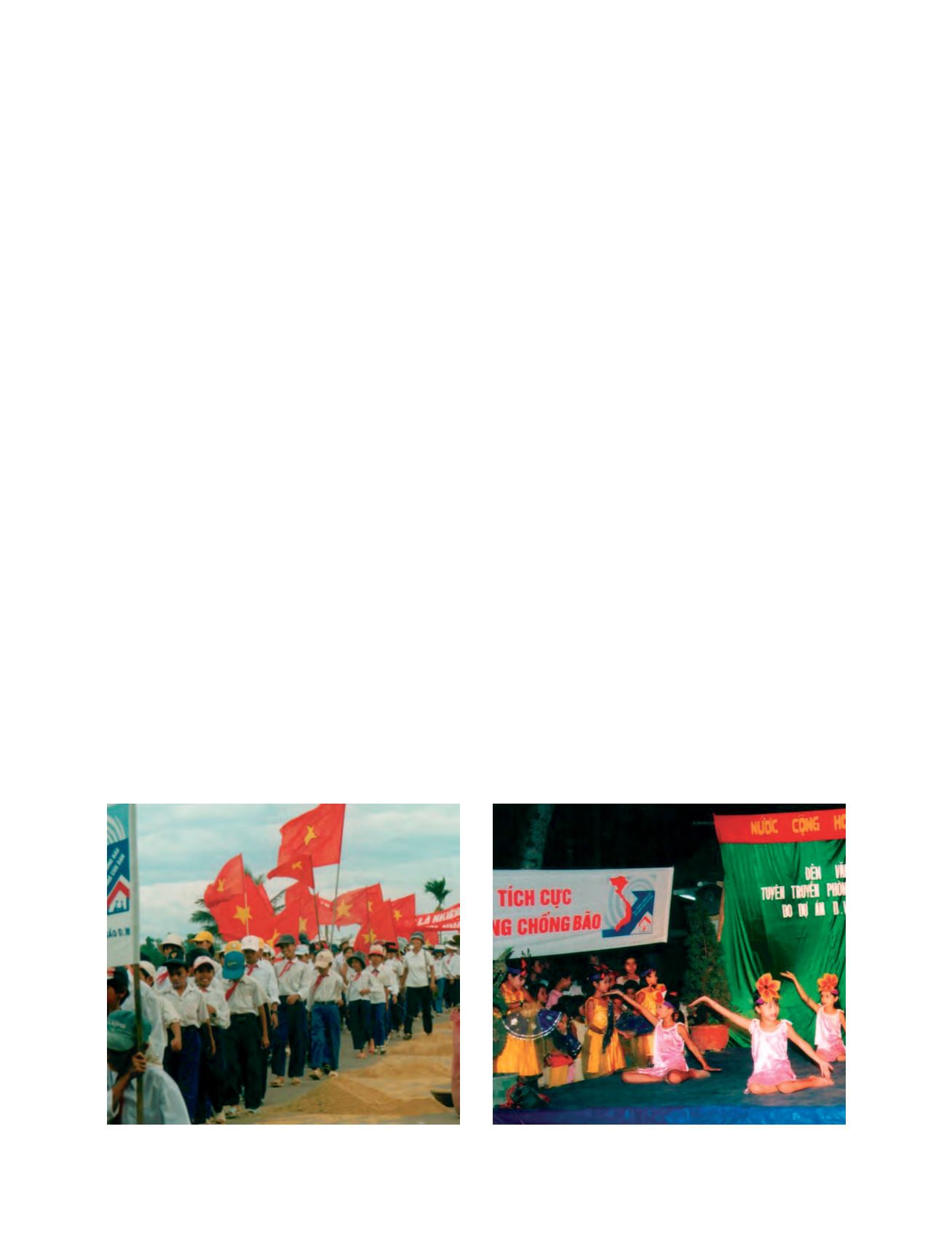
Children on a prevention march
Photo: Development Workshop
Photo: Development Workshop
Children take part in a prevention show