


 105 / 156

[
] 105
to communications – the knowledge and advice centre sent a letter
about the foundation of the IVC to all victims, sent press releases
to all national newspapers, magazines and internal ministry maga-
zines, and contacted all authorities and covering organizations
involved. In addition, a logo and corporate identity were devel-
oped, a free telephone number was published and the website was
opened.
2
The IVC could be reached every day by telephone, e-mail
and via the website.
The IVC was visited frequently during the initial months, with
most victims asking about the alternatives for assistance – for
example, Dutch people who had been involved, had returned home
or moved elsewhere, but had not yet found a new GP; or Dutch
people living in an Asian region where there was no psychological
help available. Other victims who registered were those for whom
existing aid had offered little help because of serious and persis-
tent psychological complaints. Some victims had been travelling
alone and had missed out on social support or a reference frame-
work. And there were people who had serious complaints but had
not dared to ask for help, believing that other victims with bigger
problems were more entitled to assistance.
Most victims were in need of someone who would listen to them;
complaints were defined, recognized and acknowledged.
Psychological education played an important role – it was
explained to victims how psychological complaints arise, how
natural recovery can be improved, what aid is appropriate and
where proper aid can be obtained. Sometimes there were consul-
tations with a GP about a suitable referral, which was also discussed
with aid organizations, and inquiries were made about waiting
periods and submission procedures. All those involved were called
back once or several times to check the course of the referral and
to solve any related problems.
In the initial stage, victims needed to be approached actively in
order to prevent them falling through the net and missing out on
help. Unfortunately, this was not possible – for legal reasons, the
IVC could not use the database of victims, although this database
was available at the Ministry of Foreign Affairs. Such legal imped-
iments need to be resolved in advance.
Two books published to help victims
During the coping process, Dutch victims were constantly asking
themselves, “How could this happen? What is the point of it?
Why was I affected?” It is important for the victims’ coping
process that they can comprehend the events themselves; by
placing a shocking incident in a meaningful context, they may
be able to get hold of their daily lives again. If they cannot, they
will be overwhelmed sooner or later by feelings of fragmentation
and uselessness. They will run the risk of becoming passive spec-
tators of the disaster instead of someone who is coping actively.
Over leven
(book, ‘Living and surviving’)
On the initiative of the Ministry of Health, Welfare and Sports,
Impact joined forces with the
Tsunami International Survey on
Emotional Impact
(www.tisei.org)
, the University Medical Centre in
Utrecht, the Psychotrauma Centre for children and adolescents at
the Wilhelmina Children’s Hospital and the Central Military
Hospital to publish a book,
Over leven (Living and surviving)
around
the first anniversary of the tsunami. Victims cooperated in produc-
ing the book, which acts as a sounding board and reference
framework for them.
Coping is the central theme of the book, which is based on inter-
views in which victims – fathers, mothers, children, loved ones,
backpackers, aid workers and journalists – tell their own stories
and provide insights into how they have coped. On 21 December
2005, the first copies of the book were handed to the victims who
had been interviewed. Impact then sent copies to the Dutch
victims. Judging by the grateful responses, the publication seems
to have filled an essential need.
Many children were also victims of the tsunami disaster, and
an essential part of their coping process is having a parent or
carer with whom they feel safe and to whom they can express
themselves. However, if their parents witnessed the disaster or
were victims themselves, then their ability to act as a pillar of
emotional strength could be temporarily lowered. In order to
improve the children’s coping process, the author Hijltje Vink
wrote the children’s book
Die dag toen de tsunami kwam (The
day the tsunami came)
for the Siam Care, World Concern and
Canada Fund foundations. This illustrated book has been
published in many languages including Dutch, English and
Thai. In the stricken countries, it is being used together with a
workbook and a manual to help many children cope with the
trauma they have suffered.
Further examples
Community-based psychosocial interventions can range from
simple to sophisticated, and can be provided by people who have
any experience in dealing with others (such as teachers, spiritual
leaders, youth activists). Among the priority activities are those
that help re-establish basic social structures and strengthen
community coherence by organizing schooling, providing skills
training for adolescents and adults who have lost income, ensur-
ing early family reunion and through initiatives that re-establish
mutually supportive relationships (i.e. youths, women, the elderly,
single parent groups and home visits).
Community-based intervention supports disaster-stricken communities
using their own strengths
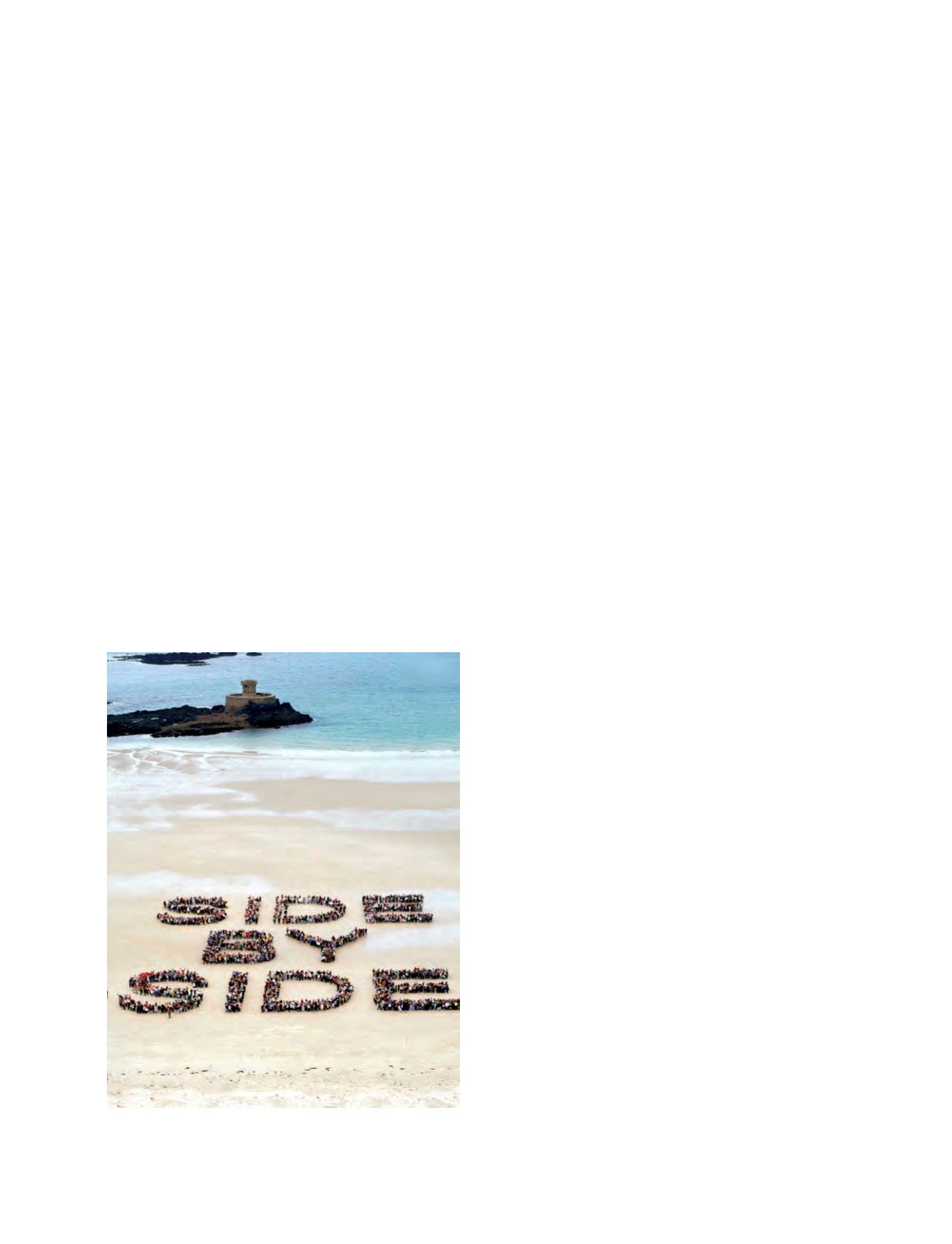
Photo: www.anp-photo.nl/ Matt Hotton