


 100 / 156

at regional level. The automatic rainfall warning system can
measure rainfall in the upper stream, analyse discharge and veloc-
ity of river flow in a specific basin and calculate the water level
downstream. When the water level exceeds certain criteria, early
warnings and evacuation orders can be issued.
When rainfall is actually measured in the observation station
in the upper stream, which is powered by batteries and sunlight,
the runoff and time of concentration can be determined using a
computer program verifying various parameters. The velocity of
flow is also determined using the computer program for multi-
dimensional display or by Manning’s formula for a simple profile.
Since hazard criteria are known by actual tests based on velocity
and water level, a dangerous water level can be detected. The
amount of rainfall accumulating in 20 minutes is used to deter-
mine whether warning and evacuation orders need to be issued
using the alarm station. The control station and field display post
also help to organize the system and inform people about it.
This localized rainfall warning system is one of the most effective
early warning systems in Korea. It is an actual-input based early
warning system using real-time monitoring. The Korean
Government established 136 systems, investing more than USD60
million between 1996 and 2003. An additional 125 systems will
be completed by 2009 at a cost of about USD40 million.
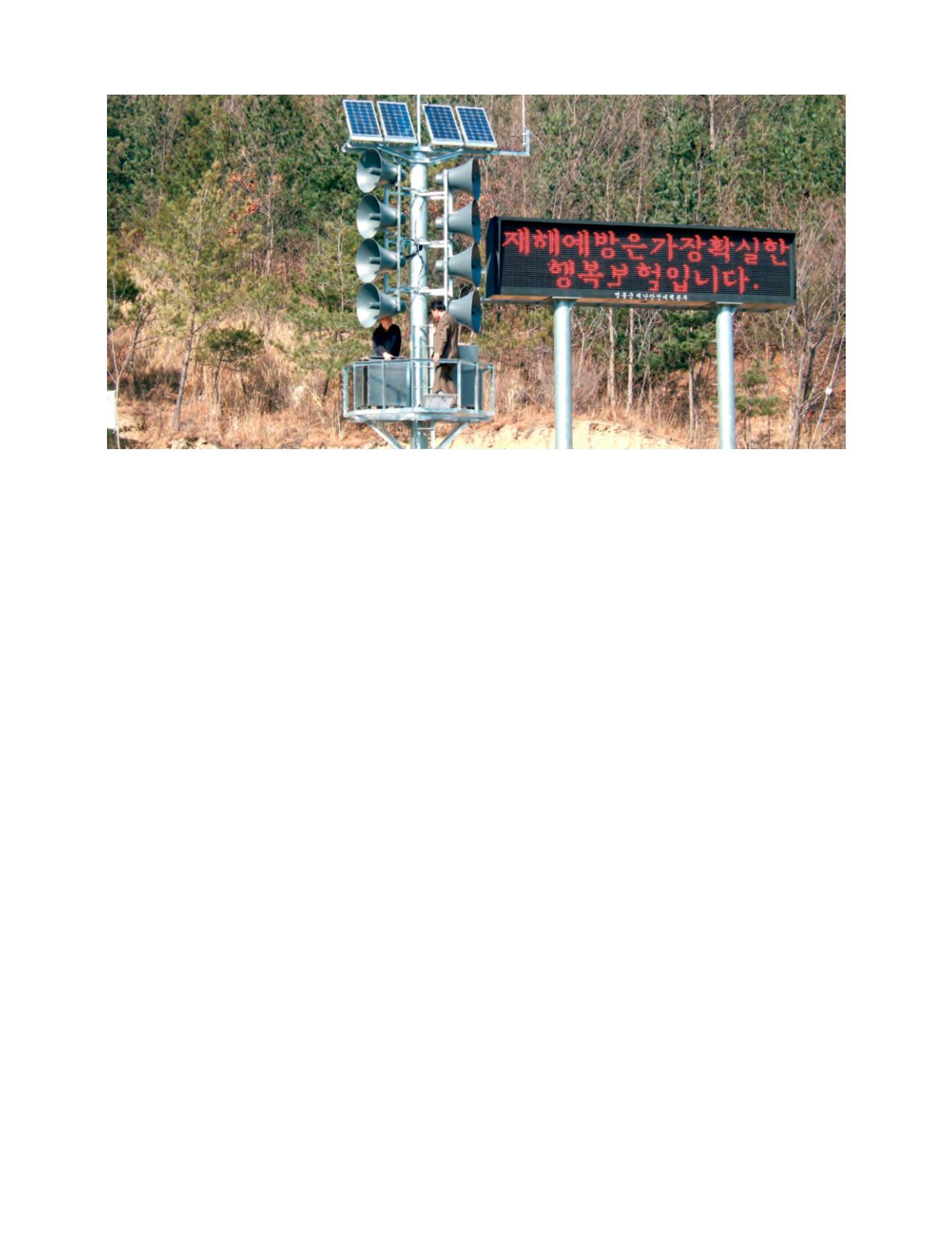
The fourth system uses electronic bulletin boards exclusively to
display disaster information and warnngs. This disaster notifica-
tion board system is 1.2 metres high and half a metre wide and
can display a maximum of 20 words. It can be attached to build-
ings, or can stand alone with a five-metre-high support. Currently,
299 systems are installed in disaster-prone areas such as beaches,
mountain areas, public parks and lowlands.
As soon as disaster information becomes available through the
Korea Meteorological Administration, NEMA and local headquarters
select a standard message and activate the system using the Internet.
The fifth early warning system is the TV disaster warning
broadcasting system, which is based on automatic TV turn-on/off
functions. Since night time is most vulnerable to disasters, these
systems enable TV systems to turn on or even change the channel
with automatic volume-up so people receive urgent disaster infor-
mation even if they are sleeping or watching other channels. This
system broadcasts urgent disaster information as sound or screen
messages using the broadcasting station’s equipment and a
special receiver connected to the home TV set. The Korea
Broadcasting System (KBS) is the primary service responsible for
broadcasting disaster information. Currently 3,997 TV sets with
special receivers are in operation at central and local disaster
management headquarters, at each of the administrative offices,
and at related organizations. These are to be expanded for the
general public.
Similar to the TV disaster warning broadcasting system, the sixth
early warning system that the Korean Government is focusing on
is the radio disaster warning broadcasting system using RDS. This
system is based on technology that can automatically turn a radio
on or off, and can activate Agora’s amplifying speaker systems.
The system can be applied to any facility that has internal speaker
systems, such as a movie theatre or shopping centre. KBS is also
responsible for broadcasting specific disaster information.
The system does not interfere with the existing FM signals, but
it requires an RDS encoder to be installed. The system consists
of three main sub-systems, i.e. control, transmission, and warning
broadcasting panels. These panels should have an emergency
power supply and be resistant to lightning damage. Also, the
system is capable of various warning durations and messages.
During Typhoon Maemi in 2003, radio disaster warning broad-
casting systems using RDS in five areas were activated, and
disseminated the appropriate disaster information.
These six systems, in operation in Korea, represent good prac-
tice in effective community-based early warning. An annual review
process by NEMA guarantees the appropriateness of these systems’
configurations, costs, and positions, while updated information
for each system is continually evaluated. Details of how to quan-
tify warning and evacuation criteria for automatic rainfall warning
systems or other early warning systems, however, need to be
reviewed and updated based on continuous validation processes
including technical assessment. Also, budget allocation and privacy
protection are issues to be tackled for the successful implementa-
tion of these early warning systems in Korea.
[
] 100
An electronic bulletin board and warning siren
Photo: NEMA