


 104 / 156

quality and well organized post-disaster psychosocial care. Firstly,
this requires proper coordination of the tasks and activities of exist-
ing aid organizations, so that the aid on offer matches the victims’
need for help as far as possible. The Knowledge and Advice Centre
combines existing practical and scientific experience, makes it
understandable, provides expertise and improves cooperation
between all the parties and organizations involved. After the
tsunami disaster, it focused mainly on community-based interven-
tions – those that depend on the supporting role of the community
in helping victims to cope with their experiences.
Impact undertook three important tasks, which are discussed in
detail below:
1. Impact gave advice about a remembrance event
2. Impact foresaw a gap in Dutch aid structures and contributed
to the foundation of the national
Informatie- en Verwijscentrum
(IVC - Centre for Information and Referrals)
3. Impact ensured the recognition of victims by cooperating in
the publication of two books.
Remembrance event
Memorial meetings are important since they enable people to
express their feelings of loss and mourning. This breaks through the
victims’ isolation and creates a sense of recognition between differ-
ent groups. For this reason, the Dutch Government organized a
memorial gathering on 25 January 2005. Impact advised the
ministry about the format and organization of this meeting. Adult
and child victims were present. After the meeting, the Queen and
the Prime Minister talked with the victims in person.
In organizing a memorial event for victims, several crucial
elements must not be overlooked:
Appearance
–Who is the memorial event for? Is it for the digni-
taries in attendance or the victims themselves? Preferably, the
victims should be involved as much as possible in the meeting and
should be given the opportunity to do the talking themselves.
Timing
– To many victims, a memorial meeting feels like a tran-
sition ritual, or closure. It may be better for victims whose relatives
are still missing not to attend this ‘closing’ event. If victims are
involved in the preparations, they can be asked if they would appre-
ciate a meeting.
Speech
– Experiences, feelings and memories are usually very
personal, so it is better not to have the speakers say things on behalf
of all the victims, but only on their own behalf.
Supervision
– Strong emotions can be channelled by having aid
workers sit among the victims, perhaps incognito. In this way, the
group of victims will be ‘diluted’ and there will be enough room,
if necessary, to provide emotional support.
Dignitaries
– If the dignitaries are provided with information in
advance, they will be able to answer the victims’ questions.
Additionally, it is appropriate for the dignitaries to be present at
the event before the victims arrive.
Media
– If there is much media attention, it is a good idea to
give television cameras and other press an inconspicuous place.
All victims and aid workers were very positive about the Dutch
memorial gathering of 25 January 2005. The atmosphere was
calm and conversations were started easily. Many emotions
surfaced, grief above all others. Victims said they felt stronger as
a result of the meeting, and many were encouraged by the
Queen’s attention.
There is still room for improvement: a lot of children attended
the meeting, and more activities could have been organized for
them, such as being able to draw pictures, light candles, release
balloons or write in a book.
The idea of one-stop shopping: founding the IVC
In order to coordinate Dutch aid at a national level the Ministry of
Health, Welfare and Sports tasked Impact with setting up a national
Information and Referral Centre (IVC). The IVC – which started
on 18 March 2005 – is a centralized virtual service desk. All the
existing aid organizations and aid workers are brought together
here under a single telephone number and a single website. The
centre provides general information about the psychosocial conse-
quences of disasters and the kinds of professional aid available.
Specific referral to appropriate aid is possible for those directly
involved. In addition, victims and aid workers can ask questions
through the website and by telephone.
The IVC Website contains the following elements:
• Information for those directly and indirectly involved and for
aid workers
• A list of available national care for victims and aid workers
• Digital links to information about authorities and organiza-
tions that were involved in the disaster, can offer help, or can
make a referral
• A
Frequently Asked Questions
list
• A feature allowing questions to be submitted in writing.
However, the IVC also plays an active role in which its tasks are:
• Approaching and keeping in touch with all victims
• Collecting and answering victims’ questions
• Monitoring victims’ state of health
• Advising on the right kind of aid at the right moment.
After the acute stage – in which the victims were looked after –
Impact started an investigation into available care in the
Netherlands and the anticipated care requirement. The IVC was
then founded using research data and information from the aid
organizations within Impact’s network. After this, the focus turned
[
] 104
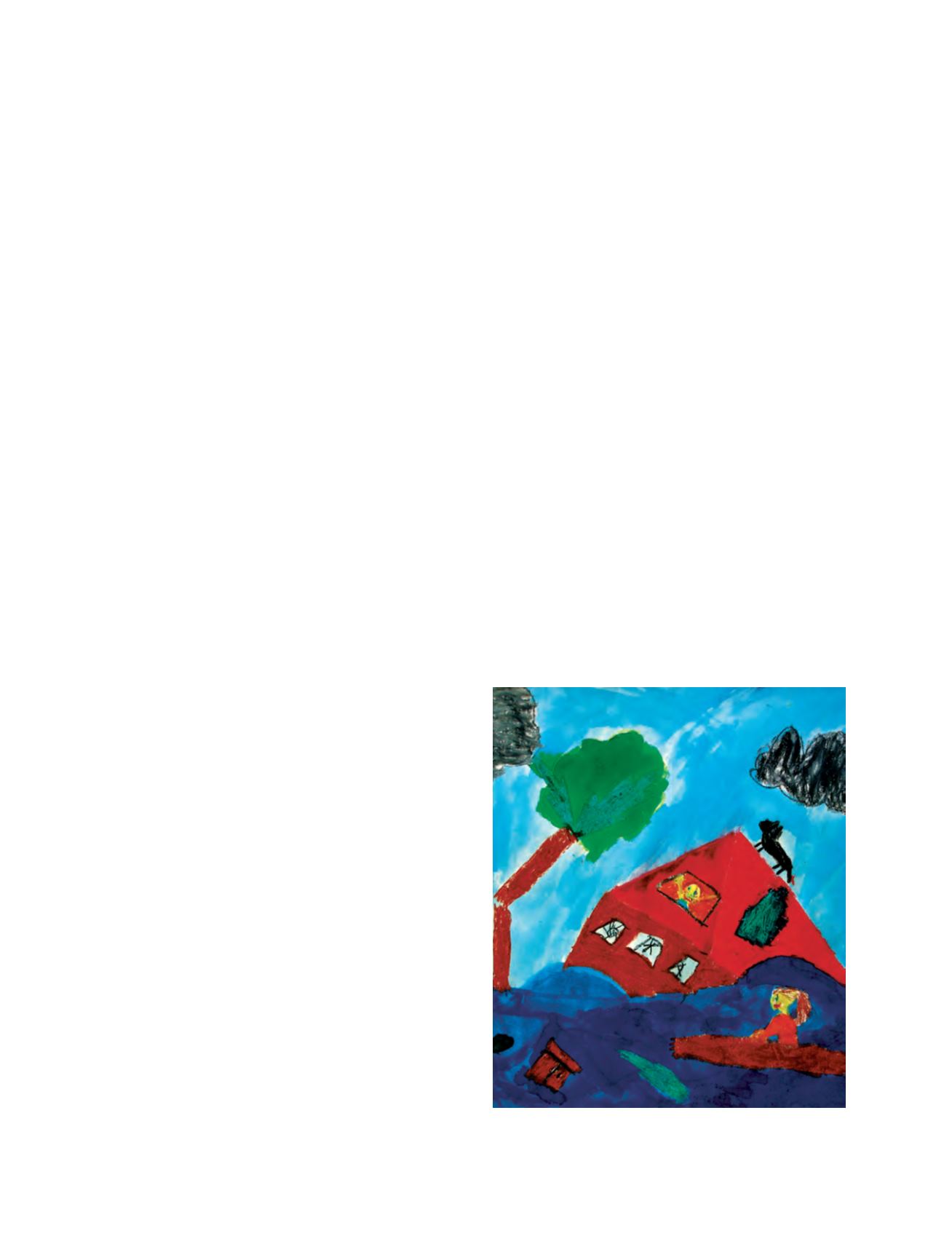
The tsunami destroyed everything, no one, including animals,
was safe. Everyone had to flee
Image: Johannes Calvijn School Gouda, Roos en Annemiek