


 102 / 156

which multiply the likelihood and impact of natural hazards,
increasing the overall percentage of population at risk.
Addressing areas at risk
The Government of Tajikistan has actively engaged the interna-
tional community in developing partnerships to address natural
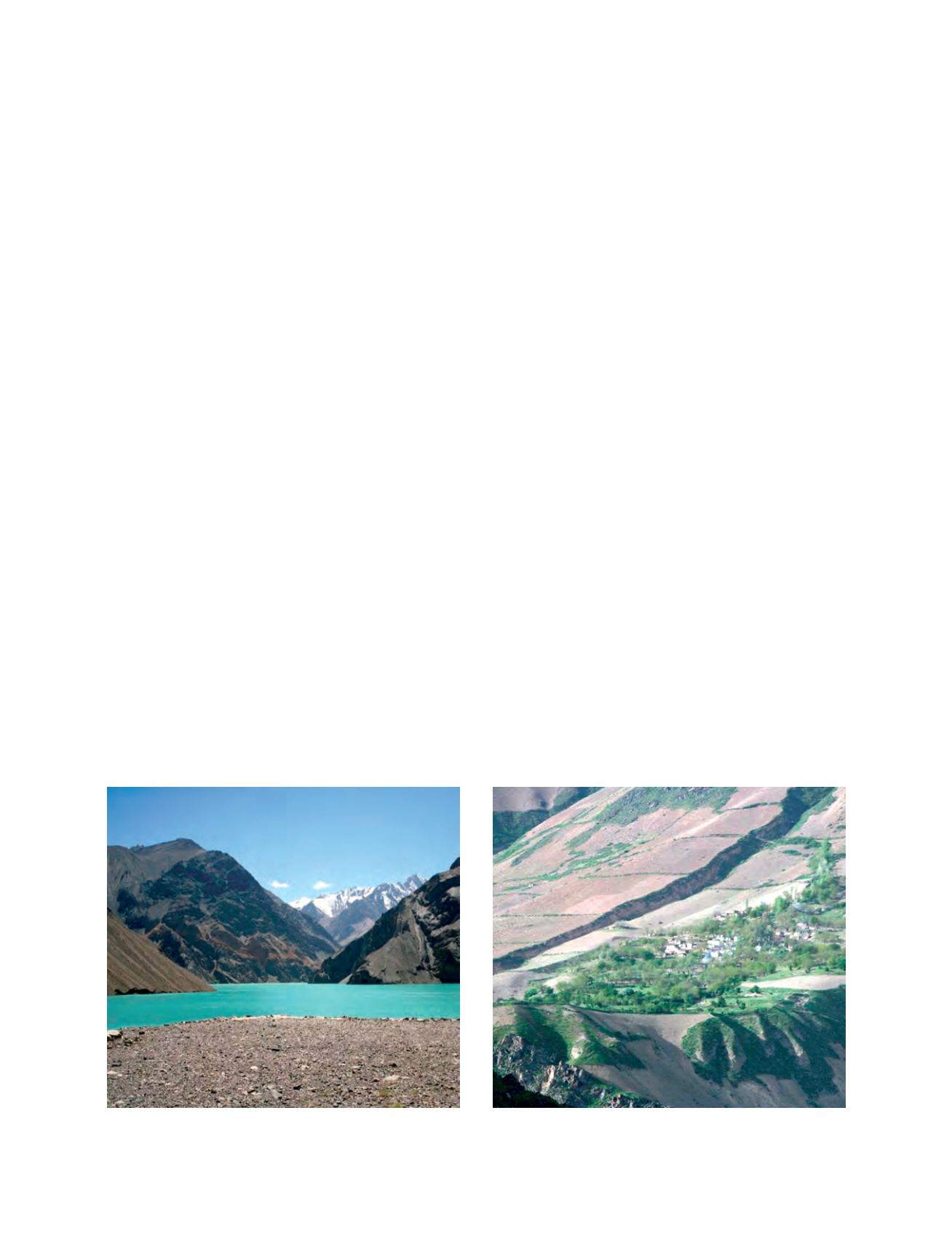
hazard risk. Using the example of Lake Sarez, in 1999 at the
request of the Government, a consortium was created to study
the risk faced by Tajikistan of an outbreak flood from the lake.
Representatives from the Ministry of Emergency Situations and
Civil Defence (MoESCD), the World Bank, the Aga Khan
Development Network (AKDN), Focus Humanitarian Assistance
(FOCUS), USAID and the Government of Switzerland conducted
an assessment of the lake to identify potential long-term risk
reduction options.
The resulting initiative, named the Lake Sarez Risk Mitigation
Project (LSRMP), focused on the installation of early warning
systems coupled with community emergency preparedness to
decrease the risk to those most vulnerable within the immediate
impact zone. FOCUS worked with communities to develop
systems of stockpiles and safe havens, along with community
based response and search and rescue teams.
In addressing the risk to communities at risk from Lake Sarez,
it was observed that numerous local hazards such as mudslides,
rock falls and flooding posed a significant immediate risk, which
was reduced using similar interventions. To this end, working with
the MoESCD and the international community, FOCUS devel-
oped a longer-term approach to addressing the hazards posed to
communities in the high mountain environments of the Pamirs.
FOCUS’ strategic approach
Established in 1994, FOCUS is an international group of agen-
cies engaged in Europe, North America and South and Central
Asia with a specialization in disaster preparedness, mitigation
and prevention, as well as disaster response.
Taking the Pamir Mountains, and specifically the Gorno
Badakshan Oblast (GBAO) as the subject for an integrated risk
reduction approach, FOCUS has engaged in a long-term plan to
build the disaster resilience of communities through an approach
that encompasses risk assessment and modelling, scenario plan-
ning and a series of interventions targeted to limit the impact of
disasters.
Public, private, community partnerships
Over the years the FOCUS programme has expanded tremen-
dously, numbering the following among its achievements:
• Development of an emergency communication system
utilizing solar powered CODAN radios
• Over 200 structural mitigation initiatives
• Risk assessments in over three-quarters of the at-risk
communities across GBAO
• A vibrant disaster management GIS and risk model tied to a
joint Government and FOCUS incident reporting system.
With an emphasis on community empowerment, FOCUS’s
approach has been to engage communities in the assessment
process along with national technical experts. These joint assess-
ments conducted with the communities result in the design of
risk reduction initiatives championed by communities. They
include the development of emergency committees and funds,
the design and prioritization of disaster mitigation initiatives,
three-way agreements on the use and maintenance of communi-
cation systems and early warning systems between FOCUS,
MoESCD and the community, and numerous other preparedness
measures such as the development of stockpiles and safe havens.
Results and impact
As measured by the FOCUS risk model, there has been a reduc-
tion in risk of over 20 per cent to the highest risk communities
in GBAO over the past four years. Where in 1997 it could take
as long as two weeks to receive information in the centre about
potential emergencies, it now takes hours. Where once commu-
nities looked to the state for every mechanism of emergency
support, most now have village disaster plans and committees
that work with state agencies as distinct civil society organiza-
tions. The lessons of the west have been incorporated into
Tajikistan and as the road to development continues, communi-
ties are ensured of a more secure future.
[
] 102
Tajikistan is located in one of the most seismically active zones of
Central Asia
Photo: Hadi Husani
Lake Sarez has been the focus of studies to identify potential long-term
risk reduction options
Photo: Hadi Husani