


 94 / 156

droughts. It also helped EFICOR to finalize Madhubani block as
the area of intervention. PADR helped the community to analyse
the ‘elements’ at risk due to disasters and what contributed to
that element being at risk – if crops were the element at risk,
then analysis showed that factors such as land tenancy, cropping
season, forming embankments along the river, and the unpre-
dictable course of the rivers made those crops vulnerable to
destruction.
Such analysis showed which factors could be addressed by the
community itself, and helped to identify the external inputs
needed from the Government or other agencies and what advo-
cacy measures were called for. It was also instrumental in initiating
a change in the attitude of the community towards disaster and
its management. Instead of thinking individualistically, people
could now think about how the community as a whole might
benefit. For example, instead of seeking to get hand pumps
installed near their houses, they now saw how strategically locat-
ing the hand pumps could help larger populations during the
floods. They could also identify their capacities, which gave them
a feeling of empowerment through the awareness that they need
not be helplessly vulnerable to floods.
Capacity building and training
Capacity building was done through the formation and training
of a village-level disaster management committee (DMC) and
task force. The village communities, in informal village meet-
ings, chose literate or semi-literate people who were
knowledgeable, respected and acceptable to most in the commu-
nity as members of the DMC. The DMC also includes
government representatives – ‘ward members’ – from the
Gram
Sabha
(Village Assembly) and members from the women’s self-
help group. Each ten-member DMC has about 50 per cent female
participation and meets once a month. The 20 DMCs were
trained in concepts of disaster management and mitigation and
its need, good practices in mitigation, the role of the DMC, the
need and purpose of the task force, and various skills necessary
for the functioning of a DMC. Once trained, the committee
serves as a decision-making and advisory body on disaster
management issues in the community.
Across the three blocks, 460 youths have been trained as task
force members. Each village has a task force, with members taking
specific responsibilities such as warning, rescue, first aid, shelter
preparation and relief management. Though each group has spec-
ified roles, each member of the task force is trained in all aspects.
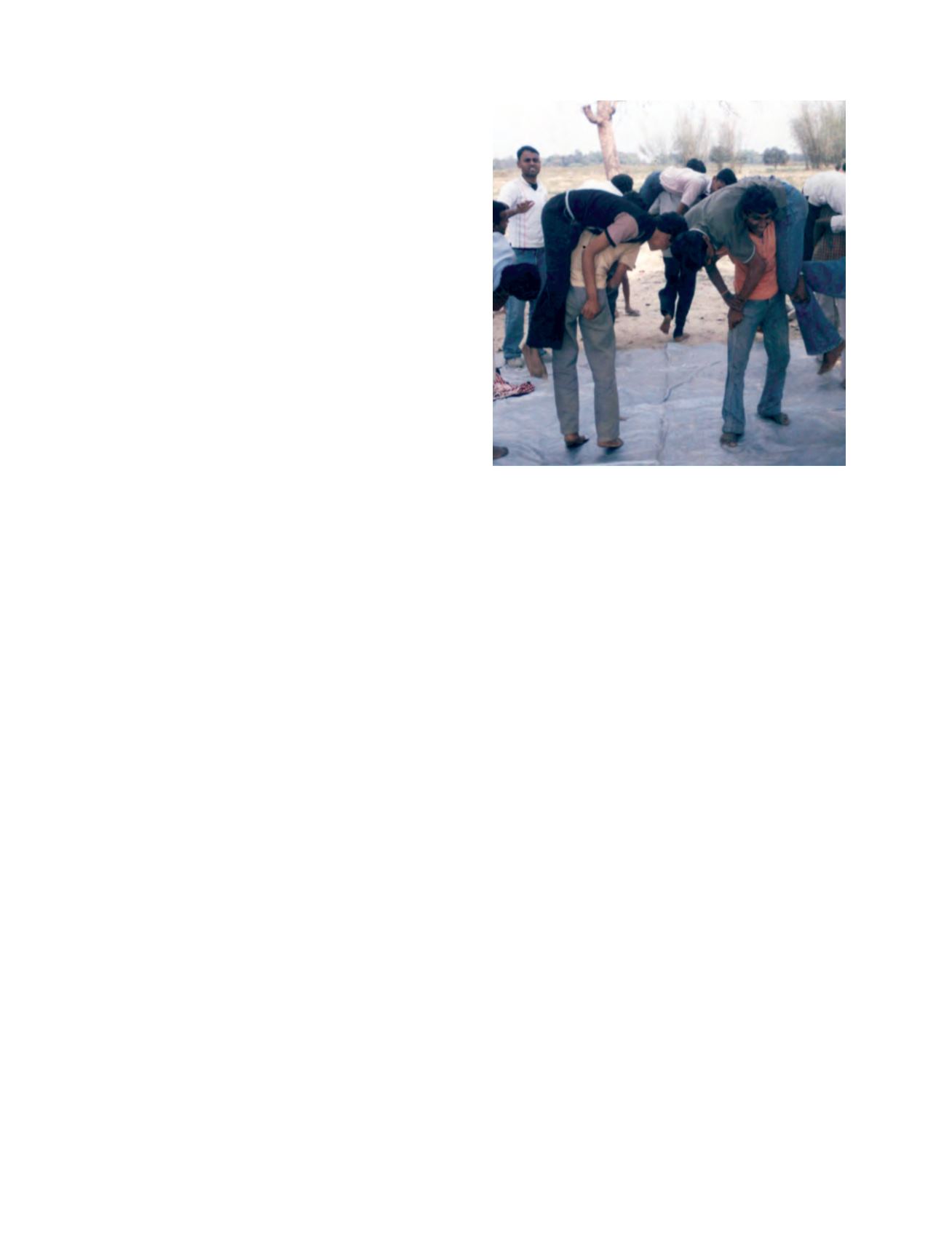
This task force passes its skills to other members of the commu-
nity through mock drills.
Small farmers with their own land have been enabled to form
a farmers’ group, and 354 such farmers were trained on subjects
such as varieties and methods of cultivation suitable for flood
prone areas, the benefits and use of organic fertilizer and pesti-
cides, and the ill effects of long-term use of chemical fertilizers.
Mitigation measures
The absence of certain structural assets also contributes to some
elements being at risk. EFICOR addressed the following elements
through the structural mitigation measures given.
Drinking water
– Non-availability of safe drinking water during
floods is a major issue. The consumption of contaminated water
results in a high rate of diarrhoea, dysentery and cholera; and
children often succumb to these diseases, as evident from the
district’s infant mortality rate of 65. Raised tube wells provided
a simple solution – 12 old tube wells were raised and 18 new
raised tube wells were installed. The height of the raised platform
took into account the highest flood level in that area.
Communication
– Means of communication, which are already
very poor, are completely cut off when water inundates the area.
Many people are stranded in these remote villages and suffer due
to lack of basic amenities like water, food, sanitation facilities,
medical aid, etc. Therefore, ten locally constructed wooden boats
were provided to evacuate stranded people to safer locations and
20 kaccha (unmetalled) roads – including minor roads – were
constructed to enable quick evacuation to safer sites. Since the
boats were locally made, the local artisans were able to benefit.
The community took the contract for constructing the roads, and
this infused much needed cash into the community.
Land and agriculture
– Land and agriculture is the element
impacted the most, and this has long-ranging impact on the social
fabric. Though most of the community does not own land, this is
an agrarian society in which most work as tenants or labourers on
the landlord’s fields. Once agriculture is affected, people have no
other means to sustain themselves –men migrate to other states in
large numbers, leaving behind the women, children and the aged.
The migration and absence of the working population
contributes to economic and social regression. To address this,
680 small and marginal farmers were assisted with late-variety
and improved-variety wheat and sugar cane seeds. The intro-
duction of late-variety wheat will allow farmers to sow wheat,
which is the second crop, a month later than the normal variety,
without losing the crop if flooding forces them to sow it late, as
is the case with the variety currently used. Sugar cane is a flood
resistant crop, but its cultivation had been stopped in this area
for over a decade due to the closure of sugar mills. The new
government has reopened the mills, and so the cultivation of
sugar has been reintroduced to enable farmers to benefit from
this opportunity.
Frequent heavy floods erode these lands, as well as filling large
tracts of agricultural land with sand, making it unsuitable for
cultivation for many years. Trees act as a good breakwater, weak-
ening the force of the deluge and preventing it from entering wider
[
] 94
Mock drill by a village task force
Photo: EFICOR