


 92 / 156

[
] 92
community interaction have been taken up. These awareness
generation initiatives have helped communities and disaster
managers at different levels in broadening their information
base.
For effective disaster management, emergency operation
centres (EOC) have been set up at the state capital and at district
headquarters. The Government of India has formulated the
National Emergency Communication Plan for data, audio and
video connectivity with a triple redundancy to connect national,
state and district EOCs. The police network, the National
Informatics Centre Network and the Virtual Private Network for
Disaster Management are the three major networks that will be
extended to all district EOCs for data, audio and video connec-
tivity in a time-bound manner.
A state of the art state EOC has been set up at the state capital,
and hazard-resistant buildings are being constructed to house
district EOCs. Emergency and modern communication equip-
ment like computers, fax, VHF systems, lifebuoys, lifejackets,
generator sets, etc. have been provided to the EOCs.
Key policy initiatives
The most important development in the field of disaster manage-
ment has been the enactment of the National Disaster
Management Act, 2005. This is now being considered for adap-
tation in the state with modifications to suit local requirements.
The National Disaster Management Act provides for the creation
of disaster management authorities at four levels: national, state,
district and local authority (gram panchayat and urban local
body).
Executive committees will implement the decisions of the
disaster management authorities at different levels, and advisory
committees will provide expert opinion to the relevant authori-
ties for effective disaster management. According to the National
Disaster Management Act, every ministry or department is
required to prepare a disaster management plan in tandem with
the developmental plan of the department.
In Orissa, OSDMA has facilitated the formulation of state
disaster management policy, plan, hazard analysis and identifi-
cation, etc. Five sub-groups were set up to prepare reports on
different types of hazards, and 31 types of disaster were identi-
fied under these groups. The state government has already
approved the state disaster management policy.
The major principles of disaster management policy
include:
• Shift from relief and welfare to rights and entitlement
• Integrate disaster management into development policy and
planning
• Legislation to provide statutory backing to essential
disaster management functions
• Community-based disaster preparedness
• Using people’s indigenous knowledge and culture in
decentralizing disaster management
• Ensuring humanitarian assistance to disaster victims
• Capacity building at all levels
• Making disaster management part of the education curriculum.
The state disaster management plan incorporates guidelines for
government departments for initiating their action plans for
management of disasters.
Preparedness through coordination among stakeholders
Disasters in the recent past have shown one thing very clearly:
that administration cannot operate in isolation. Other stake-
holders like NGOs, community-based organizations and external
agencies have a role to play in disaster management. In the best
interest of the people, coordination among the major players in
the field ought to be maintained. OSDMA has been acting as the
state level coordinator involving NGOs working in the field of
disaster management. The Social Capital Restoration Programme
has been implemented, to involve NGOs in awareness genera-
tion, capacity building and livelihood support activities in the
post-super cyclone period.
Reconstruction
Reconstruction had been a routine follow-up action of the admin-
istration in the aftermath of every disaster. But reconstruction
took on a whole new dimension after the 1999 super cyclone,
when the concepts of disaster-resilient construction, quality
monitoring through external agencies and adoption of high tech-
nology for disaster-resistant infrastructure came into play. River
training works, saline embankments and the dredging of
riverbeds were among the activities taken up under various infra-
structure reconstruction projects.
Pitching of river embankments by boulder-crate technology
was also adopted at many vulnerable places. 602 reconstruction
projects, involving 141 road works, 345 irrigation works, 19
piped water supply and 63 rural water supply works, 34 cyclone
shelter projects comprising 37 shelters, and one package under
the Agricultural Promotion and Investment Corporation of Orissa
Limited, comprising 500 agro service centres at a total approxi-
mate cost of INR270 crore (USD60 million) were taken up. Apart
from two cyclone shelters, which are underway, all the projects
have been completed.
Humankind faces disasters, learns from its mistakes and builds
an environment to mitigate the effect of future catastrophes.
Natural hazards cannot be wished away. By enhancing and
strengthening the capacities of people, hazards can be prevented
from turning into disasters. Preparedness holds the key to disas-
ter management at all levels: individual, family, community, state,
national and international.
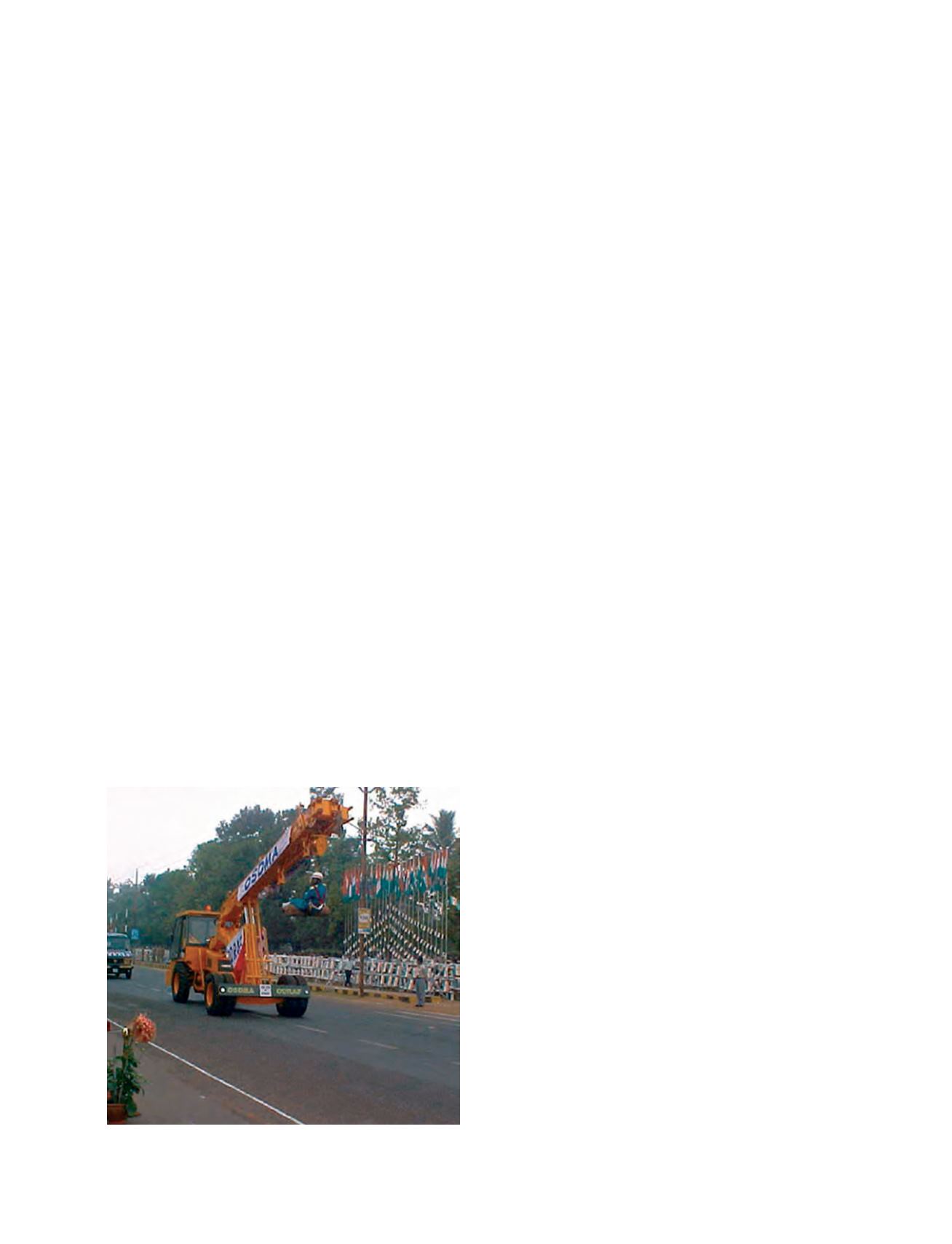
An ODRAF crane
Photo: OSDMA