


 93 / 156

[
] 93
I
N
J
ULY
2004, Bihar state in India faced its worst floods in 50
years. The water inundated over 20 districts affecting 21,251
million people in 9,360 villages.
1
The Evangelical Fellowship,
India Commission on Relief (EFICOR) intervened in this flood
providing relief to 21,245 families in 92 villages of Begusarai,
Madhepura, Madhubani, Muzaffarpur and Samastipur districts
and spending USD299,735 (INR12,888,578).
EFICOR is a relief and development agency that has been
involved in managing drought, cyclone, flooding, epidemics and
earthquakes through all phases of the disaster cycle in India for
the past 39 years. Apart from responding to minor disasters,
EFICOR has provided emergency relief to some 83,000 families,
and built about 1,700 permanent houses and a few thousand
temporary shelters in eight major disaster areas since 1977.
EFICOR bases its relief operation on the ‘Red Cross Code of
Conduct’ and is one of the pioneering organizations that initi-
ated the institutionalization of the SPHERE project in India. It
also organizes project management and disaster management
workshops and seminars for smaller local partners.
EFICOR has been involved in four community based disaster
preparedness (CBDP) projects covering about 42 villages in
Orissa, Andhra Pradesh, Rajasthan and Bihar. Recently it initi-
ated a Department for International Development (DFID)-funded
two-phase project on natural disaster risk reduction in India
intending to cover about 50 additional villages in Bihar, Orissa
and Assam in five years.
2
After the flood relief operations in Bihar, EFICOR started a miti-
gation project in April 2005 to reduce disaster risk in Madhubani,
a flood-prone district situated in the northern part of Bihar which
shares its northern border with the Himalayan country of Nepal.
EFICOR is involved in community based disaster risk reduction
in 20 villages in Khutona, Andhrathardi and Madhepur sub-
divisions (blocks) which are 36 to 42 kilometres from Madhubani
town, the district headquarters.
Reasons for involvement
Bihar, especially its northern districts like Madhubani, is one of
the most flood-prone states of India and faces floods every year.
The UNDP Disaster Risk Management Programme, which is
being implemented in the 12 most disaster-prone states in India,
recognizes Madhubani as one of the 125 most disaster-prone
districts.
3
Here, floods normally occur in mid-July and may
recur in August or September, thus July to September is consid-
ered the flood season. These floods are generally due to excessive
water from Nepal being released through the rivers Kosi,
Bhadrak and Ganga into India. The river Kosi and its tributaries
Kamlabalan, Sugervae and Kosi flow through Madhubani
district.
Not only is Madhubani one of the most flood-prone districts
in the country, it is also one of the poorest and most backward
districts. With a land area of 3,501 square kilometres and a
population of 3.57 million, the district supports 1,020 people per
square kilometre. The literacy rate in the population aged seven
years and older is 42.35 per cent, with 57.26 per cent for males
and 26.56 per cent for females, lower than the respective rates
of the state. About 96 per cent of its population lives in rural
areas and are marginal farmers or daily wage labourers.
4
The intervention is planned to bring about natural disaster
risk reduction through capacity building and community-based
mitigation and preparedness. This intervention began with a
participatory assessment of disaster risk, the findings of which
were incorporated in the project proposal.
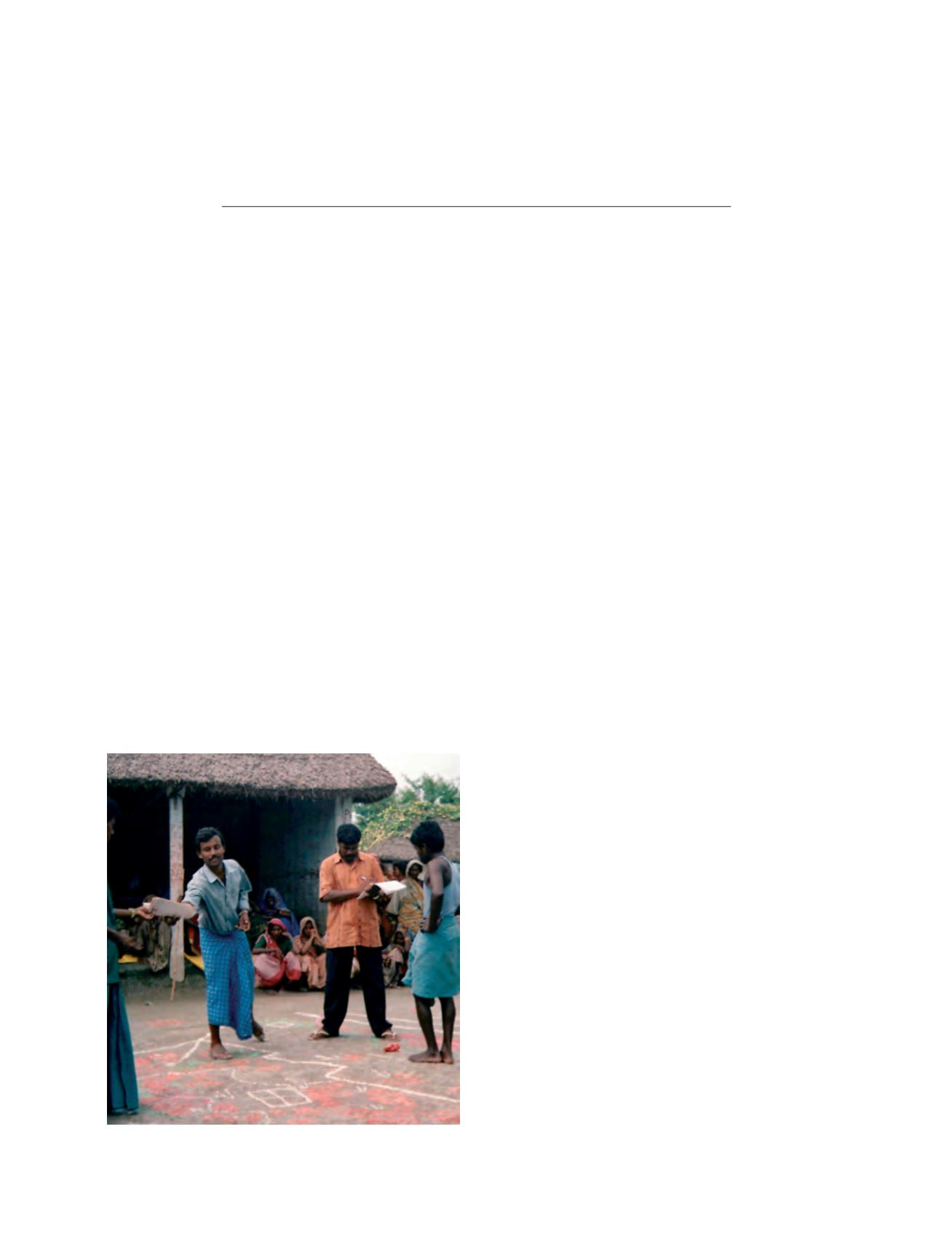
Participatory assessment of disaster risk
A participatory analysis of disaster risk (PADR) was undertaken
in September 2004 in Samastipur and Madhubani blocks.
Different participatory rural appraisal (PRA) techniques such as
social mapping, resource mapping and focus group discussions
were used to analyse the kind of disaster risk the community was
facing and the severity of that risk. This exercise showed that the
area faces frequent flooding, besides fire, earthquakes and
Mitigating Madhubani’s menace
Kennedy Dhanabalan, Director, Development Education and Capacity Building and Esther Ghosh,
Officer, Disaster Management Unit, Evangelical Fellowship of India Commission on Relief
Resource mapping in Mushari Tola
Photo: EFICOR