


 86 / 156

the more complex values such as time, religious beliefs, taboos and
traditions. At the deepest level exist values such as criteria for good
and evil, individual worth, and attitudes toward life and death –
cultural values that profoundly impact decision-making and moti-
vate willingness to change.
A second cross-cultural model is a value continuum of ‘high
and low context’ societies, made known by Robert Kohls. For
example, a member of a high context society often accepts fate
and acts in a traditional and formal manner, whereas his or her
counterpart in a low context society more readily believes in
controlling the environment, and acts in a progressive and infor-
mal manner.
These and other cross-cultural communication theories have
been successfully used for a long time in other professions outside
of emergency management. In teaching public health officials, I
find these concepts are readily accepted and used to analyse needed
approaches for entire communities as well as individual patients.
By focusing on these tools we as emergency managers can develop
informative cultural profiles of our communities that allow us to
identify the characteristics that describe the community, or a
subculture or community within that community. By understand-
ing the psychology and conditions of our target audience in that
community (e.g. business owner or student, traditional or progres-
sive values, first or fourth generation) we can craft a customized
outreach approach based on those we wish to reach and not on
ourselves as communicators.
Case example
The City of New Orleans has developed into a case study for the
need for effective risk communications. Having previously served
as a public information officer for the Federal Emergency
Management Agency, the challenges of working with multiple levels
of government in a multi-cultural environment, prior to and after
an event, are all too familiar. In Katrina, the world not only watched
the events created by wind and water and failed levies, but also the
failure during response to use effective risk communications to
safeguard the lives of those at highest risk. A previous exercise,
expressed concern by the professional community, and a report by
a group of public and private professionals examining the social
science research needs for forecast and warning systems, docu-
mented the area’s unique outreach challenges.
While participating in the Katrina humanitarian response effort
as part of the IBM Crisis Response Team, I had the opportunity to
work with disaster responders working with individuals living on
society’s edge who found their lifeline through faith-based and
other non-governmental organizations. Months later, while partic-
ipating in ongoing rebuilding efforts with the Bring New Orleans
Back Commission and other initiatives, an issue clearly repeated
was the deeply-rooted cross-cultural, cross-sector communication
needs, challenges and opportunities.
New Orleans, a multi-cultural society now in the process of
reinventing itself, struggles as a splintered transitional commu-
nity, such as those normally experienced in geographical areas
where immigrants and ethnic minorities are forced to build new
political and social frameworks. City-wide infrastructure and
neighbourhood planning efforts require customized, cross-
cultural risk communication outreach to effectively build
coalitions, create community vision, share resources, and inte-
grate hazard reduction practices in land use planning. Individual
neighbourhoods, such as the hard-hit Ninth Ward, as well as local
business and industry and other stakeholders, need not only to
be reached, but also to be understood, honoured and reflected in
an understandable communications framework that supports risk
reduction policy implementation.
Many influences shape our worldview and provide reasons for
our actions. But whoever we are, man or woman, young or old,
Muslim or Christian, landowner or migrant labourer, first gener-
ation or fifth, we share a common role as one of society’s
members. And as part of civil society we all deserve to be
informed, included, and understood. Communicating across
cultures builds a stronger, more inclusive bridge to safety and risk
reduction.
[
] 86
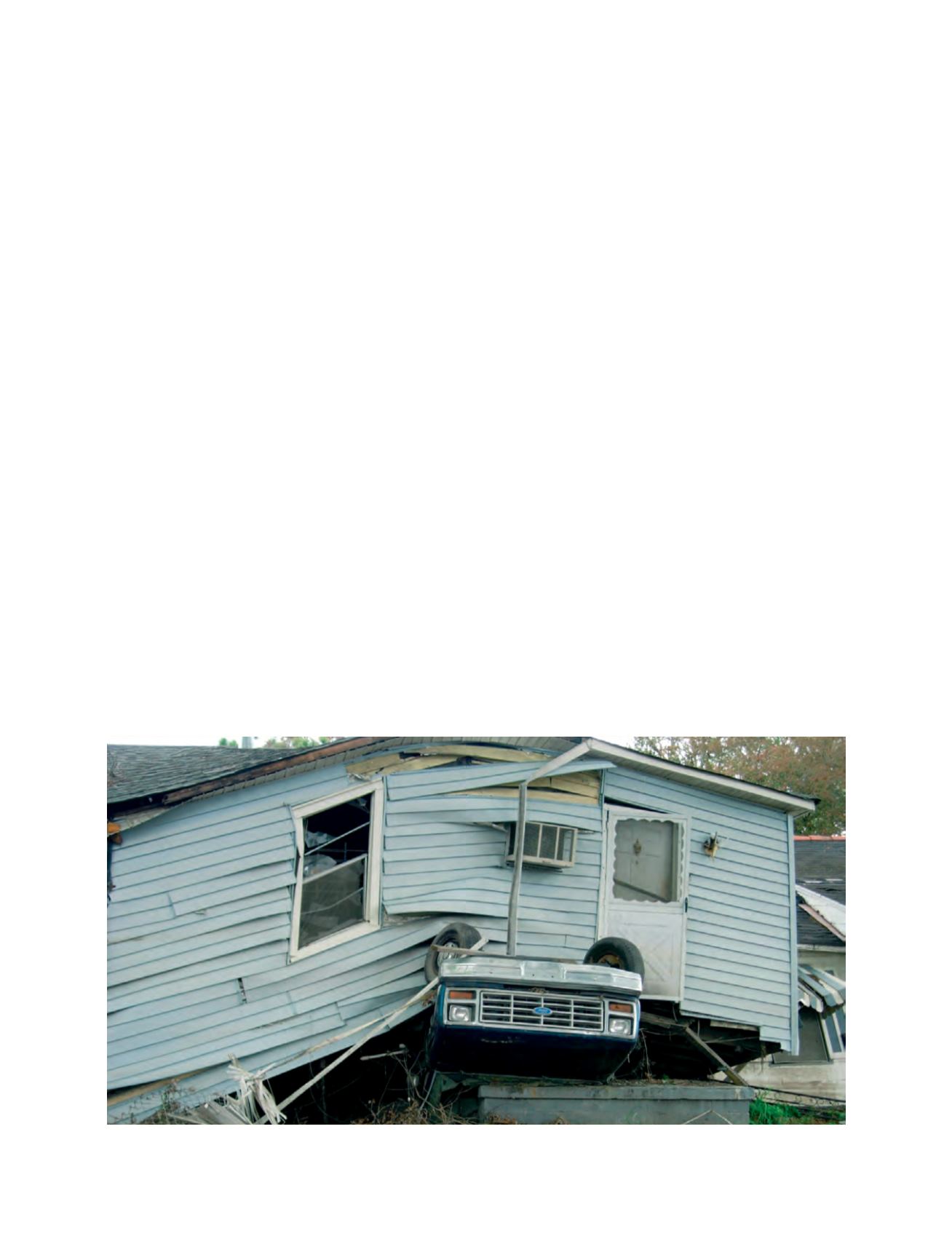
Effectively communicating loss reduction methods as well as evacuation notices to vulnerable populations will save lives and property
Photo: Suzanne L. Frew, 2005