


 63 / 156

[
] 63
T
HE CATASTROPHIC EFFECT
of Hurricane Katrina in 2005,
on the Gulf States in the USA, highlighted the importance
of understanding the impact of hurricane-generated
hazards on coastal communities. Small island states like
Jamaica, whose population centres are situated along the coasts,
are threatened by these disasters. The impact of Hurricane Ivan
on several coastal communities in September 2004 highlighted
the need to assess the effects of storms and hurricanes on these
vulnerable areas.
The town of Annotto Bay, located on the north-east coast of
Jamaica, is one such community that has repeatedly been affected
by storm surge
1
and coastal flooding associated with unstable
weather conditions, ranging from localized weather systems to
hurricanes.
2
This low-lying town (maximum elevation of 4.7m
above sea level), sandwiched between a salt marsh and the sea,
is transected by three waterways. Two of these, Annotto River and
Mother Ford (which has been converted to a culvert), are part of
an extensive creek system with numerous branching tributaries
and meandering channels. The third, Pencar River, lies to the east.
A fourth river, the Wag Water River, forms the western boundary
of the town. These drainage systems play an integral role in
sustaining and destroying life in the area; the banana industry,
which is the primary industry in this area, is located on the fertile
flood plains associated with these four rivers and provides jobs
for local residents, but these rivers also pose a threat to the
community during the rainy season.
The town, which supports a population of just over 5,300,
3
has expanded in size in the past 10 years, and this is reflected
by an increase in residential units. Evidence of this expansion
is observed from aerial photographs to be common along the
fringes of the marsh and the coastline adjacent to the sea. This
increase in residential buildings, particularly along the coast-
line of Annotto Bay, is of great concern because the area,
although designated residential, was not subdivided to support
the unit density it now supports. Most of these structures are
erected on leased land using wood sidings and concrete foun-
dations; the roofs are of metal sheeting, which provide very little
protection against strong winds. Some residents have erected
houses on the beach berm, and some are even located at the
high water mark, nevertheless most homes are an average
distance of 18m from the foreshore. This unmonitored growth
has placed additional stress on the limited resources of the town
and resulted in a densely populated area which lacks adequate
infrastructure such as waste disposal, running water and suffi-
cient drainage.
Reports of hurricane-related flood events in the area go back
as far as 1963, when flood levels as high as 1m were measured
in the town.
4
Subsequent events resulting in severe damage to
buildings include Hurricane Allen (1980) which passed north
of Annotto Bay, and whose associated surge inundated homes
approximately 137m inland,
5
impacting most of the town’s facil-
ities including the fire station, health centre, police station and
several churches which were used as shelters during these
events. Similar reports from the community describe the
complete destruction of two houses and the partial destruction
of several others along the shoreline from storm surge associated
with Hurricane Gilbert. In 2001, rains associated with Tropical
Storm Michelle caused the three channels which transect the
town to overflow their banks, resulting in damage to 307
homes.
6
The following year, rains associated with Tropical Storm
Lili produced flood levels of 1m in the town as the four drainage
features in the area exceeded capacity and overflowed their
banks.
7
Data collected through this ProVention-funded project
determined that storm surge, associated with Hurricane Ivan in
September 2004, again damaged homes and blocked roads with
sand and debris. Riverine flooding from the four drainage
features in the area produced flood levels of up to 1m in sections
of the town.
A previous hazard assessment programme in the area, orga-
nized by the Office of Disaster Preparedness and Emergency
Management, the Jamaican Government agency responsible for
disaster management, focused on the impact of riverine flood-
Impact of storms on coastal communities:
Annotto Bay, Jamaica
Shakira Khan, Department of Geography and Geology, University of the West Indies, Jamaica
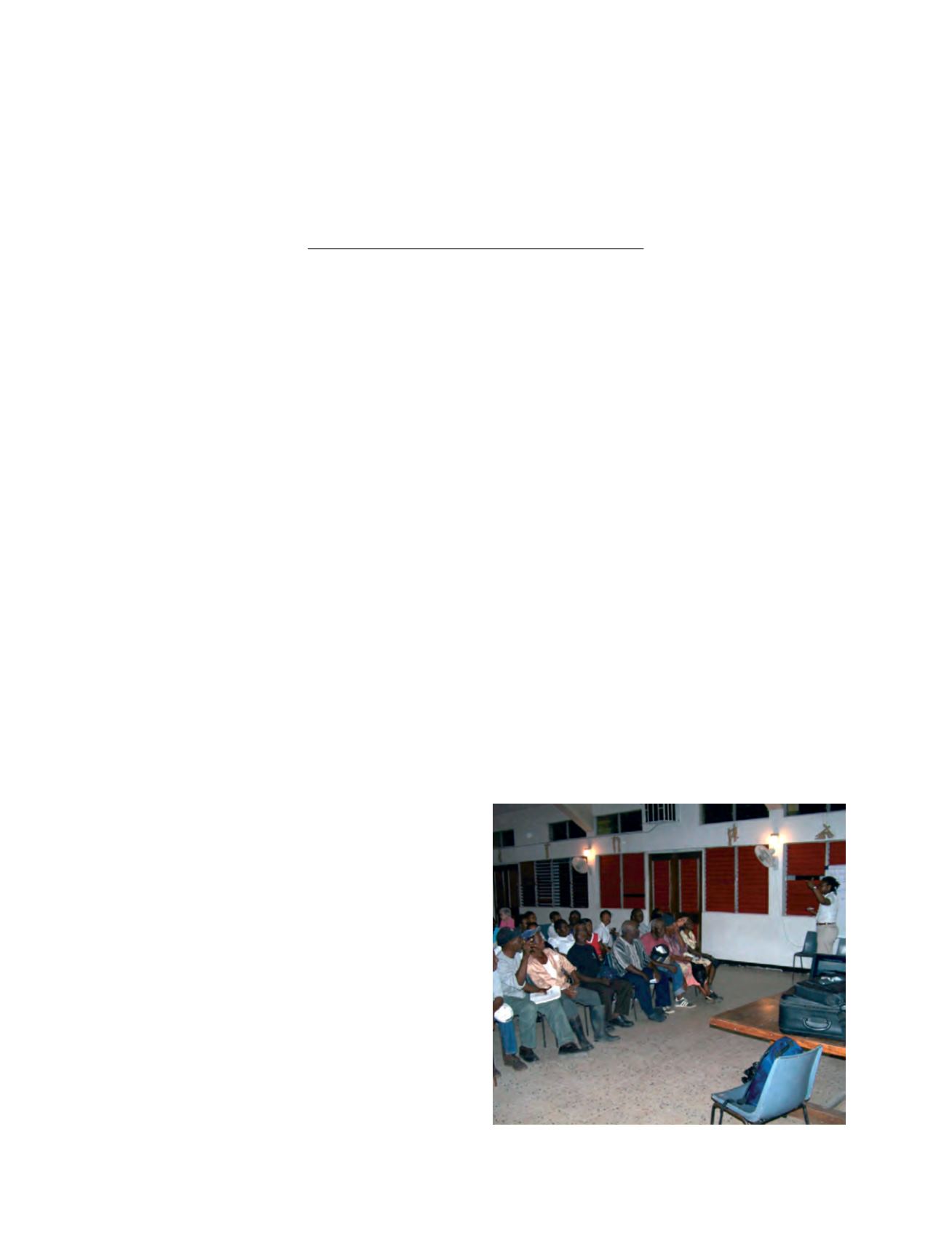
Community members participating in a hazard identification exercise
Photo: Richard Coutou