


 57 / 156

tial to worsen disaster risk with wide-reaching impacts on other
coastal and floodplain communities. Forest clearing in the hills
behind the narrow coastal plain is likely to increase runoff volume,
speed and sediment load, with subsequent implications for river
flows. Indications of these factors were seen in 1999 when a
typhoon and floods in Central Vietnam caused almost 800 deaths,
made 55,000 people homeless and caused over AUD500 million
in damage.
2
Quang Ngai Natural Disaster Mitigation Project
In order to reduce this negative impact of natural hazards on
poverty reduction and sustainable development, AusAID is
supporting improved disaster risk management in Central
Vietnam, reflected by the AUD15 million Quang Ngai Natural
Disaster Mitigation Project (QNNDMP) in addition to other recent
initiatives.
The QNNDMP is jointly funded by AusAID (80 per cent) and
the Government of Vietnam (20 per cent).
3
The overall objective
of the project is to reduce risk and improve the long-term poverty
reduction and sustainable development prospects for a commu-
nity that in the past has been severely affected by typhoons and
floods. Implementation of the project commenced in February
2003, and will be completed in early 2007.
The concept and design stages of the project included exten-
sive consultation with the community, local politicians and
government agencies to assess the specific challenges to be
confronted by the project. This consultative approach was funda-
mental to the ongoing success of the project.
Based on risk assessment and community consultation, the
following key project components were established:
• A river basin management plan that uses floodplain model-
ling to inform planning decisions and catalyse community
understanding and agreement
• A community-based disaster risk management programme
which promotes understanding of the risks of natural disas-
ters and strengthens prevention, mitigation, preparedness
and response capacity in vulnerable communities
• Demonstration infrastructure works including riverbank
protection, surge control dykes and a safe harbour for some
350 vessels.
4
The QNNDMP adopted a holistic and integrated approach to
disaster risk management. The project works with the provincial
government and technical agencies as well as with communities.
It combines land use management planning, community capac-
ity building and risk reduction activities with structural measures.
The project provides sustainable benefits by building community
capacity through methods including information delivery, skill
development and asset provision.
Recent high profile recognition of the lessons learned from the
QNNDMP suggest that this approach to disaster risk manage-
ment could become a model for wider application in Vietnam.
Lessons learned from the QNNDMP will be integrated into
AusAID-supported projects at the community level, such as
World Vision’s community-based disaster risk management
project in Quang Ngai, as well as at the national level, such as
the World Bank’s natural disaster risk management project in
Vietnam.
Innovative and successful outcomes
Several innovative and successful outcomes have been achieved
by the QNNDMP:
Modelling as a catalyst for agreement on planning
– The
QNNDMP introduced floodplain modelling to foster under-
standing of the natural disaster risks associated with development
planning. Computer modelling was used to assess the nature of
flooding across wide floodplains and to examine the potential
effects of proposed development scenarios, including floodplain
filling, roads and flood protection levees. The outcomes provided
the foundation for planning decisions and community and polit-
ical discussion and agreement.
The ability of the model to generate easily understandable outputs
proved invaluable in the consultation processes for development of
the floodplain management plan. Despite the fact that stakeholders
were initially unfamiliar with some of the concepts illustrated by the
model, a solid understanding was quickly developed by using the
model to illustrate critical issues. By viewing modelling results,
community leaders became aware of the nature of flooding beyond
their local area and developed an understanding of floodplain
management requirements. Open meetings and model demonstra-
tions developed a common understanding between communities,
politicians and government agencies and facilitated agreement on
criteria for floodplain management and planning decisions.
Community-based disaster risk management
– The QNNDMP
has implemented a range of successful community-based disas-
ter risk reduction initiatives which may be applicable to similar
programmes elsewhere:
Commune risk reduction plans have been developed for
particularly at-risk communes. This involved working with
[
] 57
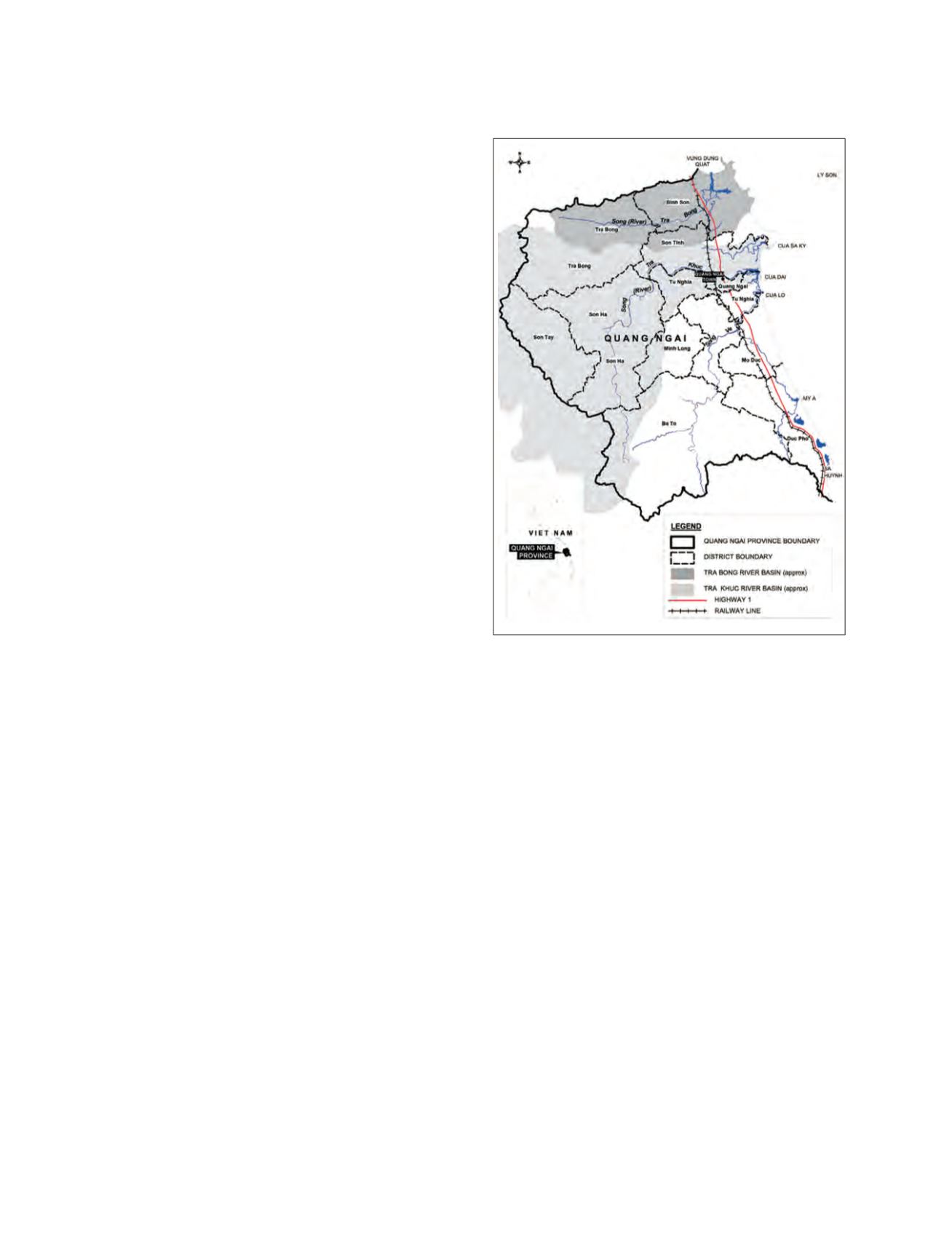
Map of Quang Ngai Province, highlighting the two northern river
basins where the QNNDMP commenced
Source: Kellogg Brown & Root Pty Ltd (KBR)