


 54 / 156

measures. The underlying objective for risk handling is to plan
and implement protective measures. The main criterion for
choosing protective measures is cost-effectiveness. To efficiently
put this ambitious concept across, a common basis of under-
standing is needed, consisting of the following:
• A risk-oriented approach and methodology for dealing with
uncertainties, applying to both the analysis and the evalu-
ation of risk
• The limits of safety efforts versus the expectations of civil
society
• The various points of view, attitudes, and values of all stake-
holders involved and affected by the risk
• Disaster risk prevention and mitigation measures must take
the whole set of pre- and post-disaster measures into
consideration, as well as measures during the event itself
or risk transfer by insurance
• The need for dialogue and communication, not only in
conveying bald facts and conducting dialogue, but also to
ensure the participation of all stakeholders, when setting limits
for protection and defining the processes of decision-making.
Risk communication can have a major impact on a society’s
level of preparation and reaction to crises and disasters
• All solutions must fulfil the criteria of sustainability, i.e. a
sustainable means of disaster risk management has to be a
socially, economically, and environmentally balanced
approach.
Integral risk management also needs a strategic and systematic
control process, including periodic evaluation of the risk situ-
ation and a comprehensive risk dialogue between all
stakeholders.
The risk concept
In order to compare different types of natural hazards and their
related risks and to design adequate risk reduction measures, a
consistent and systematic approach has to be established, from
here on called the ‘risk concept.’ This represents the method-
ological base for an integral risk management and for the
decision-making process of risk reduction and mitigation
measures, and serves as a transparent base for risk dialogue
between all stakeholders. The basic principles of the risk
concept can be summarized by the following key questions:
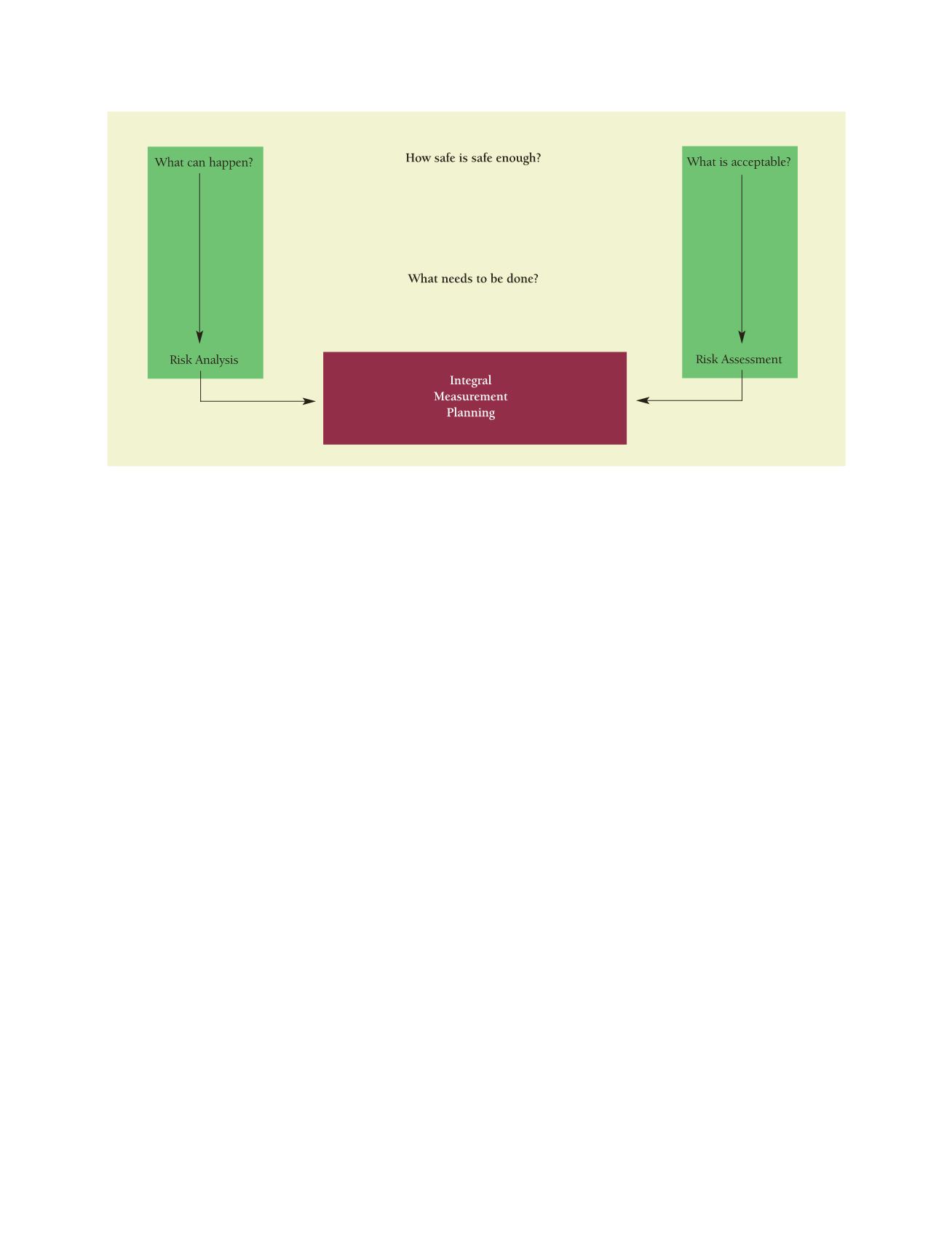
• How safe is safe enough?
• What can happen?
• What is acceptable (to happen)?
• What needs to be done?
The question: ‘What can happen?’ has to be answered by a risk
analysis procedure, while the question: ‘What is acceptable?’
Is answered through risk assessment. The goal of a risk analy-
sis is the most objective identification of the risk factors for a
specific damage event, object or area. In answering the ques-
tion of what can happen, a variety of influencing factors need
to be considered.
Risk assessment aims for an explicitly subjective answer to
the question: ‘What is acceptable (to happen)?’ by asking how
big a residual risk can be handled. Risk assessment is by nature
very complex, and has to deal with the fact that risk is a mental
construct. One important aspect is risk aversion towards events
with great extent. The total effects of a large event rise dispro-
portionately, as does the wish to prevent it.
Acceptance of a risk also depends on whether or not it is taken
by choice. Risk categories are defined to the extent of self-
reliance being deployed. The assessment is closely coupled with
protection goals, a set of criteria for the implementation of the
primary goals of all efforts to improve security as they are being
used for operational risk assessment – especially if the ques-
tion is how far the measures should go. The marginal costs of
safety measures, representing certain expenses per avoided fatal-
ity or per saved human life, have proven to be the most useful
protection goal.
3
Safety measures for the protection of people
can be increased until that level is reached. Determining the
marginal costs can lead to the misunderstanding that a price is
being allocated to a human life. But the criterion of marginal
costs makes it possible to save as many lives as possible within
the limitations of available means and resources.
[
] 54
Necessary steps for risk analysis, risk assessment and integral planning of measures