


 47 / 156

250,000 children were affected in the five worst hit countries in
Asia. These events further highlighted the imperativeness of
school safety initiatives.
From lessons to action
Real experiences thus turned into lessons that were quickly
translated into action. Both institutional changes and process
changes were initiated. The Hyogo Framework for Action
provided the direction and tied it in with other interventions in
risk reduction. The result was a combination of tools, tech-
niques and mechanisms aimed at promoting a culture of safety
in schools all across India.
During 2005 SEEDS, in association with state governments
and the international humanitarian community, introduced
school safety programmes in four regions across India.
The Andaman School Safety Initiative, covering 40 schools in
the Andaman and Nicobar Islands is using the window of oppor-
tunity offered by the post-tsunami rehabilitation process. The
tsunami experience has brought the international community
together in the most unique way. One interesting case of sharing
and learning at grassroots level has been the efforts of the Asian
Disaster Reduction and Response Network, with support from
the Asian Disaster Reduction Centre, Japan. It has brought a
famous Japanese folk tale,
Inamura-no-hi
, to be shared in nine
local languages in schools across tsunami-hit countries in Asia.
The story relates how Goryo Hamaguchi, a village elder in 19th
century Japan, saved his fellow villagers from an impending
tsunami by burning his rice sheaves, thus attracting people away
from the coast. This story is now being shared among school
children thousands of kilometres away in the Andaman and
Nicobar Islands. Children have begun to overcome their fears by
learning about tsunamis and the precautions that are needed
for protection.
In the capital city of New Delhi, which has been fortunate
not to experience any major earthquakes for a long time even
though it lies in a high seismic zone, children learnt about non-
structural hazard mitigation. Buildings do not always collapse
in earthquakes, but the elements within the building can
become potential hazards, injuring or killing people. Non-struc-
tural hazard mitigation thus becomes important for safety
against small and medium earthquakes that happen much more
frequently than large ones. The message on non-structural miti-
gation taught through simple ‘hazard-hunt’ forms was picked
up by students in schools and shared further with their fami-
lies at home.
In the north, attention has been focused along the Himalayan
belt that was most recently hit by a devastating earthquake in
October 2005. The Himalayas are notorious for some of the
most devastating earthquakes in history. The 1905 Kangra earth-
quake has been the worst in Indian history. Since then, many
earthquakes have struck the region claiming a large number of
lives. In spite of such high risk, physical development in the
region has continued unabated without incorporating any safety
standards. Building construction is largely un-engineered,
haphazard and likely to collapse even in medium-level tremors.
In and around Shimla city, the capital of Himachal Pradesh,
SEEDS launched a school safety programme with a four-pronged
strategy:
1. Structural retrofitting of school buildings to prevent their
collapse in future earthquakes
2. Implementation of non-structural mitigation measures to
avoid injuries from falling hazards in schools
3. Education of school management and construction workers
on safe infrastructure
4. Preparation of school disaster management plans and training
of school communities in immediate response, evacuation
and first aid.
In the emerging concrete jungle that continues to develop
unmindful of the growing risk, the selected school buildings will
serve as models for a safe community.
In this way, the school safety programme methodology piloted
in 175 schools in Gujarat state and covering more than 105,000
students is being applied in three other regions of India.
[
] 47
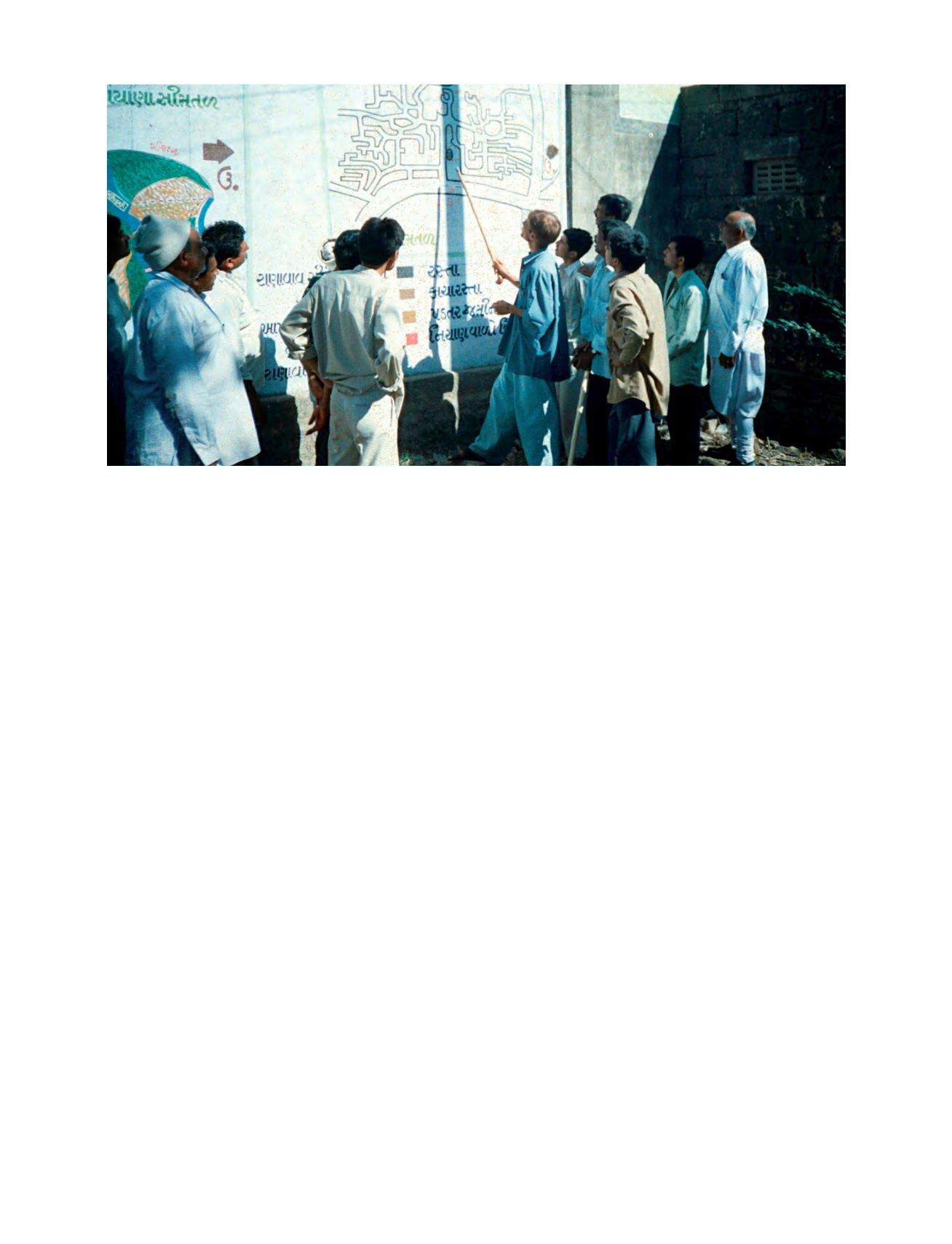
Focus has shifted towards community-based disaster risk management
Photo: SEEDS