


 24 / 156

[
] 24
H
URRICANE
I
VAN
,
A
category 3 system, impacted Grenada
and its dependencies on 7 September 2004, devastating
the island of Grenada.
1
The Organization of Eastern
Caribbean States (OECS) organized a mission of various experts
jointly with the Economic Commission for Latin America and the
Caribbean (ECLAC), to assess the socio-economic impact of the
hurricane and provide policy recommendations for risk reduction
and natural disaster mitigation.
The OECS/ECLAC mission estimated the total damage of
Hurricane Ivan at XCD2.4 billion, more than twice the current value
of GDP.
2
The bulk of this was direct damage (89 per cent of the total
and 201 per cent of GDP). Indirect damage accounted for 11 per
cent of the total (26 per cent of GDP).
3
At the sectoral level the effects were registered mostly in infra-
structure and particularly in housing. Estimates indicated that 89
per cent of the housing stock, corresponding to 80 per cent of the
total population, registered some type of damage caused by the
hurricane.
4
In the year of the disaster, the economy contracted by 3 per cent
and the rate of unemployment rose sharply to 20 per cent. In spite
of the subsequent and further damage caused by Hurricane Emily,
the economy recovered in 2005 (5 per cent growth in GDP),
spurred mainly by the dynamism of the construction sector.
5
Significant imbalances were registered in the fiscal and external
accounts. These persisted in 2005 (minus 3 per cent and minus
9 per cent of GDP in 2004; minus 17 per cent and minus 34 per
cent of GDP in 2005 for the fiscal and balance of payments out-
turn respectively).
Following Hurricane Ivan, a series of measures and programmes
were undertaken using the recommendations put forward in the
OECS/ECLAC damage assessment report as a reference point. The
aimwas to get the economy back on track and to reduce the risk and
exposure to future natural disasters.
6
Some of these measures and
programmes were designed at the national level while others were
specifically targeted to the housing, education, health, and produc-
tive sectors.
A key issue worth examining is the extent to which these measures
and respective programmes have been able to strengthen the
country’s level of resilience to natural disasters and increase the
awareness of Grenada’s population to natural risk. A corollary ques-
tion is whether the people of Grenada have been able to learn from
past disasters for better future protection and improve risk reduc-
tion measures, i.e. whether these measures and policies have been
able to ‘build back better.’
At the national level, the Government created two important agen-
cies: the Agency for Reconstruction and Development and the
National Disaster Management Agency. The former was charged
with the task of creating an improved policy and institutional frame-
work for reconstruction, mobilizing resources for reconstruction
and the monitoring of project implementation. The agency was
launched in March 2005, more than a year and six months after
the passage of Hurricane Ivan. In addition, the IMF recently reported
in May 2005 that the Agency for Reconstruction and Development
was not yet funded and needed to improve the transparency of its
operations.
The National Disaster Management Agency drafted a National
Disaster Plan and has outlined an organized response to future disas-
ter occurrences. The agency has also started a dissemination
campaign on the radio and in the press about disaster management
and preparedness.
In the productive sectors, measures have been put in place mainly
for the agricultural and tourism industries and, to a lesser extent, in
the manufacturing industry. Measures for the former include the
restoration of agricultural production and infrastructure and
attempts to diversify the sector, improve its competitiveness and
strengthen its linkages with other sectors. Notwithstanding these
Risk reduction and mitigation in the aftermath
of Hurricane Ivan: a year and a half after the
OECS/ECLAC damage assessment
Esteban Pérez Caldentey, UN Economic Commission for Latin America and the Caribbean
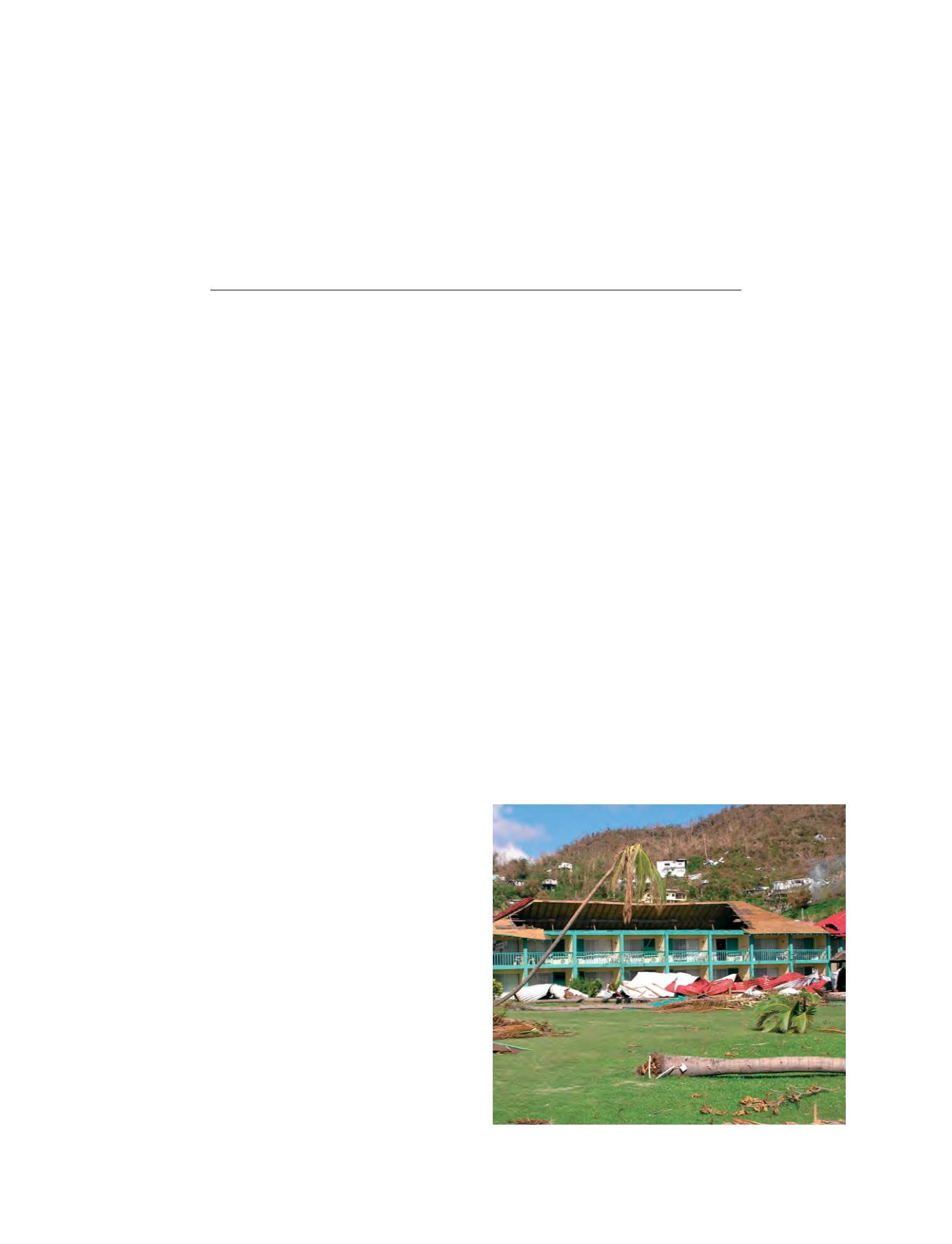
The devastation caused to part of one hotel in Grand Anse
Photo: ECLAC