


 50 / 85

[
] 50
(CDC) in the USA, the breadth of neutralization of the
two individual antibodies as well as the mixture was
assessed. The combination did neutralize all field isolates
tested, and the few isolates that were not neutralized by
one of the two anti-rabies antibodies in the mixture were
always neutralized by the other.
Next, the CR57/CR4098 mAb cocktail and HRIG, the
only available polyclonal human anti-rabies product,
were compared head-to-head. In combination with the
vaccine, the mAb cocktail protected Syrian hamsters
against lethal rabies which they were exposed to 24
hours after being administered the vaccine and cocktail.
The results were comparable with those obtained with
HRIG and the mAb cocktail also did not interfere with
the rabies vaccine differently to HRIG.
In September 2008 the first administration of the
CR57/CR4098 mixture to humans (CL184) was
reported. The studies included healthy adult subjects in
the USA and India, and involved two-part testing. Rabies
virus neutralizing activity was detectable from day one
to day 21 after a single dose of CL184 20IU, the same
dose as HRIG. All subjects had adequate protection
levels against rabies when combined with the vaccine
up to the end of evaluation, which was recorded at 42
days after the first injection of an antibody and vaccine.
The anti-rabies human monoclonal antibody mixture
CL184 is on the way to presenting a replacement to old-
fashioned immunoglobulin preparations, which are in
short supply. Because supply constraints are removed
by licensure and launch of the monoclonal mixture
CL184, this product candidate has the potential to
prevent most, if not all, of the current 55,000 deaths per
year due to rabies in the world.
virus glycoprotein. In addition,
in vitro
generated, antibody-resistant
rabies virus variants selected using one antibody should be neutralized
by the non-selecting other antibody in the cocktail and vice versa.
Subsequently, the variable heavy and light chain coding regions of
the SOJA, SOJB and SO57 antibody genes were synthesized, intro-
duced into a single human immunoglobulin G1 (IgG1) vector, and
the IgG1 molecules in PER.C6 cells were expressed. This resulted
in the antibodies CR57, CRJA and CRJB. Because CRJA had only
borderline potency against rabies and CRJB competed for the same
region on the rabies glycoprotein, only a single antibody was left for
use in an effective anti-rabies cocktail: CR57. Next, the CR57 binding
site as a linear epitope in antigenic site I was meticulously mapped
and characterized, and a hunt ensued for a non-competing and
complementary antibody. After selecting antibodies from the blood
of a rabies-vaccinated individual by phase display, a complementary
antibody (CR4098) was identified that recognized a distinct, non-
overlapping epitope (antigenic site III) of conformational nature. On
the one hand it shows a potency and breadth of protection similar
to CR57; on the other hand it has the ability to neutralize 100 per
cent of CR57 escape mutants. Reciprocally, CR57 neutralizes rabies
virus mutants escaping CR4098 neutralization.
Sequence analysis indicated that only three out of 229 rabies
isolates from different regions in the world had mutations in the
CR57 epitope and five out of 123 isolates – all from central Africa –
had mutations in the CR4098. No field isolate of rabies had both
sets of mutations.
The making of the human monoclonal antibody mixture to
replace HRIG
The human monoclonal antibody mixture differs in isotype and in
antigenic recognition to hyperimmune anti-rabies immunoglobulin
(HRIG), but is similar in potency and affinity. In collaboration with
Charles Rupprecht of the Centers for Disease Control and Prevention
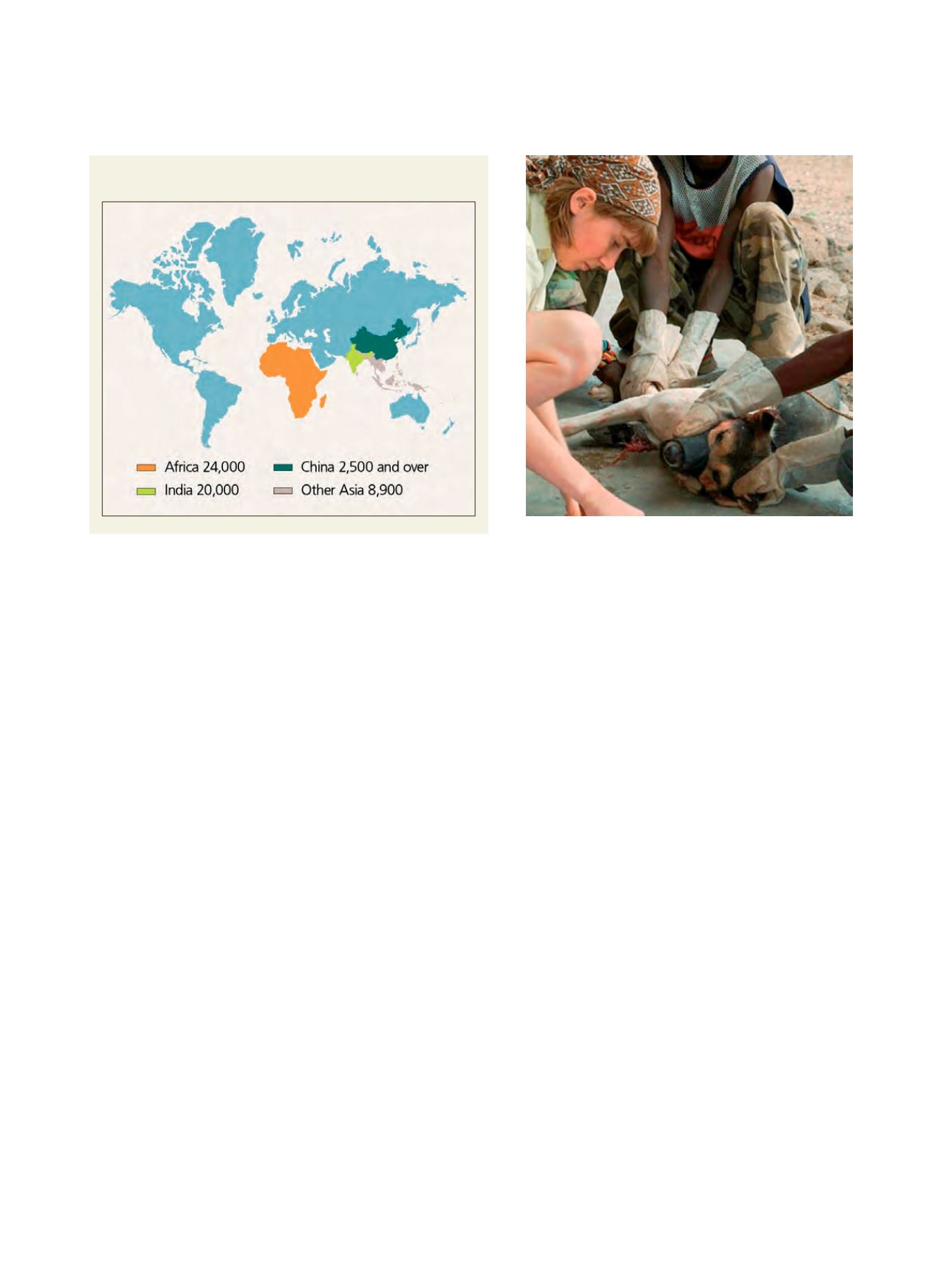
Rabies causes over 50,000 deaths each year
in the endemic countries
Source: FX Meslin, WHO NECTM, Knobel and Tang et al EID, 2005; Zhang et al
InfoRab 2005, APCRI data
Mt Kulal dogs, Kenya. Preventive vaccination against rabies. Despite
efforts to vaccinate dogs against rabies, canine bites remain a major
cause of rabies infection in high endemicity areas
Image: Embassy Czech Republic, Nairobi