


 56 / 85

[
] 56
The Argentine approach
to pandemic preparedness
Dr Oreste Luis Carlino and Pablo Orellano, Pandemic Preparedness, Ministry of Health, Argentina
V
irological, epidemiological and clinical influenza investiga-
tion has deep roots in Argentina. The first influenza
laboratory investigations began in the 1960s, leading to
certification of the effects caused by the influenza A (H3N2)
pandemic during the years 1969-1970 in Córdoba province,
Argentina. Up to the present date, there are three National
Influenza Centers (NIC), located in the Instituto Vanella,
Universidad Nacional de Córdoba; the Instituto Nacional de
Enfermedades Infecciosas, (INEI ANLIS), Buenos Aires; and in the
Instituto Nacional de Epidemiología (INE-ANLIS), Mar del Plata.
A Pandemic Plan was prepared in the national institutes as a response
to the first World Health Organization (WHO) alerts regarding the
need for preparedness for a possible influenza pandemic. This plan
was presented at a Pan-American Health Organization (PAHO)
meeting, on 19 December 2002, held in Chile.
During 2003, we kept working on the plan and added the devel-
opment of the National System of Sanitary Surveillance (SNVS) and
the Influenza Sentinel units, which contribute surveillance activity
that is vital for the correct development of the plan.
The first national meeting of the DNPS and Dirección
Nacional de Emergencias Sanitarias (DINESA) was held
on 14 December 2004, and the plan was transferred to
all the nation’s provinces. Since then, the work has
focused on three different axes:
1. Permanent updating of the plan
2. Local implementation
3. Development of rapid response teams.
To monitor the plan’s local implementation, different
simulations took place in the tabletop and drill fields.
The tabletop exercises have recreated scenarios of
eventualities and allowed the exercise of the local, strate-
gic intermediate and national levels of decision. These
were held during 2005 in the nation’s five regions.
The drills have been events that require a huge display
of human, material and economic resources. They allow
the impact that an influenza pandemic might have on
the hospital structure, airports, security forces, trans-
port, news and so on, to be measured with higher
precision. In addition, they enable the identification of
where parts of the plan can be improved, and where
there are failures of the organizations involved.
In addition to conducting the drills, and in order to
ensure preparedness for an influenza pandemic, a strate-
gic stock of Oseltamivir was acquired during April 2006.
Sixty per cent of this was distributed to the capital cities
of Argentina, while 40 per cent is stored at the central
level, in order to provide support for the first provinces
affected. While in that instance, 75 milligram tablets of
Oseltamivir were acquired for adult treatment, a strate-
gic stock has now been provided for children with the
purchase of Oseltamivir syrup and paediatric tablets.
The strategy to avoid pandemic flu spread in Argentina
is based on early detection and the immediate blockade
of initial foci with Oseltamivir, and the immediate acti-
vation of national rapid response teams (NRRTs).
The WHO checklist is incorporated into the readi-
ness tasks. In this context, work is being done with the
different national ministries, and with private organi-
zations, to spread pandemic readiness. At the legal
level, the Sanitary Load Law has been enacted, which
allows the rapid delivery of sanitary samples and
biological material. This was a great contribution to
the legal support, along with the Procedures Guide for
Avian and Pandemic Influenza, which was created by
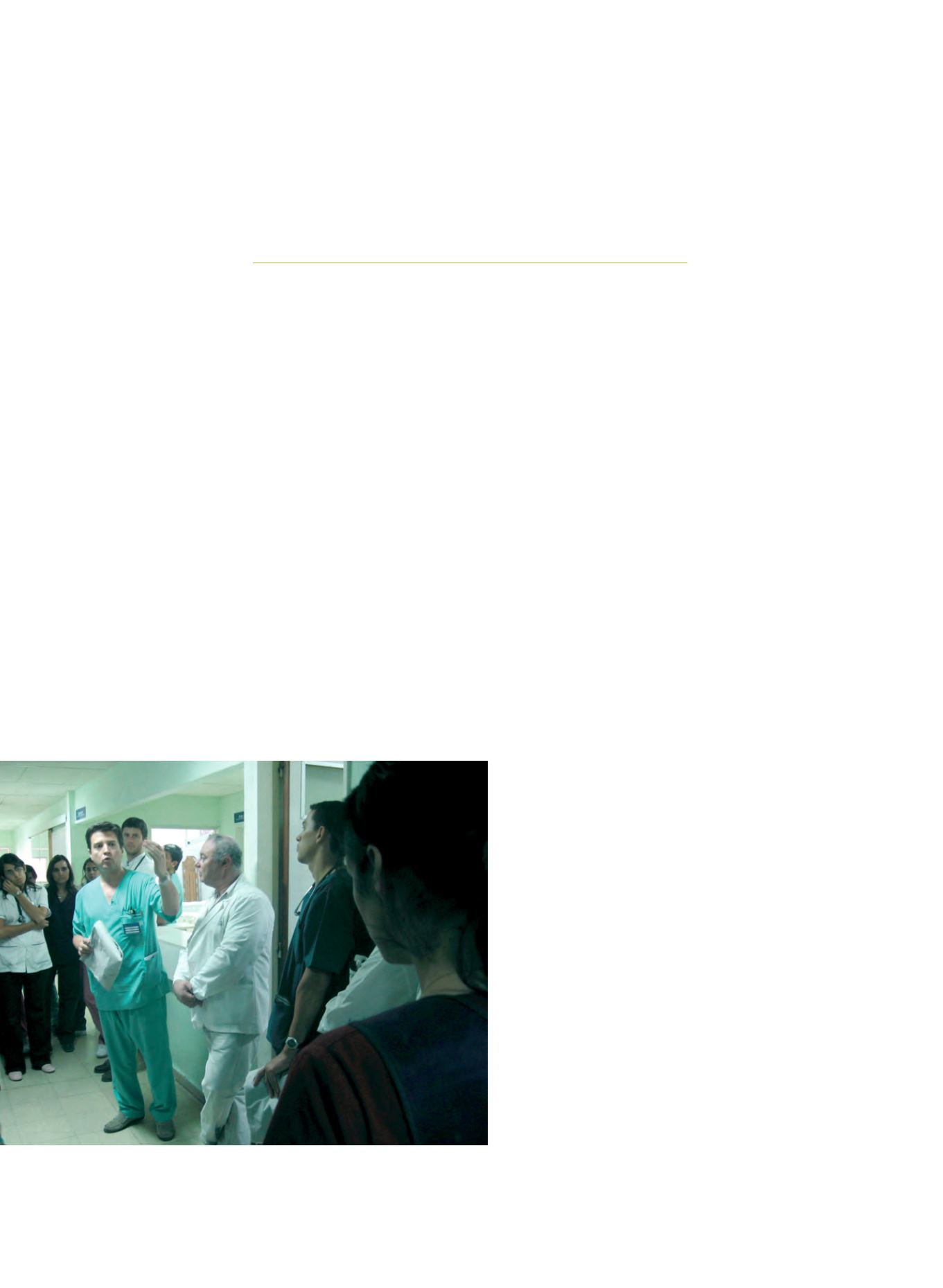
Córdoba flu pandemic drill: an emergency service physician informs his personnel of
H5N1 confirmation at the beginning of a flu pandemic
Image: Min. Health Argentina