


 59 / 85

• Presence of clusters of ARI cases
• Close communities (such as prisons, military camps, schools) with
suspected cases or related to animal exposure
• Rumours
• Others: epizootics, rise in influenza drugs sales, absenteeism in
schools.
An economic evaluation has been developed in order to assess the
cost benefit of rapid response teams intended to avoid the spread of
influenza. This evaluation is intended to assess whether the cost
associated with the creation, training and maintaining of rapid
response teams is accompanied with a cost saving related to the
avoidance of deaths and patient maintenance. Costs included within
the study could be divided into direct costs (including patient treat-
ment, hospitalizations, laboratory tests, transmission-blocking
vaccination, physicians, epidemiologists and educational health
campaigns), and indirect costs (loss of working hours, patient care
and travel by relatives). On the other hand, benefits of the preven-
tion strategy are taken into account, and for this matter ‘willingness
to pay’ studies are considered, as a monetary representation of what
a disease condition means for a patient. In order to compare and
analyze different alternatives, decision-tree models are used to help
in the classification of data and the assessment of several variables
acting at one time. In this case, data was analyzed using a decision-
tree analysis with TreeAge version 3.0.5 software.
The results showed that in the presence of an outbreak, without
rapid response teams, the cost of facing the outbreak and associated
costs rise to 750 international dollars per person, while the saving
derived from avoiding the outbreak could be estimated
in 550 international dollars per person. This means a
saving of 1,302 international dollars per person in the
general population, and identifies a value for the useful-
ness of this strategy. Nowadays, other cost benefit and
cost effectiveness evaluations are being projected in order
to continue the assessment of every strategy’s efficiency.
Among other issues, several should be highlighted:
• How much Oseltamivir or other drugs should be kept
as strategic stock, taking into account medicament lost
due to expiration?
• Should rapid response teams be maintained at national
level and move during emergencies to each depart-
ment, or should they be formed in every jurisdiction?
• What would be the right time for rapid response teams
to leave the outbreak site and permit the local team to
take care of the situation?
• Is it possible to form a regional rapid response team
that could coordinate a response in regional outbreaks,
and could be this strategy more efficient?
The answer to these and other questions would be very
important for national and provincial ministries of
health, in order to optimize and guide efforts. Basing
these efforts on the experience of other countries is
important in this early stage of planning development
for Argentina, but local resources and possibilities must
also be taken into account.
[
] 59
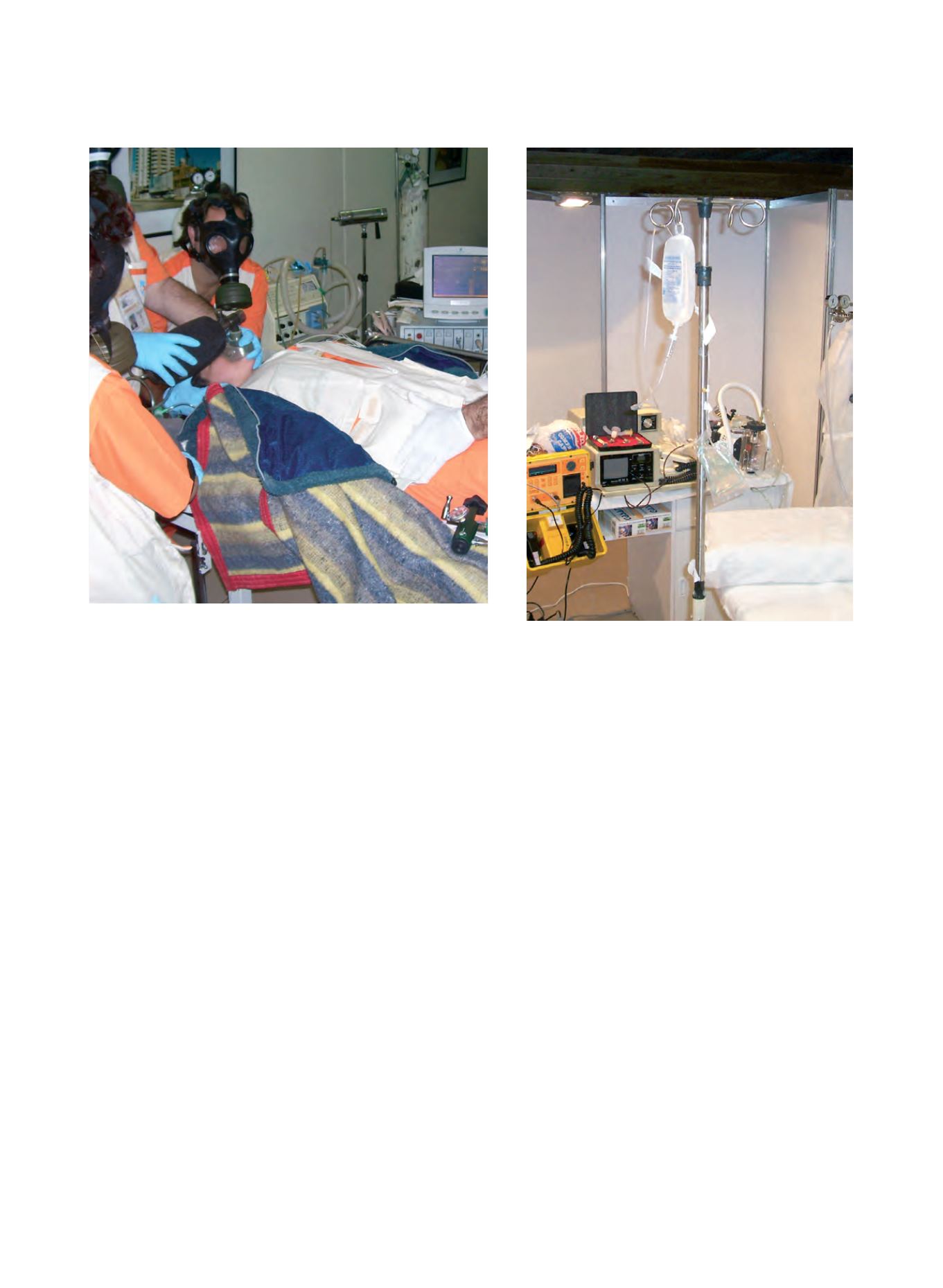
Patient care within the shock room (alternative location for intensive care unit). Every
attendant is using personal equipment for respiratory protection. Modality usually
used during drills
Image: Min. Health Argentina
Shock room for the first triage, showing all equipment
required for the task
Image: Min. Health Argentina