


 58 / 85

[
] 58
emergencies; risk communications; technology implementation for
rapid and continuous communication within the country; implemen-
tation of ethno-anthropologic potential impact (culture, language,
beliefs); legal and ethical aspects; completing the legal aspects to include
influenza in occupational diseases; revision and enactment of the plan
by a bioethical commission; goals, indicators and responsibilities of the
evaluation of the plan; preservation of basic services, development of
eventuality plans for the maintenance of basic community services;
planning for additional personnel to maintain basic community services
during emergencies; protocols for volunteer capacity in key basic
services; animal-human interphase, databases with epidemiological
surveillance information for avian influenza; studies of risk evaluation
of avian influenza introduction into the country; public health
measures; evaluation and modification according to drill fields; social
communication; development of rapid responses protocols.
Rapid response protocol development
The NRRT was created to respond opportunely to early events and
unusual cases, clusters or outbreaks of severe respiratory infections
caused by respiratory viruses, seasonal, avian or pandemic influenza,
severe acute respiratory syndrome (SARS) or other biological even-
tualities. The team will respond whether these outbreaks are
moderate or severe, seasonal or non-seasonal, and whether or not
they affect at-risk populations.
The training programme is permanent in Argentina, with exclusive
dedication during the first two weeks. After that, personnel must
participate in two training courses, two simulations and two real
outbreak studies every year. The objective of the NRRT is research
and intervention as a tool for the pandemic influenza plan and other
biological emergencies. NRRT trainees will have a specialized train-
ing in their original discipline, and are capable of devel-
oping tasks in the surveillance and response health
system:
• Public health surveillance
• Public health and epidemiology research
• Public health interventions
• Situation analysis and health tendencies
• Risk management.
Main expertise of trainees
At the end of their training, personnel are ready to inte-
grate with the NRRT as participants, where their main
responsibilities are as follows:
• Be available for transfer to the emergency site within 24
hours after the NRRT call
• Use tools for epidemiological analysis
• Ensure rapid notification and research of outbreaks, in
order to identify source and means of transmission
• Produce required information for effective social risk
communication to population and media, in associa-
tion with communication experts
• Propose effective prevention and control measures to
avoid the spread or diminish its impact
• Propose effective public health measures for post-emer-
gency rehabilitation.
There are several key indicators for the commencement
of action:
• Rise in the number of acute respiratory infection (ARI)
cases
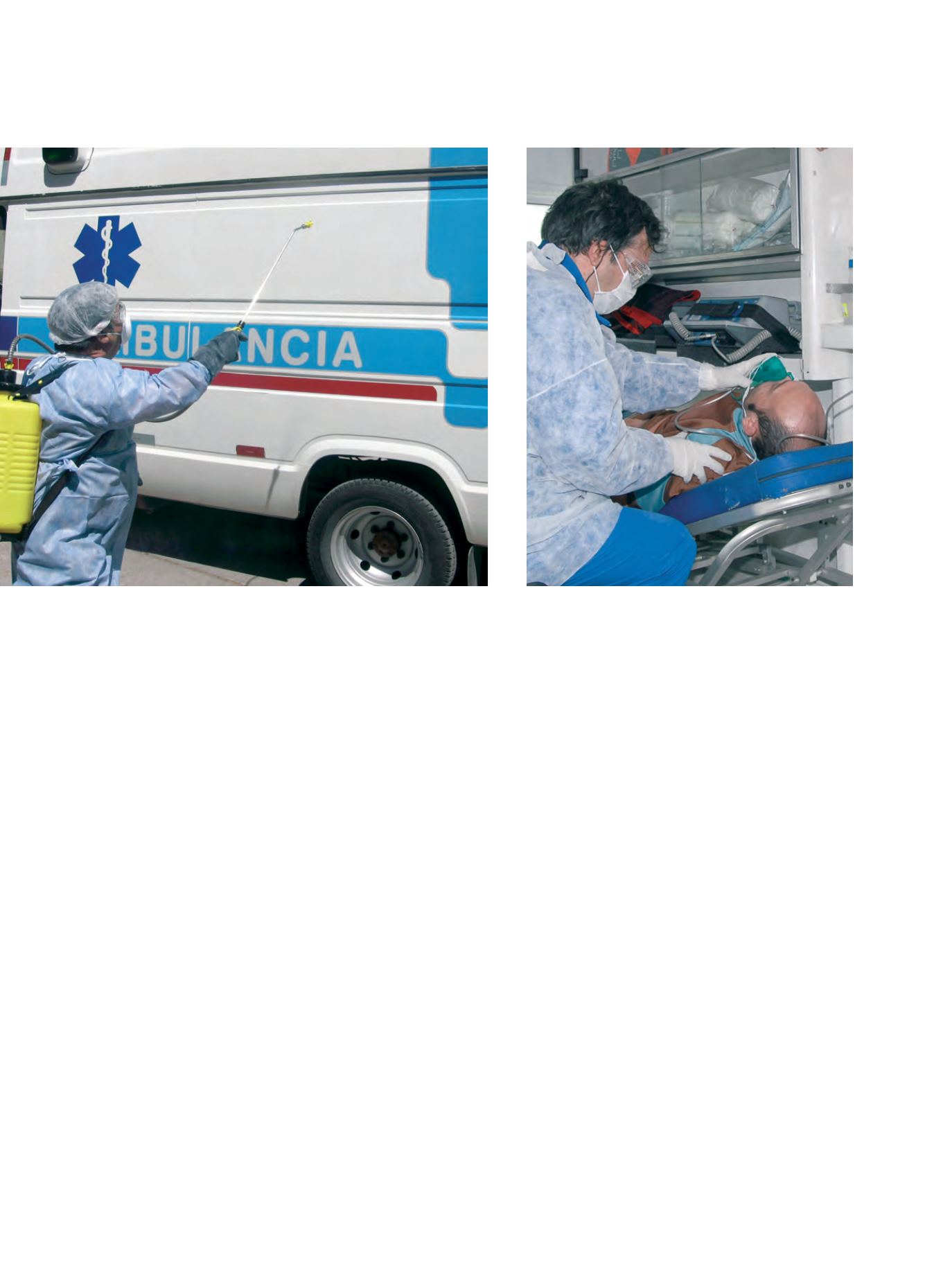
Internal and external disinfection of an ambulance with bleach solution during the
San Juan flu pandemic drill
Image: Min. Health Argentina
Patient care of severe acute respiratory illness (SARI) simulation
during San Juan flu pandemic drill
Image: Min. Health Argentina