



 52 / 85

[
] 52
Europe between June and August 2007, where a number
of dead wild birds infected with HPAI H5N1 were found
in different parts of the Czech Republic, Germany and
France, were linked to an HPAI H5N1 outbreak in a Czech
turkey farm. Again, wild birds were unlikely to be the main
factor spreading the virus since the outbreaks were
observed in mostly non-migrant species and during a non-
migratory period. Further, extensive surveillance of
apparently healthy wild birds has found little evidence of
infection in birds on migration or of their ability to carry
the virus over long distances.
9
While it is clear that trade in domestic poultry has
been the crucial factor in the spread of HPAI H5N1, even
for the transmission of avian influenza over long
distances and across continents, indirect evidence
suggests that wild birds may also play some role.
Numerous species of wild birds, especially waterbirds,
are susceptible to infection by the HPAI H5N1 virus.
Close contact between domestic birds and wild birds
can undoubtedly lead to cross-infection, from poultry
to wild birds and from wild birds to poultry. Additionally,
species that live in and around poultry farms and human
habitations may serve as ‘bridge species’ that could trans-
mit the virus between poultry and wild birds either by
Movements of people, such as farmers, veterinarians, and even jour-
nalists and tourists, as well as legal and illegal trade in poultry and
caged birds are also factors in the spread of the virus. Globalization has
led to massive and widespread movements of people, poultry and mate-
rials around the world at an unprecedented pace, providing greater
opportunity for the spread of the virus. The outbreaks in Nigeria in
early 2006 were most likely caused by the supply of infected live poultry
from multiple sources, including East Asia and Turkey. Surveillance of
5,000 wild waterbirds in African wetlands in 2006 supports the view
– since no evidence of HPAI H5N1 was found – that wild birds prob-
ably play a relatively minor role in the spread of highly pathogenic
avian influenza. This view is consistent with the fact that the north-
ward migration of wild birds from Africa to Europe between March and
April 2006 did not cause any major outbreaks. Nor do wild birds seem
to play a role in countries like Indonesia where HPAI H5N1 has been
present in poultry for some years and where human cases have
occurred. In February 2007, a HPAI H5N1 strain detected on a turkey
farm in Suffolk, UK was shown to be almost identical to a strain discov-
ered on a poultry farm in Hungary, pointing to a transmission route
from poultry to poultry and not from wild birds to poultry. The
outbreaks took place in a non-migratory period and at a site that was
not adjacent to major wetlands, nor to areas used by significant
numbers of waterbirds. So, wild birds were unlikely to have played a
significant role during these outbreaks. The outbreaks in Central
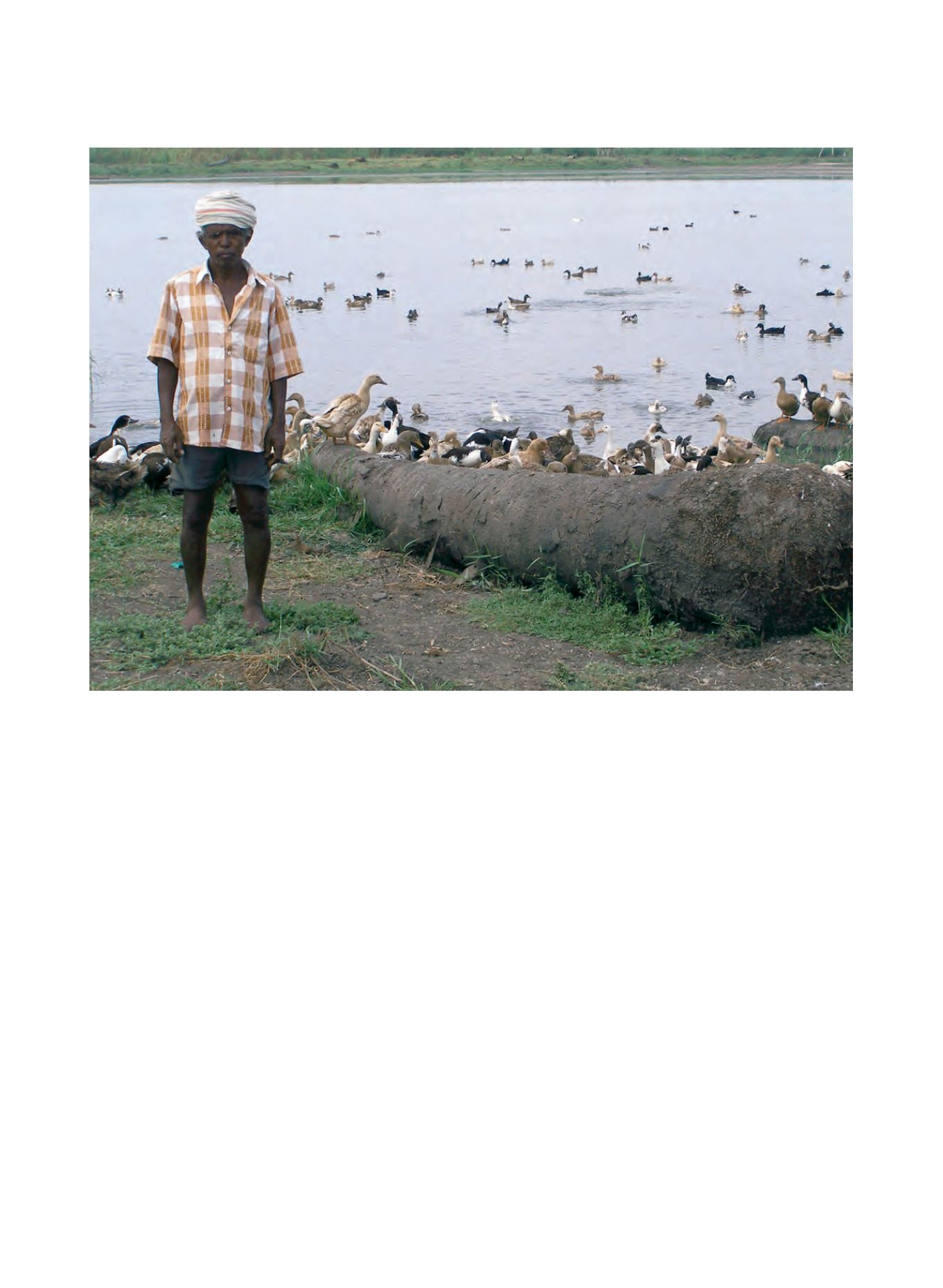
In Asia, the role of domestic ducks in the epidemiology of HPAI H5N1 has been found to be central not only to the genesis of the virus but also to its spread and the
maintenance of infection in several Asian countries
Image: Taej Mundkur