



 46 / 85

[
] 46
adverse events. The vaccine has been widely distributed in
China since its licensure in 1995 and is held responsible for
significant reductions in the rates of HAV disease.
Clearly the benefit/risk equations established for the H2
vaccine reflect the endemicity of the HAV disease and the
real probabilities of infection of vaccine recipients in the
absence of immune prophylaxis. The details of the deploy-
ment of this vaccine including those related to vaccine
shedding, reversion of the attenuated phenotype, as well
as details of the manufacturing and formulation of this
vaccine at the scales required for significant impact on HAV
endemicity in China, are not widely detailed in western
scientific literature and would be a welcome addition to
the vaccine bioprocess literature. The details would of
course be additionally of interest, as other developing coun-
tries will need to structure and organize their own national
containment programmes for HAV to confront evolving
circumstances of endemicity. In concept the control of HAV,
a picornavirus like polio with a faecal oral mode of trans-
mission and no animal reservoir, should be vulnerable to
the same strategies that have brought global poliovirus to
bay using the Sabin live attenuated vaccines in the Global
Polio Eradication Initiative. The extent to which the live
attenuated H2 vaccine or similar products of biotechnology
can be enlisted solely, without dependence on inactivated
vaccine for final closure, will depend largely on the issue
of reversion of the HAV attenuated phenotype and the
degree of vaccine virus shedding noted above. In this regard
it is of interest to note that Chinese science continues to
publish on HAV vaccine development, especially on several
of their own efforts to develop an inactivated HAV vaccine
using Vero cell substrate, in an attempt to expand the
biotechnology options for vaccine production.
oral route ensures its endemicity in developing nations, imposing a
serious burden on human health and economic development owing to
the duration of the infection and its capacity for environmental spread.
The distribution of HAV in China is particularly striking, where rates of
infection exceed 90 per cent in those over 35 years of age. Uneven stan-
dards of public sanitation in China, as well as in other developing parts
of the world, establish areas relatively free of HAV infection in childhood
making possible outbreaks of enormous scale. Such an example of this
occurred in Shanghai in early spring of 1988, when more than 300,000
cases of HAV disease were reported owing to the consumption of raw
clams contaminated with sewage. Of the 47 fatalities recorded in this
well studied epidemic, an elevated rate of mortality was observed in
patients who were HBeAg positive, a serological indicator of ongoing
disease. The Shanghai experience has not since been reported on a similar
scale, but it serves as a lasting paradigm for the consequences of emerg-
ing economies and HAV epidemiology, as developing nations emerge
with significant urban populations surrounded by rural endemic diseases.
The significant burden of HBV disease in China, estimated to exceed
more than 30 million persons affected by chronic HBV disease as well as
the burden of HCV infections and their special vulnerability to HAV infec-
tion, has imposed a particular sense of urgency in the country to control
HAV disease. To this end, the findings of Mao Jiangsen and his colleagues
at Zhejiang University and the biotechnology capability of Zheijiang
Pukang Biotechnology Institute have been especially notable. Over a
period of ten years or so, building on the precedent of P. Provost and M.
Hilleman at Merck who in 1984 reported the attenuation of the HAV
CR326F strain for replication in humans, they carried forward the isola-
tion of the H2 strain from a Chinese clinical specimen, its attenuation
by serial passage at reduced temperature in KMB17 human diploid fibrob-
lasts and its development as a candidate live virus vaccine. The H2 vaccine
is reported to be safe at doses of greater than 106 TCID50, promoting
seroconversion to protective levels of humoral immunity within 21 days
post-immunization, without liver enzyme elevations or other serious
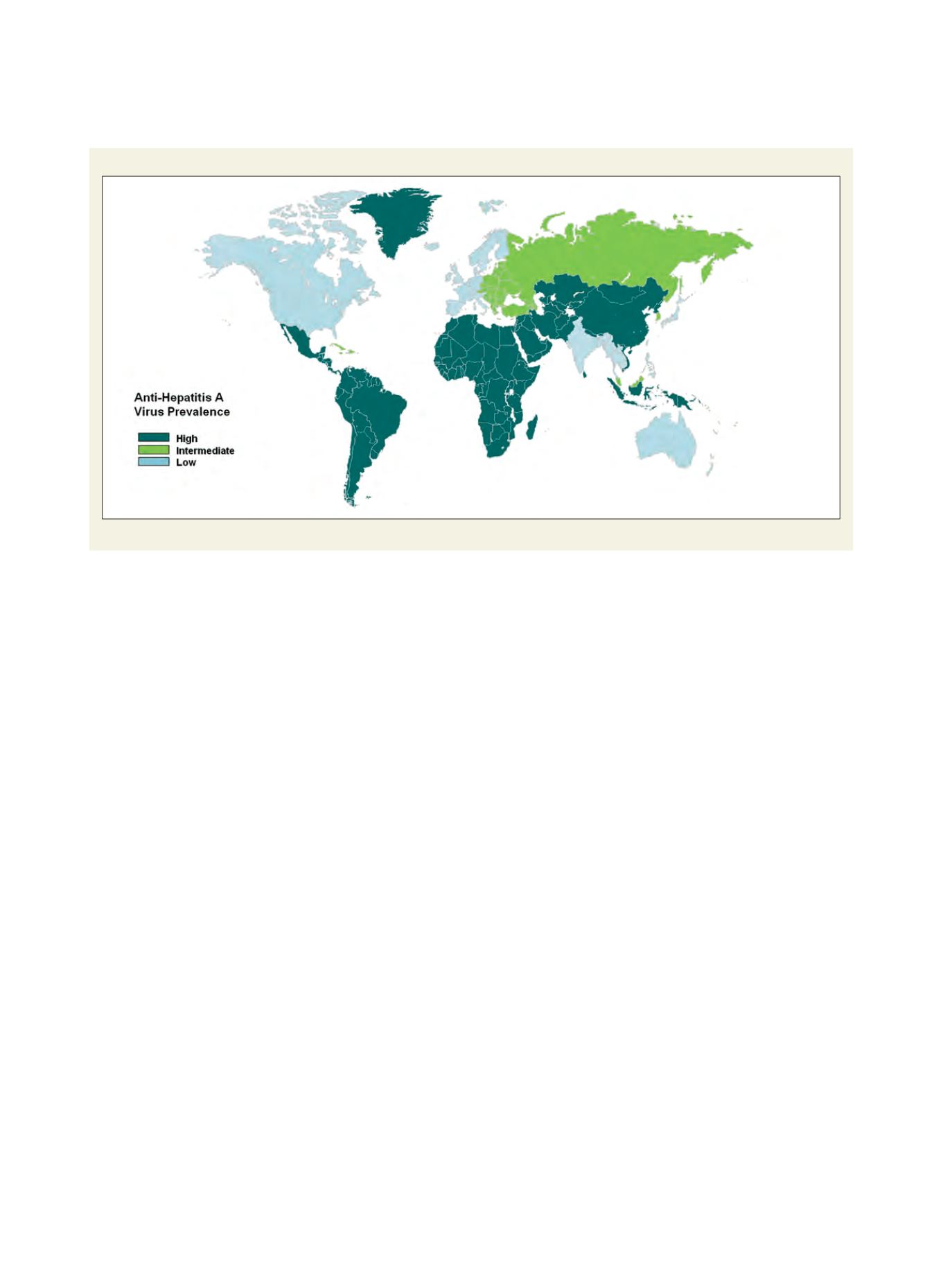
Anti-Hepatitis A virus prevalence
Global rates of hepatitis A antibody seroprevalence reflecting endemic distribution of hepatitis A virus
Source: Adapted from: CDC
http://wwwn.cdc.gov/travel/yellowBookCh4-HepA.aspx