


 38 / 196

[
] 36
to meet future needs. Other versions, tailored to the needs and spec-
ifications of specific regions and nations, including Vietnam, are also
being developed.
Information sharing
– Realizing that disaster information sharing
must be an integrated component of disaster risk reduction efforts in
the region comprising the member countries of the Association of
Southeast Asian Nations (ASEAN); the ASEAN Committee on Disaster
Management (ACDM) and PDC developed a joint framework for
establishing a Disaster Information and Communication Sharing
Network, or DISCNet. The stated objective of the programme was to
“enhance regional disaster management capacity and readiness” by:
• Developing a more effective ‘information clearinghouse’ mecha-
nism to promote regional collaboration and strengthen national
capacities in disaster risk information dissemination
• Ensuring disaster management information sharing among
ASEAN member countries that will lead to the development of a
framework for regional integrated decision support
• Enhancing disaster management readiness by supporting regional
exercises (table-top or otherwise)
• Strengthening the capacities of ACDM to integrate its disaster
information management system with other entities in the
global arena.
The collaboration of PDC and ACDM reached its first major milestone
with the publication of
Information & Communication Technology
Assessment for ASEAN DISCNet
in 2005, an analysis of the ICT capac-
ities and capabilities of ten countries. PDC and ACDM have an ongoing
partnership, which includes the development of the Online Southeast
Asia Disaster Inventory, OSADI, launched at the tenth Meeting of
ACDM in October 2007.
PDC’s dedication to information exchange and access to shared
information is perhaps epitomized by the Asia Pacific Natural
Hazards Information Network (APNHIN), an online community of
providers and consumers of disaster management data. Provider-
members of APNHIN include the USGS, NOAA and other US
Government organizations as well as GISTDA Thailand, the Pacific
Risk Management Ohana and others.
Risk modelling and mapping
– PDC worked with the State of
Hawaii, Department of Land and Natural Resources (DLNR), on its
dam safety programme throughout Hawaii. After a cata-
strophic dam failure on the island of Kauai in March
2006, dam owners were mandated to prepare, maintain
and implement emergency preparedness plans for each
dam or reservoir. A key element for each plan was a map
defining the potential downstream inundation should
the dam fail, giving an assessment of the critical infra-
structure and population at risk. PDC was contracted to
prepare these analyses on behalf of the dam owners. A
critical DLNR objective for PDC was modelling poten-
tial failures and creating inundation maps of all
registered dams for emergency planning purposes. PDC
has provided maps and consequence assessment reports
for all 135 dams. They will be used in the creation of
evacuation maps and plans.
Capacity building
– A significant element in disaster
management is the capacity to plan for, respond to and
recover from disasters, in terms of equipment, facilities,
human resources, skill sets, standard practices, and poli-
cies and procedures. PDC has worked with many of its
beneficiaries and partners to improve their systems,
develop information sharing applications, and bring staff
training to the train-the-trainer level, stabilizing the exper-
tise within the organization. PDC conducts exhaustive
analyses of data holdings, policies, practices and proce-
dures, to point out gaps and deficiencies and lay out plans
for maintaining and upgrading capacity over time.
Being wise about risk
Information alone is not an answer to the challenges of
disaster management in a world of more than six
billion people, who are crowding ever more densely
into disaster-prone regions while weather hazards are
increasing in number and severity. Analysis, integra-
tion, visualization and sharable presentation of data
are necessary to provide instantly actionable decision
support. The necessary information and communica-
tions technologies exist, and they are being improved
every day.
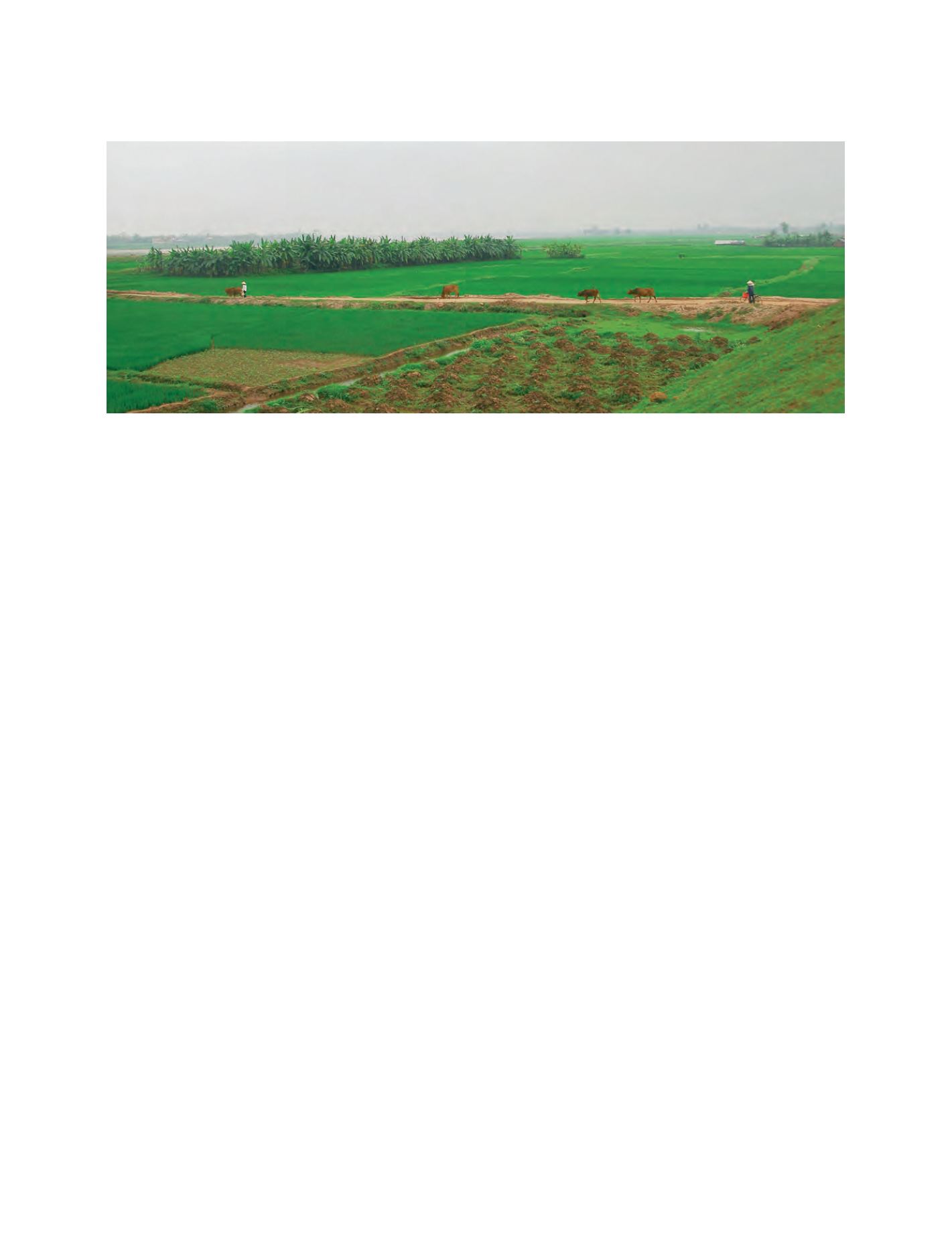
The same natural phenomena that make life possible, like the floods that produced the fertile valleys of Vietnam, become natural hazards when they intersect
with human populations in unmanaged ways
Image: Todd Bosse for PDC