


 42 / 196

[
] 40
a quantitative evaluation method for the restoration of a local commu-
nity. The introduction of such quantitative evaluation for restoration
will be helpful in other disasters as well.
Finally, we investigated the effect of lifelines such as power lines,
gas, water supply and telephone, to propose a better method of
restoration. We found that the restoration of the water supply and
electricity was very fast, taking only about one month in the Phanga
Nga province of Thailand. This was because the Government took
the policy of restoring the system as it was before the disaster. There
is a controversy as to whether restoration should be carried out to
the original state as quickly as possible; or the lifelines redesigned
to be more resilient against earthquake and tsunami, in which case
it might take longer.
Through these investigations, we stress the impor-
tance of the predetermination of the city plan before a
natural disaster occurs. For this purpose, capacity
building of local communities for disaster management
is truly important.
Resolutions for the future
In order to wrap up the project, an international sympo-
sium was held in Phuket, Thailand, over 22-24 January
2008. The symposium closed with the adoption of nine
resolutions. The following three resolutions seemed
most important for continuing our efforts into build-
ing more resilient societies in earthquake and
tsunami-prone areas of south and southeast Asia, and
elsewhere:
Promotion of cooperative scientific research related to
natural disaster mitigation
• Recognizing the importance of international and
interdisciplinary research toward natural disaster
mitigation, particularly for giant earthquakes and
tsunamis
• Resolve that all participants make every effort to
promote such international and interdisciplinary
research under the mutual and synergetic work
among related researchers.
Nurturing the next generation of researchers and commu-
nity leaders in Asia
• Recognizing that Asia is the severest area in the
world in terms of natural hazards including, but
not limited to earthquakes, tsunamis, volcanic
eruptions, typhoons, floods etc.
• Noting that the number of researchers in this area is
insufficient so that leading scientists, particularly in
the universities and other research institutes, have an
important role of nurturing researchers and local
community leaders related to natural disasters and
their mitigation
• Resolve to promote education for nurturing the next
generation of researchers in universities and commu-
nity leaders in local communities, particularly in Asia.
Collaboration among researchers and practitioners for
public awareness
• Recognizing that education and training for public
awareness on natural disasters for the public is
important to reduce risks of disasters and rapid
restoration from them
• Noting that these efforts are most effectively done
through collaboration and synergetic works among
researchers and practitioners, such as personnel in
NGO/NPOs, officers of local and national govern-
ments and other local communities, through formal
or informal classes at schools and at community
gatherings and meetings
• Resolve to promote and to build concerted and
sustained collaboration among researchers and
practitioners.
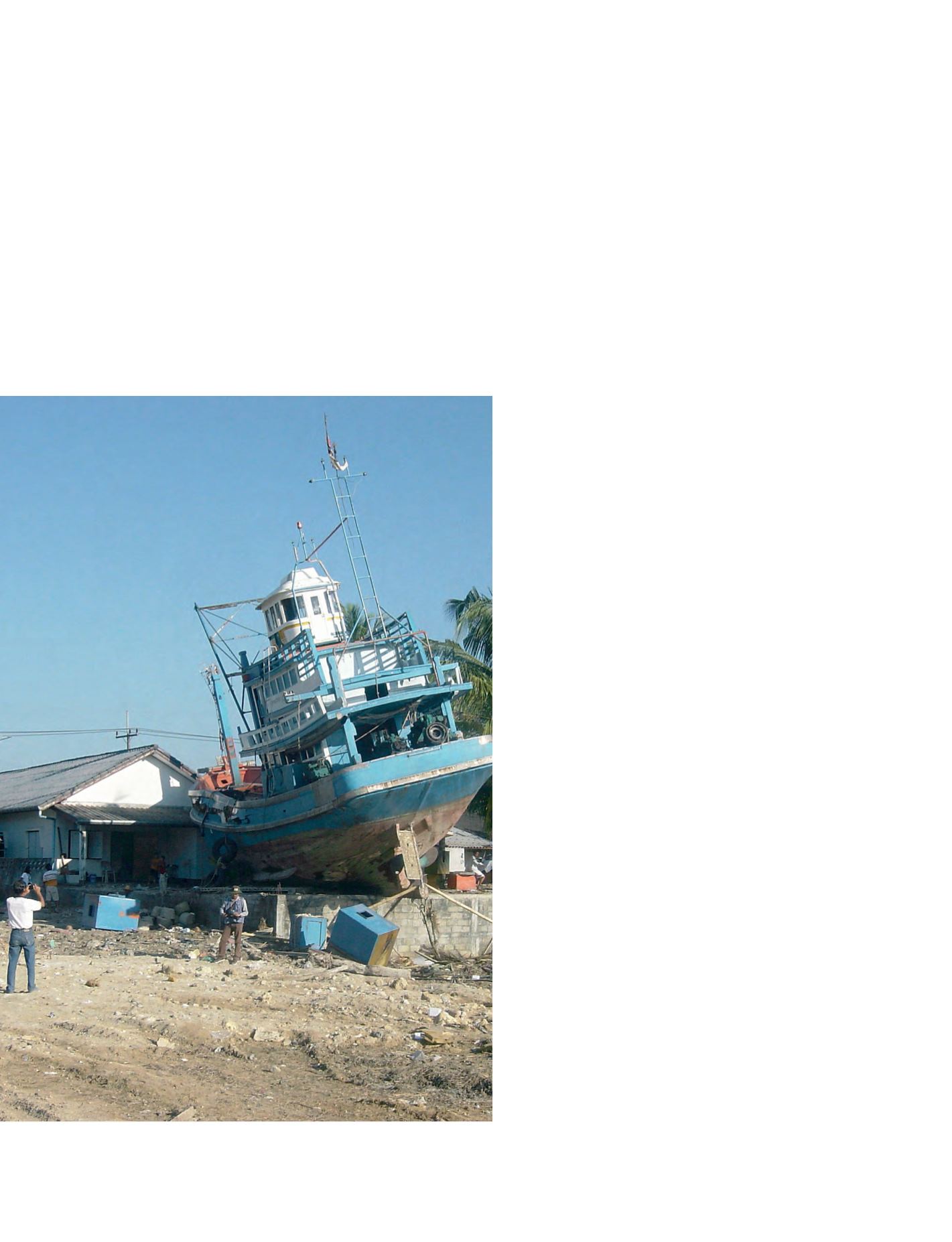
Ban Nam Ken, Thailand: a boat stranded by the Indian Ocean tsunami
Image: Kenji Satake